






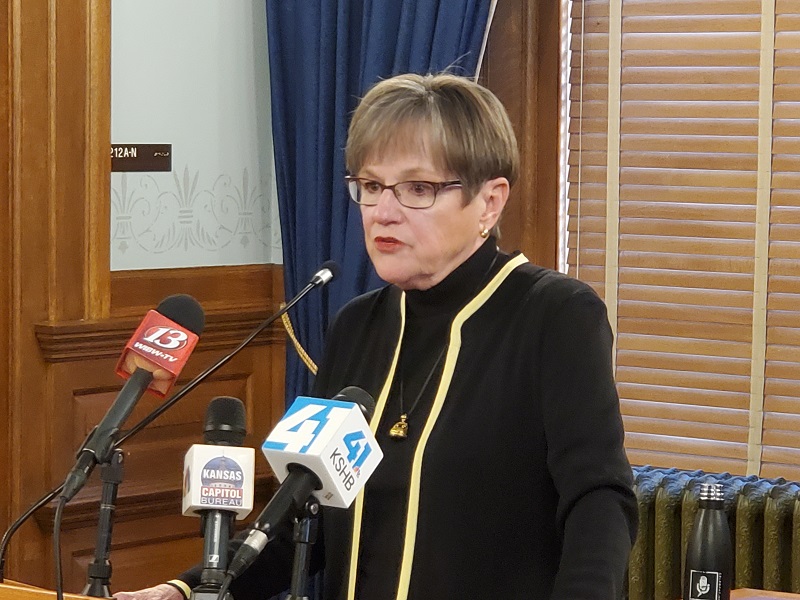
Gov. Laura Kelly is accusing Attorney General Kris Kobach of pressuring lawmakers into calling a special session to draw new election boundaries for Congress by using a court ruling that allows transgender Kansans to change their gender markers on driver’s licenses.
Kelly said in a statement that Kobach was using a call for a special session to address the court ruling on allowing gender marker changes to build enthusiasm for a special session on redistricting, which may struggle for support in the House.
“Republican legislative leaders’ efforts to call a special session for mid-decade redistricting have so far proven to be unpopular. And rightfully so, as Kansans know this is neither the right approach nor the right time,” Kelly said in a statement.
“Now, Attorney General Kobach is manufacturing false urgency to apply pressure to legislators who have not committed to supporting a special session for redistricting purposes,” Kelly said.
A spokesperson for the attorney general declined to comment Saturday morning.
Republicans in the House were presented with a petition at a retreat last weekend calling for a special session to redraw election maps, following in the path of Missouri, Texas and California.
President Donald Trump ignited a national redistricting battle when he called on Republicans to redraw congressional districts in Texas to gain five additional seats ahead of the 2026 midterm elections.
It was unknown how many lawmakers signed the petition, although the House is viewed to be cooler on the idea than the Senate. It is anticipated that the senators will be presented with a petition when they hold their retreat later this month.
Both chambers need signatures from two-thirds of their members to call a special session. The Legislature has only called itself into a special session once in state history.
Lawmakers have been considering a special session on redistricting for weeks and are now looking at Nov. 7 for convening for a one-day session to redraw congressional maps.
The issue took on a new twistafter the Kansas Supreme Court upheld an appeals court decision that allows transgender Kansans to change their gender markers on driver’s licenses while a legal battle plays out in court.
Kobach urged Republican leaders to call a special session to tweak the law – known as SB 180 or the Women’s Bill of Rights – so that the courts could not interfere with the law.
It was not known exactly how the attorney general wants to change the law.
The 2023 law required any state agency, school district or local government that collects vital statistics for public health, crime, economics or other topics to identify each individual as either a male or female at birth.
Kobach said the new law required birth certificates and driver’s licenses to show someone’s sex assigned at birth.
Kobach argued in court that a mere violation of the statute presented irreparable harm. He said law enforcement would be hurt if the new law wasn’t enforced.
Kobach said the inability to enforce the new law could create problems for authorities identifying suspects and serving warrants.
He said that because driver’s licenses are in circulation for up to six years, there would be illegally issued documents that could not be recovered.
Watson agreed, saying the threat of irreparable injury to the state outweighs any harm the injunction would cause the plaintiffs who intervened in the lawsuit.
However, the three judges on the Court of Appeals – Karen Arnold-Burger, Sarah Warner and Stephen Hill – disagreed.
The appeals court found that the attorney general failed to establish irreparable harm to support the case for a temporary injunction and failed to show a substantial likelihood that he would prevail on the merits of the case.
Further, the court found that Watson erred in issuing the injunction by concluding, without any support, that the mere fact that Kobach alleged a violation of state law meant he had established irreparable harm to support her decision.
“The problem with the district court’s finding is that the AG presented no evidence to
support this claimed injury beyond unsubstantiated speculation,” the court ruled.
The court questioned Kobach’s claims about how law enforcement would be impeded if the new law wasn’t enforced.
From 2011 to 2022, the state issued 9.3 million licenses and during that same time frame, roughly 380 drivers – or 0.0004% of driver’s licenses issued – had their sex designation on the front of their licenses changed, according to the court ruling.
“The AG was not able to come up with a single incident in which a person who had the sex designation on their physical driver’s license changed evaded arrest, posed a danger to a law enforcement officer, or was not housed appropriately in jail,” the court ruled.
“In fact, in at least the preceding 16 years, no law enforcement officer complained to the (Department of Revenue) about any problems that have resulted from the changing of the
sex designation,” the court wrote.