



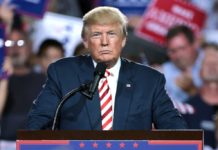

President Donald Trump is poised to run the table on federal judicial appointments in Kansas.
With U.S. District Judge Eric Melgren’s decision to move to senior status, Trump will get three appointments to the federal bench in Kansas.
He’s already named three of the state’s six judges, Holly Teeter, Toby Crouse and John Broomes. He will get three more, meaning he will end up naming all the judges in Kansas.
President Joe Biden had a chance to fill a seat that came open when U.S. District Judge Julie Robinson moved to senior status.
But the Biden administration fumbled the appointment away when the president nominated federal prosecutor Jabari Wamble, the son-in-law of Democratic Congressman Emanuel Cleaver of Missouri, to fill Robinson’s seat.
Wamble later withdrew, and the Biden administration never moved forward with another nomination to fill Robinson’s seat.
The Biden administration initially appointed Wamble to the U.S. 10th Circuit Court of Appeals, but he ultimately didn’t make the cut after he was not rated by the American Bar Association.
Now talk is starting to emerge about who might fill the slate of openings on the federal bench in Kansas for which U.S. Sens. Jerry Moran and Roger Marshall will have influence since they have the power to block a nominee they might oppose.
Multiple interviews in political and legal circles reveal at least seven candidates who are believed to have already interviewed with the White House for the position.
The candidates whose names have emerged in recent weeks include:
- Kansas Bureau of Investigation Director Tony Mattivi
- Kansas Solicitor General Anthony Powell
- U.S. bankruptcy Judge Mitchell Herren
- Topeka lawyer and former federal prosecutor Bradley Schlozman
- Kansas City lawyer Michael Raupp
- Great Bend lawyer Jeffrey Kuhlman
- State Parks and Wildlife chief counsel Kurtis Wiard
Each of those candidates were contacted and only one – Wiard – confirmed that they were a candidate. Other candidates declined to comment or did not return calls or emails.
A recent analysis by Bloomberg Law, and a separate study published by the Justice System Journal – produced by the National Center for State Courts – provide some insight into what Trump is looking for in judicial nominees during his second term, based partly on who he nominated during his first term. The Associated Press also did its own analysis that looks at nominees’ position on abortion. Here is what those outlets found:
Trump likes younger judges: Out of 20 judicial nominees who’ve appeared before the Senate Judiciary Committee for confirmation hearings this year, two-thirds were 44 or younger, Bloomberg reported. Trump’s youngest pick this year was 35-year-old Joshua Divine, who was nominated for a Missouri judgeship. Divine was the Missouri solicitor general and served as chief counsel to U.S. Sen. Josh Hawley. A study published by the Justice System Journal found that during Trump’s first term, the average age for federal judicial nominees was 49.
Trump prefers Republicans: Bloomberg reported that the president relied on candidates who worked for Republican attorneys general or served as solicitors general. Bloomberg reported that 34% of the president’s nominees were state attorneys who worked for Republican attorneys general or who worked for Republican solicitors general.
Race not a factor: Of 26 nominees announced this year, two were people of color, according to Bloomberg. Overall, 19 were men and seven were women. “Of the 11 active circuit judges who self-identified as Asian American or Pacific Islander at the end of Trump’s first term, he appointed seven. Three of his six total appellate nominees are women.” A study published by the Justice System Journal found that during Trump’s first term, about 85% of his 372 judicial nominees were white, 4% were African American and about 4% were Hispanic. About 77% were male and about 23% were female candidates. Overall, about 15% of Trump’s nominees during his first term were minorities compared to about 36% for President Barack Obama.
Top law schools: Bloomberg reported that half of Trump’s appeals court picks graduated from the nation’s top law schools. The other half earned degrees from George Washington University and Notre Dame. “Overall, a third of Trump’s judicial selections so far graduated from Yale, University of Chicago, Georgetown, Harvard, and the University of Pennsylvania,” according to Bloomberg. However, Bloomberg indicated that the Trump nomination team had take an interest in nominees who have either attended or taught at George Mason’s Antonin Scalia Law School. The study published by the Justice System Journal showed that during Trump’s first term about 30% of nominees attended an “elite” law school, which was defined as Harvard, Yale, Colombia, Stanford, the University of Chicago, University of California-Berkeley, the University of Michigan-Ann Arbor or Northwestern.
American Bar Association ratings: The study published by the Justice System Journal shows that about 68% of Trump’s nominations during his first term were rated as “well qualified.” Twenty-nine percent were “qualified” and about 3% were scored as “not qualified.” The study reported that 12 nominations were rated as “not qualified,” which was the highest rate relative to other administrations since President Ronald Reagan. Nine of the 12 nominations that were rated as “not qualified” were for the district court and three were for the federal appeals courts. All Supreme Court nominees were rated as “well qualified.”
Abortion opponents: An analysis by The Associated Press found that half of 17 candidates nominated by Trump this year have been associated with anti-abortion groups or defended abortion restrictions.
Ian Ostrander, a political science professor at Michigan State University who coauthored the study on Trump’s appointments, said state connections are important for district court judges compared to other judgeships that cover a broad geographic area.
Ostrander said district judge nominees tend to have stronger state ties, usually having gone to one of the local law schools.
“This is different than circuit court nominees that tend to have Ivy pedigrees,” Ostrander said. “Circuit court nominees are viewed differently as they are the pool of folks from which Supreme Court nominees are often taken.”
He said that the state’s U.S. Senate delegation has significant influence over the candidates since they have the power to block a nominee from advancing.
Ostrander said he thought age would be important to the president.
“A few judges failed in Trump 1 because Republican senators took issue with them being unqualified and young,” Ostrander said.
“However, I would expect to see most picks clustered at the lower end of the age distribution,” he said.
“I also think that there might be an unofficial age ceiling, but I’m not sure exactly where that would be. Perhaps 55,” he said.
After weeks of multiple interviews, seven candidates are most often mentioned as possibilities for the court.
Here’s a look at who is frequently mentioned as a possible candidate for a seat on the federal bench in Kansas, starting in alphabetical order:
Mitchell Herren: U.S. bankruptcy judge in Kansas, a position he has been in since 2020. He began his legal career in 1987 with Baker Sterchi Cowden & Rice in Kansas City and then as assistant general counsel for Koch Industries.
In 2002, he returned to private practice for 18 years with the Hinkle Law Firm in Wichita, where he served seven years as managing member and represented clients ranging from individuals to large companies, with a focus on commercial litigation.
In 2018, he helped defend Ford County in a legal dispute over a decision to move Dodge City’s lone polling place to a remote area outside of town that’s not easily accessible.
He’s a 1987 graduate of the University of Missouri-Kansas City Law School and is a 1984 graduate of the University of Central Missouri.
Jeffrey M. Kuhlman: Attorney at the Watkins Calcara firm in Great Bend. He was a judicial law clerk for U.S. District Court Judge Eric F. Melgren in Wichita. He also worked as a litigation associate at the Hinkle Law Firm. He graduated from Kansas State University in 2012 with a bachelor’s in history and a minor in political science. He earned his law degree from the Antonin Scalia Law School at George Mason University in Arlington, Virginia. He graduated with his law degree cum laude.
Tony Mattivi, Kansas Bureau of Investigation: Mattivi was appointed as KBI director in 2022 by Attorney General Kris Kobach. Mattivi came to the KBI after serving as vice president and general counsel of the health care company MedCor, although he made much more of a name for himself as a federal prosecutor in high-profile criminal cases.
Mattivi worked as an assistant U.S. attorney from 1998 to 2020. He spent more than four years as the trial counsel in the prosecution of Abd Al-Rahim Hussein Muhammed Al-Nashiri, who was charged with masterminding the attack that killed 17 on the U.S.S. Cole destroyer in 2000. He also prosecuted Terry Lee Loewen, the former U.S. Marine who pled guilty to attempting to detonate a van filled with high explosives at the Wichita airport on behalf of al-Qaeda during the Christmas travel season.
He also prosecuted John T. Booker, who pled guilty to trying to detonate a truck bomb at the base hospital on Fort Riley on behalf of the Islamic State. He also headed a team of Justice Department prosecutors who convicted three Kansas militia members for plotting to blow up an apartment building and slaughter more than a hundred Somali Muslim refugees as they worshiped. He has a bachelor’s in aviation management from Metropolitan State University in Denver and a law degree from Washburn University.
Anthony Powell: Kansas solicitor general, the state’s top appellate lawyer. He previously served as a judge in the 18th Judicial District in Sedgwick County from 2002 until his appointment to the Kansas Court of Appeals in 2013. He was appointed to the bench by former Republican Gov. Sam Brownback. During his time on the court, Powell heard more than 2,000 cases and wrote 672 opinions.
He also was a Republican member of the Kansas House for eight years, where he served as majority whip and was chair of the Federal and State Affairs as well as the Ethics and Elections committees. Powell received a bachelor’s in political science from George Washington University in 1985 and a law degree from Washburn University in 1991.
After law school, Powell practiced law at Martin & Churchill in Wichita. He also served as legislative director to Michigan Congressman William Broomfield and as an intern on the staff of U.S. Sen. Bob Dole.
As solicitor general, he urged the Kansas Supreme Court to reverse its decision that found abortion is a protected constitutional right in Kansas. He also has led efforts to stop Gov. Laura Kelly’s administration from allowing transgender Kansans to change their gender markers on driver’s licenses. He also was part of the attorney general’s effort to get President Donald Trump on the ballot in Colorado.
Michael Raupp: Partner at the Husch Blackwell law firm in Kansas City. His practice focuses on
Journey 4 Justice motorcycle group who were convicted of illegally demonstrating outside a house of worship, for holding American flags on a sidewalk near the Westboro Baptist Church in Topeka. The case was ultimately dismissed after city prosecutors agreed the law was unconstitutional as applied.
He also represented the Iowa Pork Producers, which asked the Supreme Court to review California’s Proposition 12, which prevented the sale of certain products in California that don’t comply with minimum space requirements for animals. The Supreme Court declined to hear the case.
He was recognized earlier this year by Missouri Lawyers Media as an influential appellate advocate — “awarded to the attorneys behind the most significant appellate decisions of the year.”
He graduated in 2007 from the University of Kansas in with a bachelor’s in finance and management and in 2012 from the University of Texas law school. He worked as a clerk for Duane Benton, a judge on the U.S. Eighth Circuit Court of Appeals, who was appointed to the bench by former President George W. Bush.
Before attending law school, Raup was an investment analyst at an asset-management firm that focused on investments in China. While there, he focused on evaluating the current operations and growth plans for numerous businesses.
Bradley Schlozman: Joined the Hinkle Law firm in 2007 after serving as the U.S. attorney for the Western District of Missouri. He also served as acting assistant attorney general of the civil rights division at the U.S. Justice Department and counsel to the deputy attorney general. The law firm’s profile says his practice is concentrated primarily on “high-stakes government investigations and civil rights litigation defense of states, municipalities, and law enforcement groups.”
His work in Kansas has been most apparent in his defense of voting laws enacted by the Kansas Legislature. He has defended state laws that limited ballot collection by third parties and banned anyone from impersonating election officials. He also defended state laws that placed limits on mailing advance ballot applications from out of state and whether advance mail ballot applications could be sent to voters with prepopulated personal information.
He also defended the Legislative Coordinating Council – made up of legislative leaders – against a lawsuit brought by Gov. Laura Kelly when the panel tried to revoke the governor’s executive order limiting the size of religious gatherings to 10 or fewer people. He also represented the secretary of state’s office in a case from 2014 when the state Supreme Court ordered the state to remove Democrat Chad Taylor’s name from the ballot in the U.S. Senate race against Republican incumbent Pat Roberts. The ruling cleared a path for Greg Orman to run as an independent, although he still lost to Roberts.
Schlozman ran into trouble at the U.S. Justice Department when he was accused of engaging in improper, politically motivated hiring practices in an inspector general’s report from 2008. The report, which focused on activity from 2003 to 2006, found that Schlozman violated federal law and department policy that prohibited discrimination in federal employment based on political and ideological affiliations. The report said Schlozman made false statements to Congress about his actions. At the time, Schlozman’s lawyer called the accusations “grossly inaccurate and biased.” Then-Attorney General Eric Holder decided against bringing any charges in the case.
Kurtis Wiard: Chief legal counsel at the Kansas Department of Parks and Wildlife since September 2024. He previously worked as an assistant solicitor general under Anthony Powell in the attorney general’s office, a position he was in for about six years.
Earlier, he worked as a research attorney for the Kansas Supreme Court and the Kansas Court of Appeals. He also was a law clerk for the state Labor Department and a Columbia, Missouri, law firm.
He graduated in 2009 from Washburn University with a degree in political science and in 2014 with a law degree from Washburn as well. He was part of a team of lawyers at the attorney general’s office that defended the redrawing of the state’s legislative districts in a lawsuit brought by a now former state senator.
He also was part of a team of lawyers who defended the congressional districts drawn by the Legislature in a lawsuit that was appealed to the U.S. Supreme Court. He also was on a team that defended the constitutionality of the state’s criminal threat statutes before the U.S. Supreme Court.
.