




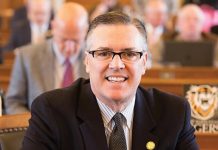


Republican senators on Thursday quizzed Kansas Board of Regents Chair Jon Rolph over diversity, equity and inclusion as they considered confirming his renomination to the panel that oversees higher education.
Gov. Laura Kelly renominated Rolph to the Board of Regents last summer, but his appointment was held over to the legislative session so he could go before the Senate Education Committee.
Rolph was asked about what he thought about DEI, including job postings at state universities that sought information about a candidate’s experience or background in diversity, equity and inclusion.
Republican state Sen. Renee Erickson of Wichita raised the issue, pointing to university job postings at the University of Kansas, Kansas State University, Washburn University and others asking about DEI.
She said there was one university with 27 positions in the office of diversity, equity and inclusion. She asked Rolph how diversity can be implemented in the university system.
“I don’t think our mission is to create diversity,” Rolph said. “Our campuses are becoming more diverse, and we’re really trying to make sure we’re responsive to that.”
With more campus diversity, Rolph said, there’s more “richness” and many more opinions and life’s experiences at state universities.
“Most of the work that I see in diversity isn’t about creating diversity, it’s recognizing what’s already going on on our campuses,” Rolph said.
Rolph said as he looked at university programs and offices related to diversity and inclusion, he found them to be connected to enhancing student success.
“They’re tied in to the programs around welcoming students,” he said.
“That’s generally what those programs are about,” he said. “They’re about helping students find a place on the campus, know that they’re valued and help bring the services around them that are going to set them up for success.”
Erickson said after the hearing that she’s opposed to DEI, calling it “discriminatory” and the “antithesis” of what should be promoted on college campuses.
She said she believes that DEI requires people to adhere to a certain set of values and beliefs to advance through the university system.
“I think that’s not what we want to focus on,” she said. “It ought to be about merit. It ought to be about competency. I think it’s actually a step backward.
“It’s not personal against Mr. Rolph. I am adamantly opposed to DEI.”
Erickson said she had been told that Rolph had been supportive of DEI on university campuses.
She said she had a private conversation with Rolph where he addressed the issue. She said she wanted more ongoing conversations with Rolph about the matter.
“I don’t question his sincerity or integrity,” she said. “I just want the reassurance that we’re talking about the same thing and we’re not going to have DEI in the negative sense that I view it in our universities here in Kansas.”
The Senate Education Committee didn’t vote on Rolph’s nomination Thursday. A vote could come next week. Erickson said she didn’t know how she would vote on Rolph.
Republican state Rep. Beverly Gossage of Eudora also asked Rolph about DEI.
“DEI can mean a lot of things to a lot of different people,” he said.
“For us in the state of Kansas, this isn’t about reverse racism,” he said. “We try very hard to make sure that’s not happening on our campuses.
“By that I mean, the stories you hear that based on your race, oftentimes being white, that means that you’re naturally a bad person,” he said.
“We don’t promote that on any of our campuses,” he said.
“We have no practices that hold one race down to elevate another race. We really look for the best candidates who are the most qualified for the positions.”
For example, he said Kansas universities are not confused about whether advocating for genocide is against their code of conduct.
He pointed to recent congressional testimony from the presidents of the Massachusetts Institute of Technology, Harvard and the University of Pennsylvania who said it would it would depend on the context of calling for genocide.
“That’s not an issue of confusion for our universities,” he said.
DEI on college campuses is getting increasing attention in the Kansas Legislature.
Last year, the Legislature added language to the budget that would have barred state universities from demanding job applicants to articulate their experience or commitment to diversity, equity and inclusion.
The governor vetoed the language, which the House failed to override.
The language was backed by Republican state Rep. Steven Howe, who expressed concern about how DEI was being used in hiring practices at state universities.
Howe said Wichita State University had listed DEI experience under “preferred knowledge” on its job postings.
He said Kansas State required some type of DEI statement for some of its jobs, while the University of Kansas appeared to ask faculty applicants to include a statement about their DEI experience.
The proviso language was similar to what was added in the Senate that barred state universities from demanding a “diversity-equity-inclusion oath” of job applicants, students and contractors. The Senate language didn’t make it into the budget.
Also, legislative auditors are now conducting an audit that examines how much each state university spends on diversity-related departments and how much they received in funding and contracts from foreign countries.
The audit is to collect data from university staff to determine how many departments they’ve operated and how many staffers they’ve employed for DEI purposes.
Auditors also would collect data from the universities to determine how much state funding they’ve spent on DEI-related training.
Some lawmakers opposed the audit, saying there are mixed views about how to define diversity, equity and inclusion and there’s no clear way for how it can be quantified or measured.