




(Updated to include comments from House speaker, Senate president and top House Democrat)
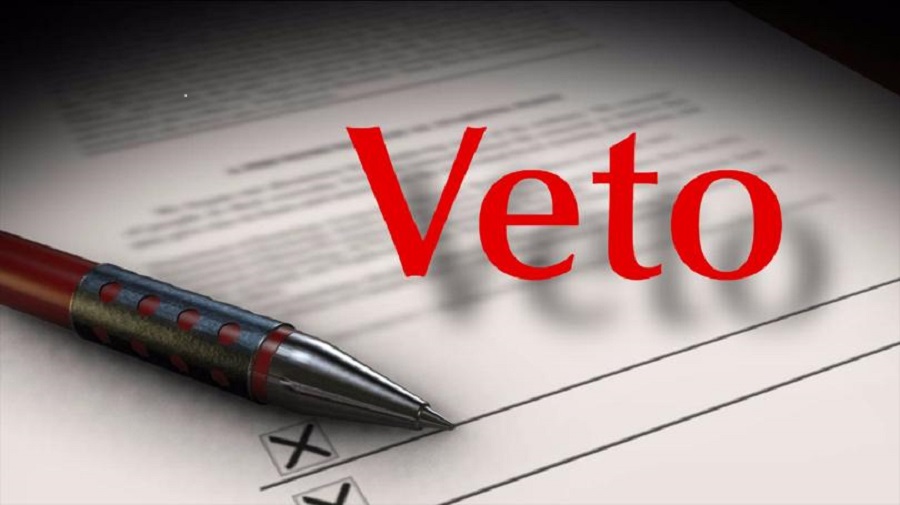
Gov. Laura Kelly on Friday vetoed a bill banning transgender people from using restrooms and locker rooms in government buildings that don’t correspond with their biological sex.
The bill, which passed with the two-thirds majority needed in the Legislature to override a veto, also requires the sex designation on driver’s licenses and birth certificates to reflect someone’s biological sex at birth.
Kelly, who vetoed an earlier iteration of the bill a couple years ago, said the legislation was “poorly drafted” and would “have numerous and significant consequences far beyond the intent to limit the right for trans people to use the appropriate bathroom.”
She said that under the bill:
- “If your grandfather is in a nursing home in a shared room, as a granddaughter, you would not be able to visit him.”
- “If your wife is in a shared hospital room, as a husband, you would not be able to visit her.”
- “If your sister is living in a dorm at K-State, as a brother, you would not be able to visit her in her room.”
House Speaker Dan Hawkins said the House is ready to override the “ridiculous” veto.
“It’s hard to wrap my mind around why the governor would veto something so fundamentally common sense,” Hawkins said.
The bill “simply recognizes biological reality in state law and ensures that single-sex spaces, such as restrooms and locker rooms in public buildings, are designated
accordingly,” he said.
“That’s not extreme — it’s basic clarity, truth and dignity,” he said. “Kansans expect their laws to reflect reality and protect privacy.”
The bill requires state and local governments to designate restrooms, locker rooms and changing rooms for use based on someone’s biological sex. State and local governments would be at risk of significant penalties if they don’t comply with the law.
The bill, which was broadened to cover bathrooms, originally came in response to an appeals court ruling that allowed transgender Kansans to change their gender markers on driver’s licenses while a legal battle plays out in court.
As it eventually passed, the bill requires state and local officials to take “every reasonable step” to ensure that someone does not enter restrooms and locker rooms designated for the opposite sex.
Any government agency that violates the law could face a civil penalty of $25,000 for the first violation and $125,000 for each subsequent violation.
Each day of a continuing violation is considered a separate infraction.
Any individual who violates the law by entering the restroom of the opposite sex would get a notice from the government that owns the public building.
A second violation would carry a fine of $1,000.
“I never thought I’d see the day when our state’s own governor would turn her back on women by forcing them to use bathrooms in public buildings with biological men,” said Senate President Ty Masterson.
“Sadly, our governor has decided she will side with they/them over simple, scientific truth,” he said. “The Kansas Senate will restore sanity, and override her veto.”
Democratic state Rep. Brandon Woodard said the bill “represents a failure of both process and priorities.”
“The bill was rushed through the Legislature without meaningful public input or debate,” he said.
“The legislation targets a small and vulnerable group of Kansans while creating sweeping and unintended consequences for communities across our state,” he said.
The entire debate was rooted in a court decision stemming from a legal dispute over SB 180, known as the Women’s Bill of Rights.
Enacted in 2023, the law required any state agency, school district or local government that collected vital statistics for public health, crime, economics or other topics to identify each individual as either a male or female at birth.
Attorney General Kris Kobach issued an opinion in 2023 saying that the law required Kelly’s administration to restore any driver’s licenses and birth certificates that were modified to reflect someone’s gender identity.
Three years ago, Kobach took the Kelly administration to court over its refusal to change its policy for allowing transgender Kansans to change their gender markers on driver’s licenses.
He said that the Women’s Bill of Rights expressly required that documents such as driver’s licenses reflect biological sex and not a person’s gender identity.
A district judge issued a temporary injunction blocking the Kelly administration from allowing transgender Kansans to change their gender markers on driver’s licenses.
A panel of state appeals court judges reversed the injunction, and the Kansas Supreme Court later decided against taking up the lawsuit, effectively upholding the lower-court ruling.
The case is still pending in Shawnee County District Court. It could be rendered moot if the bill ultimately becomes law.
The bill requires any driver’s license issued before this July 1 to identify the gender of the individual by their biological sex or it becomes invalid.
The bill would require the state to send written notices to any drivers with licenses that don’t comply with the law and direct them to surrender the license.
Since 2011, the state has completed roughly 582 gender marker change requests. There may have been requests before 2011, but those numbers were not available.
It also requires birth certificates to reflect someone’s biological sex at birth.
It directs the state to change any birth certificate records that identify the sex of the individual so it’s consistent with the Women’s Bill of Rights.
Between 2005 and 2026, there have been more than 1,800 birth certificates in the state health department’s electronic system that have had changes made to the sex field.
However, reasons for the changes to the sex field can range from correcting data entry errors to recognition of gender changes.
The state’s system doesn’t currently track the cause of a change to the sex field — just that there was a change — and each record would have to be reviewed to ascertain the cause of the change.