






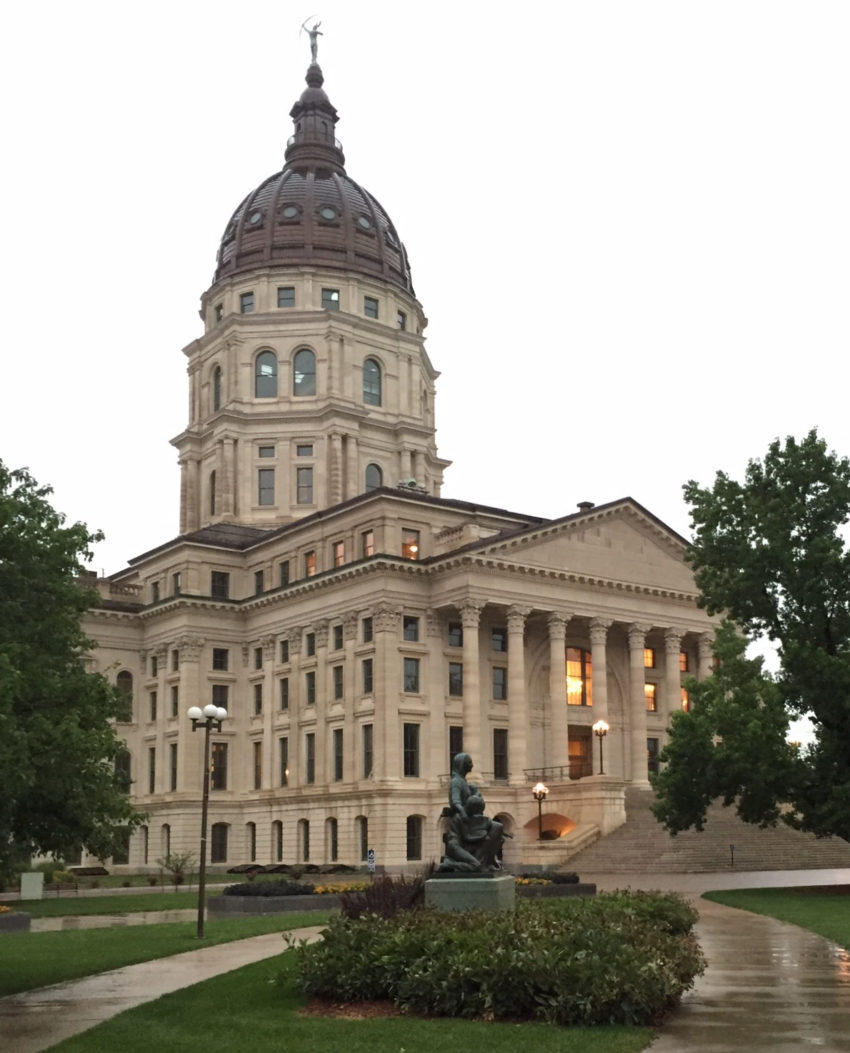
Following a marathon day of debate, the Kansas Legislature on Wednesday approved a bill banning transgender people from using restrooms and locker rooms in government buildings that don’t align with their biological sex.
In a single day marked by more than six hours of debate at the statehouse, the bill whipped through the House and Senate two days after it emerged from a committee. The bill passed 87-36 in the House and 30-9 in the Senate.
The bill, which has the two-thirds majority to override a likely gubernatorial veto, also requires the sex designation on driver’s licenses and birth certificates to reflect someone’s biological sex at birth.
The bill requires state and local governments to designate restrooms, locker rooms and changing rooms for use based on someone’s biological sex. State and local governments would be at risk of significant penalties if they don’t comply with the law.
The bill, which was broadened this week to cover bathrooms, came in response to an appeals court ruling that allowed transgender Kansans to change their gender markers on driver’s licenses while a legal battle plays out in court.
The bathroom provision sparked furious protests from Democratic lawmakers who said they only learned about the bathroom proposal late Monday afternoon when the driver’s license bill was amended in the House judiciary committee.
They accused Republican leaders of procedurally cutting the public out of commenting on the proposal and fast-tracking it through the Legislature by using a “gut-and-go” maneuver to expedite the process without a hearing.
They tried to slow the process down by trying to make 14 amendments or motions in an effort to gut or limit the bill, but Republicans overwhelmingly turned them back each time.

“The process with this bill is egregious,” said state Rep. Brandon Woodard of Lenexa, the top Democrat in the House.
“Kansans, whether you agree with them or disagree with them on this issue, deserve to be heard,” he said.
“If this isn’t something that’s so deeply unpopular to the public, then why are you doing it in a rushed and hidden process?” he said.
“You have the numbers. You have the supermajority that you expanded after the last election. You have the ability to pass these things,” he said.
“Shoving bills like this through the process this quickly is wrong,” he said.
Republican state Rep. Susan Humphries of Wichita, chair of the House judiciary committee, said lawmakers followed procedure.
“Everything was done according to the rules. We didn’t do anything that was outside of what was possible.

“All the rules and procedures were followed,” she said. “They might be distasteful to some, but they were followed.”
Supporters of the bill said it was needed to protect women’s privacy and safety while bringing clarity to state law about gender markers on state documents.
Opponents said the bill was discriminatory against transgender Kansans and resolved no ongoing harm to the state.
“Right now, anyone can walk in any bathroom,” Humphries said.
“This is about making it really clear who can go in each restroom.
“This is about making it clear that states have a duty to protect the privacy and the safety of women,” she said.
Democratic state Rep. Lindsay Vaughn of Overland Park said the bill in its entirety – the bathroom and driver’s license provisions – discriminate against transgender people because they are “based on ignorance, fear mongering and misinformation.”
“There is not actual problem that these bills solve,” Vaughn said. “There is no existing harm that needs to be addressed.

“What these bills do is cause real harm to transgender, intersex and transgender diverse people,” Vaughn said.
“The ignorance, misinformation and disinformation underlying the bill feed into people’s stereotypes that create real violence,” she said.
Vaughn said the bill would force transgender people to out themselves in public life, which would heighten the discrimination they already face.
Republican state Rep. Bob Lewis of Garden City, the author of the bathroom amendment, said the bill wasn’t complicated.
“This bill simply codifies societal norms,” Lewis said.
“That is what people expect, that public spaces used for private purposes will be single sex and that a person’s identification document will accurately reflect the biological sex.
“That’s just what people expect and we’re simplifying codifying that with this bill,” Lewis told the House.
“I have heard from a number of constituents and others about concerns about both privacy – especially from women – and safety inside these public spaces where men are allowed to come in and use the facility at the same time,” he said.
Republican state Rep. Charlotte Esau of Olathe shared that view during the debate on the House floor.
“I’ve had folks tell me they won’t go out in public,” Esau said.
“They won’t go to public pools where they have to go to a locker room, that sort of thing. For generations we have protected women in women spaces.
“We need to continue to do that.”
Democratic state Rep. Nikki McDonald of Olathe said the bills paint an unwelcoming image of Kansas.
“The choice you make sends a message to Kansans,” McDonald said.

“Do you focus on issues that add to division, that vilify people, that stereotype people that are different than you?” she asked.
“There’s is your chance to take government out of people’s bedrooms, out of their bathrooms, out of their business.”
Supporters of the bill said it posed risks, for example, if someone who has transitioned as a female must enter a men’s restroom to comply with the law. Or the reverse, someone who has transitioned as a man enters a women’s restroom to adhere to the law.
There were failed amendments proposed by Democrats that would have made it a violation of the law to lodge a false accusation against someone or to add gender identity to the state’s hate crime statute.
Woodard said during the floor debate in the House that the bill was driven by a new transgender lawmaker, Rep. Abi Boatman of Wichita, who replaced Silas Miller in the House. Boatman is the state’s second transgender lawmaker.
“I am an elected official like almost everybody in this room,” Boatman said.
“Am I afforded all of the rights and responsibilities of an elected official, or do I need to go waste my time at facilities asking where I am allowed to take a dump?” Boatman said.
“What this bill is about is sending a very clear message to people who are transgender that you are not welcome, you are not safe here.”
Humphries said the idea of the bill has been percolating since before either Boatman or the last transgender legislator, former Rep. Stephanie Byers, arrived at the Capitol.
She said a similar bill had been introduced in 2017 or 2018.
“This is something that we’ve been concerned about since then,” she said, adding she’s been worried about acts of violence against women in restrooms.
“It just seemed like it was time to bring this back,” she said in an interview.
Throughout the debate, Democrats pressed the argument that not only was the bill fast-tracked without public input, but that it lacked an assessment of the cost it would impose.
Humphries said that the bill would not have much cost, if any, because it only required additional signage.
As it passed, the bill requires state and local officials to take “every reasonable step” to ensure that someone does not enter restrooms and locker rooms designated for the opposite sex.
Any government agency that violates the law could face a civil penalty of $25,000 for the first violation and $125,000 for each subsequent violation.
Each day of a continuing violation is considered a separate infraction.
Any individual who violates the law by entering the restroom of the opposite sex would get a notice from the government that owns the public building.
A second violation would carry a fine of $1,000.
The entire debate was rooted in a court decision stemming from a legal dispute over SB 180, known as the Women’s Bill of Rights.
Enacted in 2023, the law required any state agency, school district or local government that collected vital statistics for public health, crime, economics or other topics to identify each individual as either a male or female at birth.
Attorney General Kris Kobach issued an opinion in 2023 saying that the law required Gov. Laura Kelly’s administration to restore any driver’s licenses and birth certificates that were modified to reflect someone’s gender identity.
Three years ago, Kobach took the Kelly administration to court over its refusal to change its policy for allowing transgender Kansans to change their gender markers on driver’s licenses.
He said that the Women’s Bill of Rights expressly required that documents such as driver’s licenses reflect biological sex and not a person’s gender identity.
A district judge issued a temporary injunction blocking the Kelly administration from allowing transgender Kansans to change their gender markers on driver’s licenses.
A panel of state appeals court judges reversed the injunction, and the Kansas Supreme Court later decided against taking up the lawsuit, effectively upholding the lower-court ruling.
The case is still pending in Shawnee County District Court. It could be rendered moot if the bill approved Wednesday becomes law.
The bill requires any driver’s license issued before this July 1 to identify the gender of the individual by their biological sex or it becomes invalid.
The bill would require the state to send written notices to any drivers with licenses that don’t comply with the law and direct them to surrender the license.
It also requires birth certificates to reflect someone’s biological sex at birth.
It directs the state to change any birth certificate records that identify the sex of the individual so it’s consistent with the Women’s Bill of Rights.