





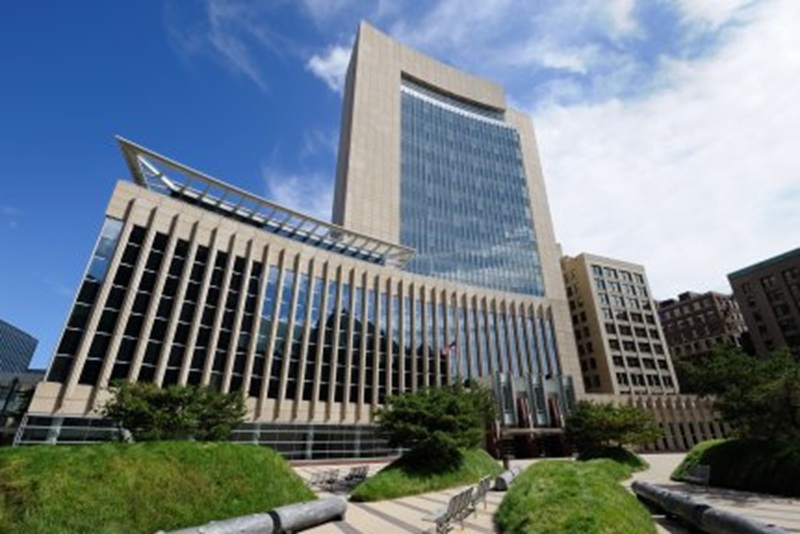
A Minnesota law giving in-state tuition at higher education institutions for students unlawfully in the United States has survived a legal challenge from the Trump administration.
Last Friday, a federal judge ruled against the U.S. Justice Department, which has brought similar suits in seven states.
The Kansas attorney general indicated a similar lawsuit would be filed in Kansas if lawmakers didn’t repeal the current statue.
The decision in the Minnesota case came just days after the Kansas Legislature voted to eliminate in-state tuition at higher education institutions for students who don’t live in the country legally.
The bill, which was passed short of veto-proof supermajorities, is now in the hands of Democratic Gov. Laura Kelly.
The Minnesota case was decided in a separate federal circuit outside of Kansas and is not binding here but could provide a guidance in other cases.
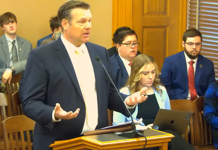
It’s relevant in Kansas, however, because Attorney General Kris Kobach has determined the Kansas law to be illegal and has indicated that the federal government would challenge the Kansas law like it has in other states if legislators didn’t act.
“Kansas legislators would do well to bring Kansas into compliance with the law rather than being sued by the federal government,” Kobach said a couple of weeks ago.
The federal government challenged the Minnesota statute last year, saying the state was “flagrantly” violating federal law.
“No state can be allowed to treat Americans like second-class citizens in their own country by offering financial benefits to illegal aliens,” Attorney General Pamela Bondi said at the time.
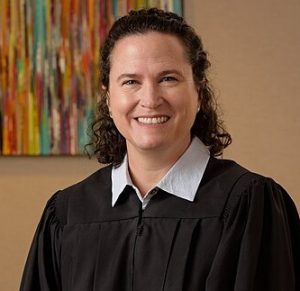
U.S. District Judge Katherine Menendez – nominated to the court by former President Joe Biden – ruled in favor of the Minnesota tuition program last Friday.
Menendez ruled that the in-state tuition program in Minnesota wasn’t preempted by a 1996 federal law prohibiting states from providing immigrants not lawfully in the United States with any postsecondary education benefit that is denied to U.S. citizens.
The judge homed in on two passages of the law in reaching her decision.
The law says an “alien who is not lawfully present in the United States shall not be eligible on the basis of residence within a state…for any postsecondary education benefit unless a citizen or national of the United States is eligible for such a benefit.”
The judge agreed with the state of Minnesota that its in-state tuition law did not conflict with federal law because Minnesota does not provide benefits to undocumented students on the basis of residence.
The state had argued the resident tuition law determined eligibility based on residency-neutral criteria, specifically where a student attended and graduated high school.
The state law lays out two criteria for the program: Students must attend a Minnesota high school for three or more years and they must graduate from a Minnesota high school or must have achieved the equivalent education.
“While these criteria certainly require some connection to Minnesota, they do not require Minnesota residency,” Menendez wrote.
“The resident tuition statute simply does not make eligibility for postsecondary education benefits contingent upon the location of a person’s ‘principal, actual dwelling place in fact,'” she wrote.
“As defendants point out, there are multiple ways a student could qualify for resident tuition without residing in Minnesota, such as attending a Minnesota high school while living in a neighboring state, or by attending a Minnesota boarding school,” she wrote.
She said that the plain text of the federal law was clear: “It does not preempt the Minnesota statutes because the resident tuition statute does not determine eligibility for resident tuition on the basis of residence.”
While case law on the issue is sparse, Menendez drew on a state Supreme Court ruling from California that considered whether federal law preempted a similar statute in the state with identical language for resident tuition eligibility.
Agreeing that the California case was not binding, Menedez noted that the state Supreme Court concluded that the California statute was not preempted because resident tuition was not determined based on residence, but on “other criteria.”
She also zeroed in on part of the federal law prohibiting someone who is here illegally from receiving residency-based postsecondary benefits “unless a citizen or national of the United States is eligible for such a benefit…without regard to whether the citizen or national is such a resident.”
The law prohibits someone who is not the country legally from receiving such a residency-based postsecondary benefit unless a citizen or national of the United States is eligible for such the same benefit.
The state had argued that because some nonresidents are eligible for resident tuition, the state law satisfies the requirements of the citizenship eligibility clause because “a citizen” is eligible.
The state contended the language in federal law only requires “a” citizen to be eligible, meaning “one” or “any.”
And because three classes of citizen nonresidents can be eligible for instate tuition, that requirement is met, the state said.
The federal government, meanwhile argued that “a” means “all,” requiring all nonresident citizens to be eligible for resident tuition should “a” noncitizen be eligible.
The judge ruled that the federal government misreads this statement as suggesting that “a” can mean “all.”
She said federal precedent supports the use of “a” or “an” before a noun naming an object is understood to mean to “one or more” unless the context sufficiently indicates otherwise.
“Under Minnesota’s statutory scheme, nonresidents can — and do — qualify for resident tuition: by living in a neighboring state and attending Minnesota high schools, attending a Minnesota boarding school, or attending and graduating from a Minnesota high school before moving out of state.
“So even if the resident tuition statute contained a de facto residency requirement, ‘a citizen or national’ is eligible for Resident Tuition without regard to that individual’s residence.”
In an opiniion issued Feb. 10, Kobach said the Kansas in-state tuition program is based on residence. He cited three examples of how:
- He cites language in Kansas law that says “illegal” immigrants are “deemed” to be residents of Kansas. “Such deeming is solely for the purpose of making such illegal aliens eligible for postsecondary education benefits.”
- He says Kansas postsecondary educational institutions are required to offer the postsecondary education benefit to immigrants in the country illegally who have attended accredited Kansas high schools for three or more years. “Eligibility to attend an accredited Kansas high school is based on residency within the state of Kansas. Residency in Kansas triggers a constitutional and statutory right ‘to attend the public schools.'” As a result, he said, it’s an immigrant’s Kansas residency that entitles them to attend a Kansas high school, which in turn entitles them to tuition benefits.
- He says an alien who is eligible for fees and tuition for “residents” of another state is deemed ineligible for the postsecondary education benefit offered by the state. “Thus, being a resident of another state disqualifies an illegal alien from obtaining this education benefit. Therefore, only an illegal alien who is a resident of Kansas is eligible to receive the postsecondary education benefit.”
He says the in-state tuition program in Kansas directly conflicts with federal law “because it permits illegal aliens to qualify for in-state tuition rates without providing the equivalent benefit to U.S. citizens without regard to residency. It is therefore preempted.”
“Kansas has been violating this federal law ever since…(it) was enacted.”
A federal judge halted a 2001 Texas law signed by former Republican Gov. Rick Perry that gave college students without legal residency access to in-state tuition.
On that same day, Texas Attorney General Ken Paxton filed a joint motion along with the Trump administration to end the law for in-state tuition for immigrants not living in the country legally.
Texas was the first state to permit in-state tuition benefits to undocumented students.
Last August, Oklahoma Attorney General Gentner Drummond filed a joint motion with the U.S. Department of Justice to end a state law giving in-state tuition to immigrants who live in the country illegally.
;