




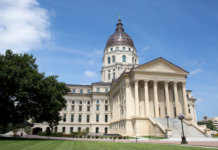
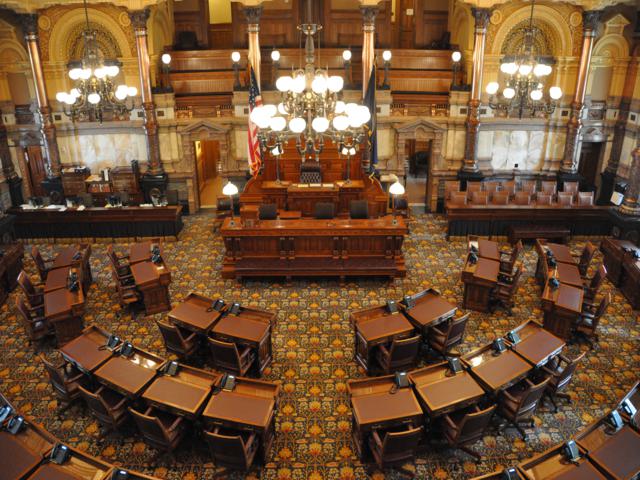
A bill eliminating in-state tuition at higher education institutions for students who don’t live in the country legally cleared the Legislature on Tuesday, but neither the House nor the Senate mustered enough votes for it to survive a veto.
The Senate voted 22-18 to approve a conference committee report that included the in-state tuition measure as part of a larger bill banning immigrants living in the country illegally from receiving most state or local benefits.
The bill, pushed by Republican Attorney General Kris Kobach, now goes to the governor after the House approved the legislation on a 78-46 vote last week.
If the governor signs the bill and the law is enacted, Kansas would be the fourth state to repeal the in-state tuition law since 2025, according to the National Immigration Law Center.
The Kansas law has been in place since 1994.
The bill in the Senate is five votes short of overriding a gubernatorial veto and six short of being veto-proof in the House.
Republican state Sen. Mike Thompson of Shawnee, chair of the Federal and State Affairs, said Kansas has been violating federal law for years because it is violating in-state tuition to young immigrants who are in the United States unlawfully.
He warned the Senate that the state could face litigation from the federal government challenging the tuition law if it’s not repealed by the Legislature.
“We either pass this bill now or we end up in court,” Thompson said.
“It doesn’t make sense to pull heart strings on this,” he said. “You either have the rule of law or you do not.”
Republican state Rep. T.J. Rose of Olathe asked Thompson whether the Bible shows that God has a special place for the widow and the orphan but also for the immigrant.
“I believe the United States of America is a just and compassionate nation,” Rose said.
Rose said the students affected by the legislation are in the country by no choice of their own and are living out their lives quietly and productively chasing the American dream.
“As a just and compassionate nation, I believe that it’s important that we treat them well.”
Republican state Rep. Tim Shallenburger of Baxter Springs voted against the bill.
He questioned how the law would affect athletes whom universities recruit from other countries to play sports in the United States.
“KU has a list of football players that they bring in from other countries. They don’t just not only give them in-state tuition; they pay them money. They don’t pay any tuition,” he said.
“They’re coming in to play soccer at K-State. They’re coming in to play golf and tennis from China. China is not a place we want anybody to come,” he said.
“We’re hypocrites here,” he said. “We’re saying we don’t want someone who has lived in this state for 19 years who has done everything they’re supposed to do. And they can’t come.
“But we can get John Q from Iran to come over if he’s a good soccer player,” he said. “Not only will we give him a full-ride scholarship, we’ll put him up in some housing, we’ll write him a check.”
Republican Sen. Virgil Peck of Havana asked Thompson whether student athletes from other countries were here legally.
Thompson said he would assume that athletes were here legally and they had gone through the immigration process to ensure they could play sports in the United States.
“I’m confident that they came here legally. The school made certain that they were here legally because if they came illegally, ICE might show up and take them back home,” Peck said.
He added, “I think it’s about time we finally take a stand and say the laws of the United States mean something and we’re just not going to give special treatment to those who break our laws.”
President Donald Trump issued an executive order last year vowing to confront state and local officials who he said use their “authority to violate, obstruct, and defy the enforcement of federal immigration laws.”
Last year, the U.S. Justice Department filed lawsuits against seven states — Texas, Kentucky, Illinois, Oklahoma, Minnesota, California and Virginia — with in-state tuition policies similar to Kansas’.
The Florida Legislature repealed that state’s law when the legislators passed a broad immigration law in 2025 that limited waivers for the in-state tuition program to only “citizens of the United States” or those “lawfully present in the United States.”
A federal judge halted the 2001 Texas law signed by former Republican Gov. Rick Perry that gave college students without legal residency access to in-state tuition.
On that same day, Texas Attorney General Ken Paxton filed a joint motion along with the Trump administration to end the law for in-state tuition for immigrants not living in the country legally.
Texas was the first state to permit in-state tuition benefits to undocumented students.
Last August, Oklahoma Attorney General Gentner Drummond filed a joint motion with the U.S. Department of Justice to end a state law giving in-state tuition to immigrants who live in the country illegally.
Kobach had predicted the Trump administration would eventually sue Kansas if the Legislature didn’t pass the legislation.
“Kansas legislators would do well to bring Kansas into compliance with the law rather than being sued by the federal government,” Kobach said a couple of weeks ago.
The Kansas in-state tuition program is open to someone who attended an accredited Kansas high school for three years or more, graduated from an accredited Kansas high school or earned a general equivalency diploma and sought to legalize their immigration status.
There were 310 students – 0.2% of the total student population – enrolled in state universities, community colleges and technical colleges who received in-state tuition in the program as of the fall of 2024, according to the most recent state data available.
The Board of Regents said there was no more recent information because the agency no longer collects that data.
Most of the students -180 – were enrolled in community colleges. Another 106 were enrolled at public universities, and 24 attended technical schools.
In 2024, 102 were enrolled at Johnson County Community College, 46 attended Wichita State University, 26 attended Kansas City, Kansas Community College, 24 attended the WSU Campus of Applied Sciences and Technology, 21 attended Butler Community College and 17 attended Fort Hays State.