


(Updated to include interview with Schwab and more background with context; adds Senate president as a potential candidate)
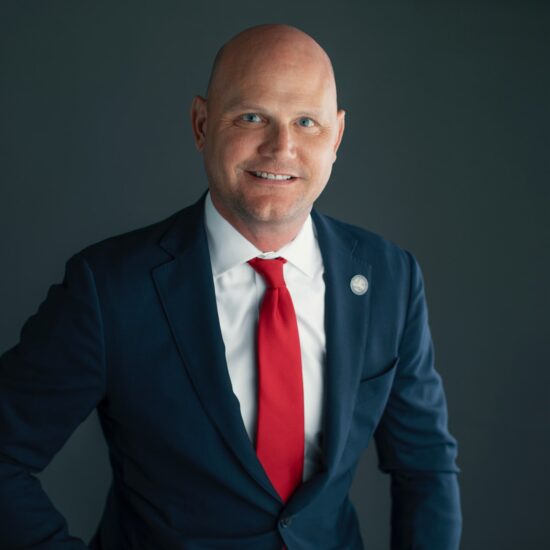
Republican Kansas Secretary of State Scott Schwab is the first major candidate to announce he’s running for Kansas governor in 2026.
Schwab announced early Wednesday that he would seek the seat now held by Democratic Gov. Laura Kelly, who is finishing her second term as governor.
Schwab’s name had been circulating for months as a likely candidate for governor and last week acknowledged publicly for the first time in an interview with the Sunflower State Journal that he was seriously looking at the race.
“We need to return to the values and principles that have always fueled us, and gave me the strength to lead in Topeka,” Schwab said in a statement.
“I have a proven conservative record. And a servant’s heart. It’s important for Kansas to take the right path,” Schwab said.
“A Christian, a father, and a believer in the American dream, I believe that to do something
great, you need to throw off the chains holding you back. For Kansas, that’s big government, and that is why I am running for governor,” he said.
Schwab, a former state legislator from Olathe, is now serving his second term as Kansas secretary of state.
He won a second term in 2022 when he had to overcome a primary challenge from now Kansas Republican Party Chairman Mike Brown, who had stirred doubt about elections in Kansas and was labeled as an “election denier” nationally.
He defeated Brown with about 55% of the vote before winning the general election against Democrat Jeanna Repass with about 58% of the vote.
Schwab won his first term in 2018 when he defeated Brian “BAM” McClendon with about 53% of the vote in a three-person field.
Schwab is the first to jump into the race, which also may very well include former Gov. Jeff Colyer, Senate President Ty Masterson and Insurance Commissioner Vicki Schmidt.
Wichita businesswoman Stacy Rogers has already appointed a treasure to start raising money to run for governor.
Others mentioned include Republican Congressman Ron Estes and Wichita businessman Jon Rolph, although they have indicated they would not run.
Johnson County businessman and Republican donor Philip Sarnecki also has surfaced as a possible candidate, but some believe he would not run for governor if Schwab entered the race.
On the Democratic side, Lt. Gov. David Toland is considered the leading candidate, although he has not spoken publicly about his political plans.
It’s not clear whether Toland is more interested in a political career at this point or leaving government for the private sector where he could land a lucrative career after a successful run recruiting businesses for Kansas.
A little more than a week ago, Toland was asked if he was willing to discuss his political plans and he said, “Not at this time.”
Schwab’s announcement gives him an early fundraising start.
He said in an interview that it would be his goal to better the $1.6 million that former Attorney General now Congressman Derek Schmidt raised in 2021, the year before the 2022 governor’s race against Kelly.
Going back to the 2018 governor’s race, the two GOP front-runners raised substantially less than Schmidt in 2017.
Colyer raised about $632,000 in the year before the 2018 election, while then-Secretary of State Kris Kobach raised about $354,000.
Schwab has carved out a national presence for himself in recent months, appearing in various national media outlets talking about the threats against poll workers and criticizing the U.S. Postal Service’s inability to deliver ballots before the election deadline.
Throughout his term, Schwab has worked to instill confidence in elections at a time when they were coming under question after President Donald Trump alleged they were rigged when he lost the presidential race in 2020.
Schwab had suggested in a national interview there was money to be made off of denying election outcomes.
“I love a phrase that was in the Wall Street Journal that said this has become an industry. People are raising and making money almost like a ministry,” Schwab told CBS News.
He referred to Douglas Frank, a prominent election conspiracy theorist.
“I know people that give Dr. Frank $200 a month to help his cause. I’m like — but he’s been disproven. Their mind’s made up. No confusion with facts.”
During his term, Schwab took opposite sides of Attorney General Kobach over the use of ballot drop boxes, which the Legislature has tried to limit out of fear they could be vulnerable to vote tampering.
Kobach, the former secretary of state, backed limits on the boxes for fear that so-called “ballot havesting” could not be prevented.
Kobach has said ballot boxes made it impossible to enforce a law that limits to 10 the number of ballots someone can deliver on behalf of someone else – a scheme known as “ballot harvesting.”
Schwab has said the boxes are more trustworthy than the Postal Service and encouraged lawmakers to give his office the power to regulate them.
He has urged lawmakers – and is doing so again this year – to give his office the regulatory authority so it can have the agility to make sure the boxes are secure in contrast to sending every voter to one location.
Schwab said Tuesday that drop boxes are a more reliable and secure way for delivering ballots than the U.S. Postal Service.
“I don’t understand the angst with drop boxes,” Schwab told the House elections committee in testimony in 2022.
“If I owed you $1,000, do you want me to put that cash and mail it to you, or would you rather me drop it off?” Schwab asked in response to a question from Republican state Rep. Pat Proctor of Leavenworth.
“When you’re mailing a ballot, you’re giving it to someone who is not a poll worker and if you’re on the eastern side of the state it goes to Kansas City; it leaves the state and is brought back into the state,” he said.
Schwab set aside questions that his candidacy could be undermined by conflict he’s had in the past with segments of his party that don’t trust elections.
Schwab pointed to his primary win two years ago over Brown as evidence that Kansas primary voters trust the faith he has in elections.
“I was primaried two years ago and won by double digits,” Schwab said in an interview.
“Clearly, not only the primary voters but also the general election voters believed what I was saying and believed in the work our local election workers do,” he said.
“I’m not worried about that,” he said.
Schwab said he had no regrets in standing behind the integrity of the election system.
“You should never have regrets for doing the right thing,” he said.
Looming in the backdrop of a Republican primary is President-elect Trump and what role he could play in the governor’s race.
Seven years ago, Trump endorsed then-Secretary of State Kobach in the governor’s race. The endorsement was credited with putting Kobach over the top in the 2018 Republican primary against former Gov. Colyer.
Colyer has been supportive of Trump, endorsing him for president. He could stand to get the president’s endorsement leading up to the 2026 primary.
Schwab said that if Trump makes an endorsement, it will come in late July 2026. He suggested it couldn’t be assumed that Trump wouldn’t endorse him.
“The runway doesn’t get any longer from here,” Schwab said. “That portion of how it affects the race is so far down the road, it’s hard to predict the effect.
“It’s just kind of a waste of emotion.”