






(Updated to include comments from attorney general, secretary of state and plaintiffs)
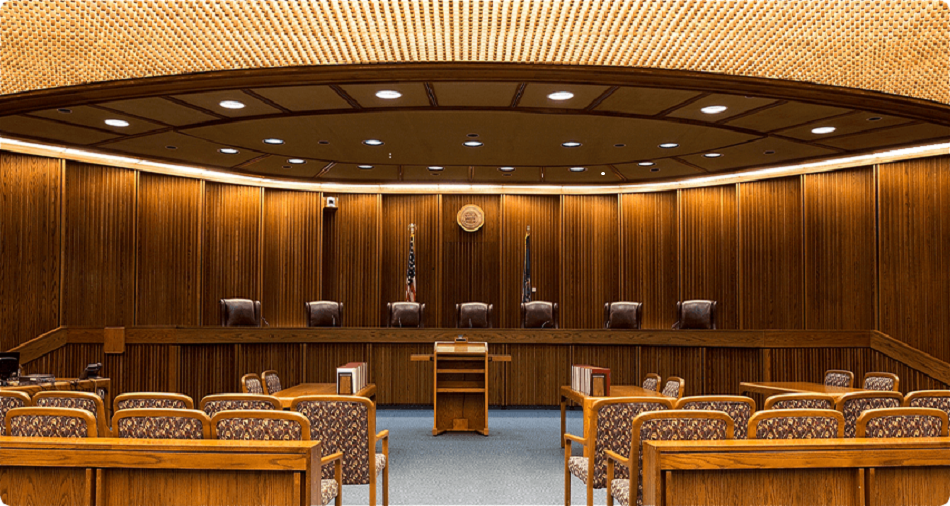
The Kansas Supreme Court on Friday handed down a mixed ruling on new election laws passed by the Legislature with sharp disagreement over how far the state can go in the future to regulate voting under the Kansas Constitution.
The court ruled against a law prohibiting the false representation of an election official, a restriction civic groups said chilled their ability to register voters for fear of prosecution.
The court was more favorable toward state laws limiting collection and delivery of advanced ballots to election offices and imposing new signature requirements for mail ballots.
The court was fractured on the larger question over whether voting was protected as a fundamental right by the Bill of Rights in the Kansas Constitution. Three justices issued separate dissenting opinions that also concurred in part.
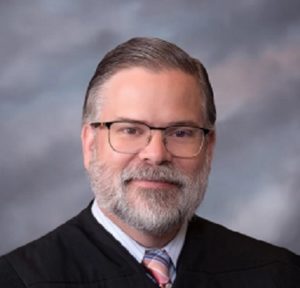
Writing for the four-justice majority, Justice Caleb Stegall said that the Kansas Constitution gives the Legislature the authority to pass “reasonable” laws allowing election officials to determine whether someone is a qualified voter.
He said that included “the ability to require a potential voter to identify himself or herself in some fashion, thereby answering the question, ‘Are you who you say you are, a constitutionally qualified elector?'”
He said the right to vote is not an unenumerated natural right protected by the state constitution’s Bill of Rights. He said the right to vote is specifically protected by a separate part of the Kansas Constitution in Article 5.
“Put simply, if a law violates the article 5 right to suffrage, it is unconstitutional, full stop,” Stegall wrote.
“Just because the right to vote is not protected in our Bill of Rights does not mean that constitutional voting guarantees are somehow weak or ineffective. Quite the contrary,” Stegall wrote.
Voting, he said, is an enumerated “political right” that’s protected by Article 5 of the Kansas Constitution.
“As an expressly enumerated right, Article 5 provides the strongest possible constitutional protections,” Stegall wrote.
“For 140 years this court has recognized that the Legislature violates the Article 5 right…if it imposes any extra-constitutional qualifications to the precisely defined right to suffrage,” he wrote.
The state claimed victory in the overall finding that officials said would potentially keep civic groups from challenging any election law passed to ensure election security.
“The justices got it right,” Secretary of State Scott Schwab said in a statement.
“This ruling allows us to preserve reasonable election security laws in Kansas,” he said.
Attorney General Kris Kobach sounded a similar theme.
“The Kansas Supreme Court’s well-reasoned opinion confirmed that the Legislature has the constitutional authority to establish proofs ensuring that voters are who they say they are,” Kobach said in a statement.
Justices Eric Rosen, Melissa Standridge and Dan Biles wrote separate opinions, highly critical of the majority opinion, saying it left the right to vote vulnerable to restrictions.
“Today, the court majority strips Kansans of our founders’ ultimate promise that the majority will rule and that the government it empowers will answer to its calls,” Rosen wrote in his separate opinion.
“It staggers my imagination to conclude Kansas citizens have no fundamental right to vote under their state constitution,” he wrote.

“Admission to the United States was predicated on a constitutional guarantee of a republican form of government,” he wrote.
“Over 160 years later, this court removes that guarantee. I cannot and will not condone this betrayal of our constitutional duty to safeguard the foundational rights of Kansans.”
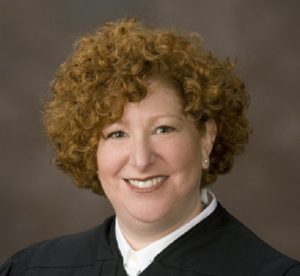
Justice Standridge shared a similar view, calling the majority opinion a “troubling decision with far-reaching implications.”
She compared the reasoning used by the majority to how the U.S. Supreme Court reached its historic decision overturning the right to an abortion.
“The majority paradoxically holds that section 2 of the Kansas Constitution Bill of Rights —which states ‘all political power is inherent in the people, and all free governments are founded on their authority’ — does not, in fact, protect the right to vote as this court has long held,” Standridge wrote.
“In holding section 2 is merely a foundational political idea and not a substantive right to vote, the majority departs from this court’s long-standing precedent recognizing voting as a substantive right grounded in the essence of a republican form of government,” she wrote.
In response, Stegall wrote that the dissenting justices could not point to where the court held that section 2 of the Bill of Rights protected a fundamental right to vote.
“Today’s decision does not conflict with any of our past precedent, though we are more precise and rigorous in how we concretely describe our constitutional provisions and how they function together to guarantee and protect the people’s constituting decision to form a government of limited and delegated powers.”
Stegall added that where popular elections are required, the mode, form and rules governing those elections are constitutionally delegated from the people to their “free government in concrete constitutional commands.”
“While setting forth the specific and required qualifications for all electors in the constitution, the people empowered the Legislature to ‘provide by law for proper proofs of the right of suffrage,'” he wrote.
“One gets the impression reading the dissents that they think of the ‘right to vote’ in talismanic terms, as though it were a kind of superpower of citizenship, to be wielded in times of trouble whenever and wherever desired,” he wrote.
“Our view is both more realistic and practical as well as more legally and constitutionally precise. There can be no ‘right to vote’ unless there is first a ‘right to elect.'”
On the narrower issues of the laws passed in 2021, the justices found that a district court judge erred by denying a request to halt a law prohibiting the false representation of an election official. The court sent that back to the district court for further review.
Four groups – the League of Women Voters of Kansas, Loud Light, the Kansas Appleseed Center for Law and Justice, and the Topeka Independent Living Resource Center – challenged the law. They said it hurt their efforts to educate and register new voters out of fear they could be prosecuted if someone wrongly believed they were election officials
The state had argued the language in the law meant that those groups had to “knowingly” misrepresent themselves as election officials. The court disagreed, finding that the law made “honest speech” criminal.
“We discern from the plain language used by the Legislature that it included no intent to misrepresent or deceive requirement in the statute,” Stegall wrote.
“As such, it sweeps up protected speech in its net. That is, (the plaintiffs are) correct that the law criminalizes honest speech which is “known” to cause occasional misunderstandings or misperceptions on the part of the listener,” the court ruled.
The court noted the civic groups knew from the past that their “innocent acts” had caused people to mistakenly believe they were election officials despite efforts to avoid the confusion.
“The district court thus erred and its faulty statutory interpretation infected each portion of its free speech analysis, and we conclude that it abused its discretion by making an error of law when it denied the…motion for a temporary injunction.”
Martha Pint, president of the League of Women Voters of Kansas, said the law severely limited her group’s ability to help voters.
“The League’s critical voter assistance work is not a crime, and we are confident this provision will be quickly blocked when the case returns to the district court,” Pint said in a statement.
Teresa Woody, litigation director for Kansas Appleseed, praised the outcome but expressed concern that the court ruling didn’t go far enough.
“While Kansas Appleseed is pleased the Court recognized the unconstitutionality of the election impersonation statute,” she said, “we are disappointed that the majority did not find the fundamental protections outlined in the dissent.”
The Supreme Court found in favor of a 2021 law that barred county election officers from accepting advance voting ballots sent by mail unless they verified the signature on the ballot envelope matches the signature on file with the election office.
The court found that the signature verification requirement was a “valid effort” by the
Legislature to pass laws that may be needed to ascertain whether a Kansas resident is entitled to the right to vote.
“It is reasonable for the Legislature to impose such proof requirements,” Stegall wrote.
“It is important for election officials to determine whether a person is who they say they are — which again, is not an extra-constitutional elector qualification, ‘but rather, it is a mode of identifying those who possess constitutionally required qualifications.'”
However, the court sent that back to the district court as well to consider whether the law and its implementing regulations comply with the constitutional guarantees of equal protection and due process.
The court agreed with the state to dismiss a challenge to a law limiting to 10 the number of ballots third parties can collect and deliver to election offices on behalf of someone else.
“The restriction is not a new qualification on the right to be an elector, and because the
proscribed activity — the delivery of ballots — is not political speech or expressive
conduct,” Stegall wrote.
Pint sees the ballot collection law differently.
“Let’s be clear: This law is meant to target the rights of Kansans to make their voices heard The League will continue to empower and aid Kansas voters in whatever way we can.”