


A broader proposal allowing Kansas schoolchildren to use state aid to attend private school was put on the fast track for approval by a House committee Monday night.
The school-choice legislation was sweetened with proposals to add money for special education and teacher salaries in what Democrats described as a cynical attempt to win votes for an unpopular idea.
“What we just saw in there is a continued, unrelenting attack on public schools in the state of Kansas. There’s no other way to say it,” said Democratic state Rep. Brad Boyd, who also sits on the Olathe school board.
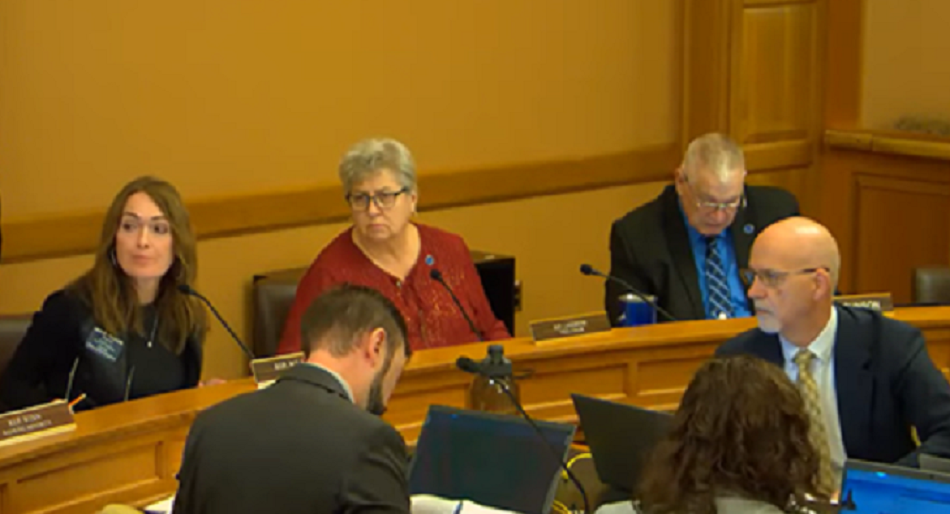
On Monday, the House K-12 Education Budget Committee inserted the school choice legislation – otherwise known as education savings accounts – into another bill that already passed the Senate.
The bill now goes back to the full House for approval. It would skip committee debate in the Senate. The Senate only needs to concur with the bill before it would be sent to the governor, who may very well veto the legislation.
The legislation headed to the full House calls for depositing a student’s state base aid – about $5,100 – into a savings account they could use at a private school.
Opponents of the legislation say it will gut funding for public schools and allow private schools to cherry-pick only the best students from across Kansas.
Supporters see the bill as an attempt to give less affluent students and their parents more educational choice, although critics say the program would be open to more than just disadvantaged students.
The newly written bill directs local school districts to use half of their $174 million increase in new state base aid for 2024 for teacher salaries.
It was estimated that the average increase per teacher under the bill would be about $2,020.
The increases are not to supplant any teacher salaries that have already been negotiated with school districts for 2024.
The committee also added $72 million for special education, something that Democrats have been working for throughout the session.
The program would not start until the 2024-25 school year, but students could start applying for the program as early as 2023.
The bill that emerged from the committee drew strong criticism from Democrats because of how it wrapped teacher pay raises and special education funding with the school choice program.
“This is no way to make policy in a K-12 budget committee,” said Democratic state Rep. Jarrod Ousley of Merriam.
The move was also criticized by Democratic state Rep. Mari-Lynn Poskin of Leawood, one of the more vocal critics of the school-choice bill.
“I resent the committee putting good policy that we all support and know needs to be done in the state to a voucher bill that will still be a voucher bill and undermine our public schools,” Poskin said.
Republican state Rep. Kristey Williams, chair of the K-12 Education Budget Committee, rebutted the criticism.
Williams said she didn’t see a problem with rolling legislation together that many lawmakers could agree on.
“I think it is good policy to pair things we believe in,” Williams said after the committee meeting.
“I believe in our students and I believe in giving them the best shot for success, and that sometimes includes a variety of other funding options,” she said.
Williams said Gov. Laura Kelly should sign the bill into law.
“It’s best for kids, and I think she’ll want to do what’s best for kids,” Williams said.
“The bottom line is this: We live in the 21st century, where we need to provide a variety of options for our kids. Not every kid is going to excel in a public school or a private school. We need schools that fit their needs,” she said.
“I think she would want to recognize that matching a student with the right environment, with the right teacher, with the right type of instruction, with the right interest of that child is really important.”
There was a lack of clarity about how much the bill would cost, especially after provisions were added for funding special education and increasing teacher pay and phasing in participation of private school students.
It was originally loosely estimated that the bill could cost the state $151.9 million a year based on certain assumptions, such as all 26,000 accredited private school students taking advantage of the program.
The fiscal analysis indicated that for every 1% of the state’s 484,000 public school students participating in the program, or 4,840 students, about $24.6 million would be transferred out of the state budget to pay for private-school tuition.
Williams told the committee that the fiscal analysis was “structurally flawed” because the estimate was made before the bill was amended in committee and made assumptions using data from other states.
Williams also said there would be money saved from students not attending public school.
Democratic state Rep. Valdenia Winn of Kansas City suggested there was uncertainty about the cost of the program.
“There’s not uncertainty. It’s just math,” Williams said.
Winn pressed again, asking if anyone calculated the math.
“Actually, I have,” Williams said. “That’s not part of working the bill.
“The fiscal note is not part of the bill, so it’s not something that we go into.”
There is still another school-choice bill in the wings that would expand a program making tax-subsidized scholarships available for more students to attend private schools.
Currently, the scholarships – limited to $8,000 a student each school year – are available to students who are eligible for free and reduced lunches and are enrolled in any public school in Kansas.
The program gives up to $10 million a year in state tax credits to entice businesses and individuals to donate money to a scholarship program for private schools.
A donor to the program now gets a 70% tax credit on their individual or corporate income taxes with contributions from a single taxpayer capped at $500,000.
The tax credit would be increased to 100% under the bill sitting in the House K-12 Budget Committee.
The new plan also expands student eligibility for the program to include being from a family with an income less than 250% of the federal poverty level.