




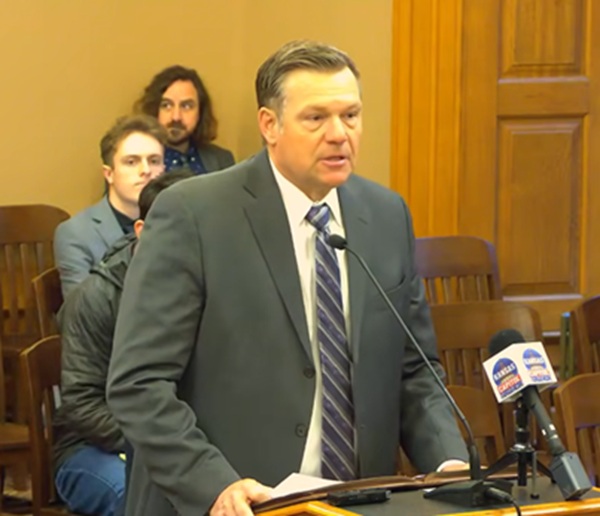
Republican Attorney General Kris Kobach on Tuesday urged Kansas lawmakers to pass a law that would force Gov. Laura Kelly’s administration to supply food-assistance information sought by the federal government.
Kobach testified on behalf of a bill requiring the state’s social services secretary to respond fully to any written request for information from the U.S. Department of Agriculture, which oversees the food-assistance program.
The USDA is demanding that Kansas and other states provide records identifying applicants or recipients of food assistance such as names, birth dates, addresses and Social Security numbers. The USDA has suggested the request is intended to root out fraud and abuse.
The Kelly administration has been steadfast against turning over the information, saying that state and federal law protect personal identifiable food assistance data except when necessary to administer the program.
“I think the Kansas Legislature back a couple decades ago, several decades ago probably never imagined that you would have an environment in which the governor of the state of Kansas would be refusing to provide a list of the people that get this data,” he said.
“This is all about preserving the Legislature’s will,” he said in an appearance before the Senate’s government efficiency committee.
“The Kansas Legislature, your predecessors, decades ago said, ‘Yeah, whenever the federal government requests data, cough up the information,'” he said.
The USDA has already threatened to withhold $10.4 million a quarter from the state in food-assistance administration funds until Kansas complies with the information request.
The Kelly administration is now appealing that decision, an action that effectively stops money from being cut off until the dispute is resolved – a point that USDA agreed with in a separate court filing in a similar legal dispute in California.
There is a hearing on the state’s appeal on Feb. 17. Kobach predicted the state will lose an appeal to the very federal agency that is threatening to withhold the funds.
Kobach said the bill makes it explicit the secretary of the Department for Children and Families must comply with written requests for records from federal agencies that oversee state benefit programs.
“With this simple change, there will be no question what DCF is required to do — which is to do what the Legislature always intended — to keep Kansas compliant with these federally funded benefit programs so the neediest families in Kansas don’t lose their benefit,” he said.
Fiscal analysts said the cost of complying with a data request would depend on the specific request.
Each data request could require different levels of effort and assistance dependent on the items such as the frequency of the requests, where data for the request is maintained and the time frames covered by the requests.
It is estimated contractor-assisted data extracts could cost between $50,000 and $300,000 per request
Kobach suggested the Kelly administration has an ulterior motive in not turning the data over to the federal government.
“You can ask them, but I’m almost certain they don’t want to share it with the Justice Department so that a (food assistance) recipient who is fraudulently getting this money could be prosecuted,” Kobach told senators.
“They probably don’t want to share it with the Department of Homeland Security where an illegal alien or a temporary alien who is illegally getting the money could be removed from the country,” Kobach said.
The bill comes months after the attorney general took Kelly to court to force her to turn over personal data for the federal food-assistance program to President Donald Trump’s administration.
Kobach accused the governor and state social services Secretary Laura Howard of violating a state law requiring Kansas to make available any reports sought by federal agencies when Kansas participates in a federally funded assistance program.
He also argued that the Kelly administration’s refusal to provide the data to the federal government violates the Kansas Constitution because it could lead to the termination of the food-assistance program.
Shawnee County District Judge Teresa Watson denied the attorney general’s request.
Watson ruled that the lawsuit wasn’t ripe and that state law did not dictate a specified or clearly defined legal duty on the part of the Kelly administration to comply with the request for the information.
Kobach said the ruling in Shawnee County District Court was rooted in loose wording that helped hand the governor a victory in that case.
“It is a very strange position to be put in where the state is clearly breaking federal law and breaking Kansas law,” he said.
“As attorney general, I’m simply trying to get everybody to follow the law,” he said.
“This clarifies the law so that there’s no wiggle room.”
The Kelly administration, meanwhile, is pressing ahead with its appeal.
In appealing the Trump administration’s decision to withhold millions from the state for not turning over the data, Kelly’s legal team focuses on a rule allowing the federal government to share the information with other agencies, including foreign governments.
In legal parlance, the rule is known as Routine Use 8.
The rule says that when a record on its face – or in conjunction with other records – indicates a violation or potential violation of law, the USDA “may disclose the record to the appropriate agency, whether federal, foreign, state, local, or tribal…”
“The governor’s administration has been repeatedly raising concerns about the legality of the USDA’s data request as it pertains to the ‘Routine Use 8′ provision which includes sharing Kansans’ personal private data, including full social security numbers, with foreign entities,” said the governor’s spokesperson, Olivia Taylor-Puckett.
“It is both disappointing and disturbing that the attorney general still doesn’t know the basic issues with the USDA’s request.”
The Kelly administration argued that the USDA is required to adhere to a federal court ruling from last October that blocked the agency from acting on warning letters threatening to withhold money for food assistance from states refused to turn over information sought by the agency.
The judge found that 22 states – not including Kansas – were likely to show that federal law prohibits them from disclosing the information demanded in the formal warnings threatening to withhold the food-assistance money.
While the court ruling does not apply to all judicial districts, Kelly administration lawyers say that it should apply to the appeals board.
In the California case, U.S. District Judge Maxine Chesney found that when a state provides information under the law cited by the federal government, the recipient is subject to strict limits on how the information is used.
And the states in that case argued the USDA had announced its intent to use the information in ways beyond those permitted under the law.
In particular, USDA said it had the right to disclose the data to a number of entities, including those not administering assistance programs, and for purposes other than the administration or enforcement of the programs, the judge wrote.
The agency said that when a record indicated a violation of the law, the document would be turned over to the appropriate agency, “whether federal, foreign, state, local, or tribal” for enforcement, investigation or prosecution.
The judge wrote that plaintiff states are required by the food-assistance program to safeguard information they obtain from applicant households and are permitted to disclose the information for limited purposes set out by law.
In subsequent court filings, USDA said it does not intend to use or share information outside the agency for purposes other than administration and enforcement of the law governing the food-assistance program.
The agency said it would employ Routine Use 8 for the purpose of “ensuring the integrity of government programs,” including the verification of food-assistance eligibility against
federally maintained databases.