



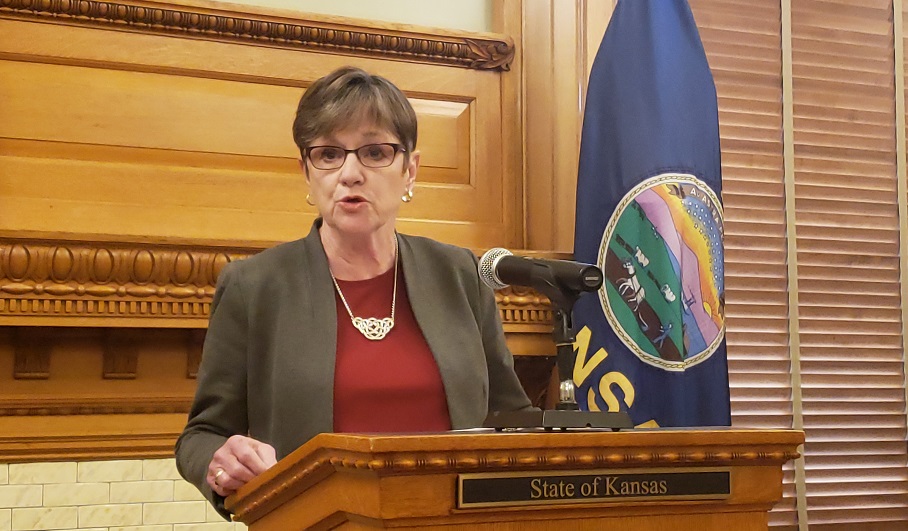
Gov. Laura Kelly on Wednesday signed the new education budget but vetoed a provision allocating $5 million for school grants to equip buildings with surveillance cameras with artificial intelligence that can locate people carrying guns.
Kelly vetoed part of the budget for the surveillance equipment that she said was essentially written to be a no-bid contract with criteria that eliminated nearly all potential competition.
The governor retained the $5 million for school security grants but vetoed how the money would be used for the surveillance cameras, drawing a protest from the chair of the House K-12 Education Budget Committee.
The company that would have met the criteria has been identified in news reports as ZeroEyes of a Conshohocken, Pennsylvania, although the education budget committee chair said there were other companies that could have been eligible for the business.
The new education budget spending allocates $6.6 billion for public education, including $4.9 billion from the state general fund. The budget includes $75.5 million in additional funding for special education state aid.
“This funding will provide critical support to districts that have been shouldering the burden of the state’s decade-long failure to meet its statutory obligation to fully fund special education,” the governor said in her message to the Legislature.
“Investing in special education serves all students as it reduces the amount of general education funds that must be transferred to cover special education costs,” Kelly said.
“This means districts can now consider increasing teacher salaries, expanding career and technical education opportunities, and supporting enhanced literacy instruction.
“While this funding is a critical first step, it is just a first step. We must continue to increase special education funding in future years.
“I appreciate the Legislature’s willingness to collaborate on this funding increase and look forward to their continued commitment to our special education students and educators.”
House Republicans celebrated the signing of the bill, saying it adds more than $300 million in new funding for elementary and second education.
“The work done to bring this bill to fruition truly highlights the legislature’s continued commitment to fully funding Kansas schools, an integral part of our Kansas communities,” House Speaker Dan Hawkins said in statement.
“We focused on crafting increased school funding that better addresses the needs of our Kansas students and our dedicated teachers and staff members,” Republican state Sen. Molly Baumgardner, chair of the Senate education committee.
“Our commitment to distributing increased special education funding in a more equitable way to Kansas school districts was accomplished by collaborating directly with the Department of Education leadership team,” Baumgardner said.
“This is an important change for children that receive these special services.”
In recent days, the $5 million allocated for gun surveillance has drawn national media attention.
The Associated Press reported over the weekend that the appropriation had become emblematic of how school security has become big business and that some firms were getting lawmakers to write their products into state law.
The AP reported that the firm ZeroEyes “appears to be the only firm qualified for state firearms detection programs under laws enacted last year in Michigan and Utah, bills passed earlier this year in Florida and Iowa and legislation proposed in Colorado, Louisiana and Wisconsin.”
Last week, The AP reported that Missouri passed legislation tailored to ZeroEyes with $2.5 million in matching grants for schools to buy gun-detection software that is “qualified anti-terrorism technology.”
“We’re not paying legislators to write us into their bills,” ZeroEyes co-founder and Chief Revenue Officer Sam Alaimo told The AP.
“But if they’re doing that, it means I think they’re doing their homework, and they’re making sure they’re getting a vetted technology,” he told the news service.
The governor said the measure in the Kansas budget would have significantly altered the current School Safety and Security Grant program, which the Legislature created in 2018 after the mass shooting at Marjory Stoneman Douglas High School in Parkland, Florida.
In 2023, the state Department of Education received proposals from 188 districts totaling about $14.4 million for the program funded by the Legislature.
The money could have only been used for security infrastructure, security technology, communications for security, new school resource officers and Narcan kits that can be used to reverse the effects of an opioid overdose.
The safety grants had a dollar-for-dollar match requirement.
“If enacted, schools would not be able to use these funds to invest in other school safety efforts, like purchasing updated communications systems, hiring more security staff, and making investing in physical infrastructure,” Kelly said in her veto message.
“While the goal of this provision to provide schools with the opportunity to secure new weapon detection systems is laudable, districts should be provided with the flexibility to use these funds to address needs that are of utmost priority to student safety.”
The governor urged the State Department of Education to direct the $5 million to school districts for the purchase of automated external defibrillators and the other allowable uses that were previously approved for the program.
In March, the K-12 Education Budget Committee agreed to direct $5 million specifically for ZeroEyes, but the company’s name was later removed from the education budget as it moved through the legislative process.
Republican state Rep. Kristey Williams, chair of the K-12 Education Budget Committee, said it was not constitutional for the governor to keep the money but veto how the Legislature had decided to use the funding.
“She would be violating the intent of the Legislature that voted for this with an overwhelming majority by dictating to the Department of Education that they should use last year’s proviso language that is not in statute,” Williams said.
Williams disputes the idea that the money is for a no-bid contract, saying there are other companies that could comply with the criteria to provide the equipment.
“Yes, it does have very strict requirements, but we know that more than one company does qualify. It is not a no-bid contract,” she said.
“We want the very best for our kids, so having the bar set high should be everyone’s goal,” Williams said.