






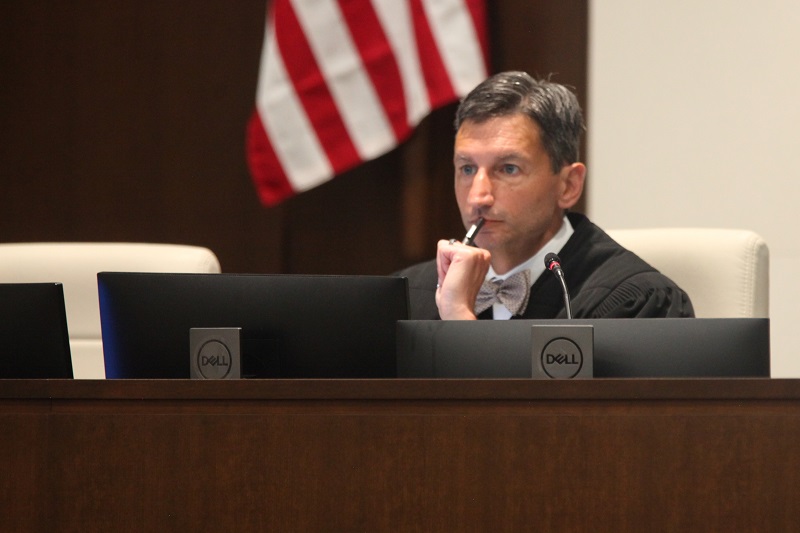
(Developing: Will be updated as warranted)
A Johnson County judge who was just appointed to the Kansas Supreme Court has permanently blocked the state’s 24-hour waiting period for abortions as well as a recent law requiring physicians to notify women that their drug-induced abortion can be reversed.
He also blocked portions of state law requiring abortion clinics to ask women why they are getting an abortion as well as other provisions of state law requiring providers to describe to patients the risks related to the procedure such as premature birth or breast cancer.
The law required the information to be provided on white paper in a printed format in black ink with 12-point times new roman font.
The ruling was filed at 4:50 p.m. on Monday, the same day he was sworn in as a new justice on the Kansas Supreme Court. The court announced the swearing-in via an email sent at 6:55 p.m.
The timing of the ruling angered supporters of the law given that Kansas voters are deciding on a constitutional amendment that calls for electing justices to the Kansas Supreme Court.
Jayaram found that parts of the state’s abortion law ran afoul of the Kansas Constitution because they “violate the inalienable natural and fundamental rights of Kansas women to exercise her bodily autonomy with respect to her pregnancy…” He also found that the laws in question violate the plaintiffs’ right to free speech.
He left intact parts of the law that require the state health department to post information from the surviving parts of the Womens’ Right to Know law, including the abortion-reversal language. Clinics can’t be required to provide that information to patients under the ruling.
“This court has great respect for the deeply-held beliefs on either side of the broader and contentious social issues presented in this case,” Jayaram wrote in 261-page opinion.
“Nevertheless, the court is obligated and charged with applying binding Kansas law to the facts of the case,” he wrote.
“And, indeed, as the court indicated when ruling on the prior request for a temporary injunction, the state’s capacity to legislate pursuant to its own moral scruples is necessarily curbed by the Kansas Constitution and its Bill of Rights.
“The state may pick a side and a viewpoint, but in doing so, it may not trespass upon the inalienable natural and fundamental rights of the people,” he wrote.
“In this case, the record before the court clearly and unequivocally demonstrates that the subject laws impair and unconstitutionally
infringe upon Kansans’ natural and fundamental rights” under the state constitution.”
In his opinion, Jayaram questioned the scientific credibility for some of the disclosure requirements about fetal pain and that women would be at risk for cancer if they get an abortion.
Kansans for Life said the ruling would strip away “commonsense protections that had been in place for nearly 30 years and helped ensure women received the information they needed before making a life-altering decision…”
Abortion rights supporters praised the decision.
“Kansans were resolute when they voted to preserve abortion rights, and today’s victory is a reflection of their will,” said Alice Wang, senior staff attorney at the Center for Reproductive Rights.
“Restrictions like these only exist to push abortion care out of reach. And as we’ve seen across the country, people are dying because of delays in accessing essential health care,” Wang said.
“Still, politicians have repeatedly ignored this reality and their voters as they continue to push for harmful laws. We will continue to defend democracy and freedom in Kansas,” she said.
Three years ago, Jayaram issued a temporary injunction preventing the state from enforcing broad sections of the Women’s Right to Know law, which was first enacted in 1997 and has been amended six times since.
Jayaram’s decision came seven years after the Kansas Supreme Court found that the state constitution protects the right to an abortion, a decision that was upheld by voters in 2022.
The court’s 2019 decision has been an issue in the ongoing debate over whether Kansans should approve a constitutional amendment calling for the election of justices to the Kansas Supreme Court.
Coincidentally, the court’s decision was made public as Kansas voters were deciding the fate of the amendment on Tuesday, infuriating supporters of the law.
Brittany Jones, president of the Kansas Family Alliance, said Kansans should be furious with the timing of the decision.
“On the literal eve of an election that could fundamentally change how the Court is selected, the newest Supreme Court justice selected by this lawyer-control commission revealed just how political he is,” Jones said.
“Mere hours before being sworn in, he released a 261-page opinion on a very important and controversial topic–whether women deserve informed consent before an abortion.
“This trial ended over ten months ago. We were promised all spring the opinion was coming at any time. He clearly did not want the people of Kansas to know about this decision before they voted today.
“And now this man sits on the highest court in our State. The current process does not produce the kind of justices that reflect the people of Kansas. It is well past time for us to return to directly electing our justices,” she said.
Jayaram concluded that the abortion law in question failed to meet the constitutional burden of strict scrutiny because it affected fundamental rights.
“Kansas law sets a high bar for the Legislative branch to justify such regulatory mandates, and the prevailing law requires protection and analysis using a “strict scrutiny” standard,” he wrote.
“In the final analysis, the state defendants simply failed in their obligation to clear that high bar to justify such intrusive legislative mandates. It is not, in this Court’s view, even a close call, based upon the record before the court,” he wrote.
“Because a woman’s right to bodily autonomy (including her right to decide whether to terminate or to continue a pregnancy) is fundamental, the court concludes, given the overwhelming evidence adduced at trial, that the State’s rationale and legislative schemes…simply do not, in significant part, survive constitutional scrutiny,” he wrote.
The court’s decision was welcome by abortion-rights advocates.
“This ruling reaffirms what Kansans have made clear time and again: the Kansas Constitution protects the fundamental right to make personal decisions about pregnancy and abortion without political interference,” said Emily Wales, president and CEO of Comprehensive Health of Planned Parenthood Great Plains.
“This decision provides greater certainty for patients, providers, and communities. It allows us to keep investing in Kansas by strengthening our health center infrastructure and ensuring that every patient who relies on our team for care can continue to access compassionate, high-quality reproductive health care now and into the future,” she said in a statement.
Abortion providers brought a lawsuit in state court in 2023 after the Legislature enacted a state law requiring physicians to notify women that their drug-induced abortion can be reversed. They used their lawsuit as a springboard to contest an overall law requiring them to provide women with other information about the procedure.
The lawsuit pointed to the 2019 state Supreme Court case, which found that the state constitution provides a right to an abortion. The lawsuit also noted that voters rejected a proposed constitutional amendment that would have reversed that ruling.
The lawsuit targeted a law passed over Gov. Laura Kelly’s veto requiring physicians to notify women that their drug-induced abortion can be reversed.
The bill – referred to in the ruling as the APR mandate for “abortion pill reversal” – was based on the idea that a medical abortion could be stopped halfway through a two-drug regimen.
The law created a civil cause of action for health care providers that did not comply with the requirement.
“The overwhelming majority of that new enactment is targeted at provider obligations to inform their abortion patients (and frankly anyone entering their offices, whether they are there for an abortion or not) of the existence and particulars of this unproven theory that the state wishes to espouse as mainstream medicine,” Jayaram wrote.
“The overwhelming majority of the APR Mandate seeks to compel providers to speak on such issues and tacitly endorse this unproven theory that endangers women, and it seeks to punish or chill those that refuse to comply by way of its various civil, criminal, and administrative penalties,” he wrote.
“This court has grave reservations and concerns about the use of APR theory, having carefully considered the available credible medical evidence. It is a statutory scheme that, more likely than not, makes pregnant women less safe and less knowledgeable —not more.
“However, the issue of whether this is a good policy choice or a suspect one is better left to the Legislature and our elected representatives in that branch of government — to the extent that it is exercised through voluntary dissemination and does not otherwise infringe upon the fundamental rights of Kansans or those within its borders seeking care.”
He also was critical of other parts of the law, including requirements that clinics notify women that an abortion would make them at risk for getting cancer.
“The mandated disclosures regarding risk of breast cancer and preterm birth in future pregnancies are medically inaccurate and misleading, as there is no credible scientific evidence that abortion causes an increased risk of such conditions.”
He also said that disclosures suggesting that fetuses can feel pain at 22 weeks are irrelevant to plaintiffs’ abortion patients, whose pregnancies measure no later than 21 weeks and six days.
“The disclosures about fetal pain are also medically inaccurate, and misleading,” he wrote.
He said that pain, as defined by the International Association for the Study of Pain, is “an unpleasant sensory and emotional experience
associated with, or resembling that associated with, actual or potential tissue damage.”
He said that under that definition consciousness is required to feel pain and that consciousness cannot occur until the necessary connections of pain fibers to the cortex have developed, which does not occur until at least 24 weeks.