





A Saline County judge has dismissed a lawsuit challenging a state law that bans “fusion candidates” who could represent more than one party on the ballot, saying Kansas has the right to keep elections free of potential misconduct.
District Judge Jared Johnson ruled against the lawsuit brought by United Kansas Inc. and others, saying the state’s interests in keeping elections free of manipulation outweighs any burden the law might impose on political parties.
“Kansas anti-fusion laws impose reasonable modes of voting,” Johnson ruled.
“Nothing in the law prevents UKP, or any other political party, its candidates or its voters from associating with each other or nominating one of their own to appear on the ballot.
“Kansas anti-fusion laws impose reasonable modes of voting and are not an abuse of power, “Johnson ruled.
The lawsuit argued that the 1901 state law banning fusion voting violated the state constitutional guarantees of freedom of speech, freedom of association and equal protection.
“The notion that the state could prevent two groups of voters from supporting the same candidate under their respective party labels would have been unfathomable when
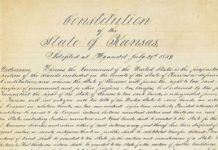
the Kansas Constitution was ratified in 1859,” the lawsuit claimed.
The party said it would appeal the district court ruling.
“Any law invalidating our nominees undermines the fundamental rights of candidates to associate with the parties of their choice, and of parties and voters to choose their preferred nominees,” said party chair Jack Curtis.
“We respect the court’s decision, but disagree with the outcome,” Curtis said. “We’ll be filing our appeal right away to ensure the rights of our party, our candidates, and Kansas voters are respected and the Kansas Constitution is honored.”
Fusion voting allows multiple parties to nominate the same candidate for the same office in a general election with all the votes added together for a final tally.
While the two major parties nominate different candidates, third parties may cross over and endorse one of the major party candidates and “fuse” with them.
Organizers of the effort said fusion voting could help moderate Kansas politics and drive the state more to the political center.
Johnson’s opinion was predicated on a 1997 U.S. Supreme Court case that found Minnesota’s ban on fusion voting didn’t violate association rights under the First and 14th Amendments of the U.S. Constitution.
Johnson found that the fusion voting “incentivizes mischief” by allowing candidates to appear on the ballot multiple times as the nominee of different parties.
For example, Johnson said a major political party could create multiple minor parties to have its candidate appear multiple times using “valuable ballot real estate to promote their platform.”
Similarly, a fringe candidate could obtain multiple minor party nominations that suggest they have more widespread support than exists.
“The state has a strong interest in procedures that avoid, or at least minimize, the potential for gamesmanship at the nomination stage and improperly inflate their party’s support,” Johnson ruled.
“Rolling the clock back 125 years to a time when fusion voting was allowed would allow a minor party to circumvent the rule for obtaining the status of a major political party.”
He said a minor party could get around a state law that requires it receive at least 5% of the total votes cast for all candidates in a primary election to avoid its loss of party recognition by cross nominating major party’s candidates.
“It is difficult for this court to see a scenario where fusion voting would not cause voter confusion, at least for a time,” Johnson wrote.
“Fusion voting has been banned in Kansas for over 120 years, and is the exception, not the rule, across the country,” he wrote.
“Common sense would dictate that voters are not used to seeing candidates endorsed by multiple parties during a campaign or on the ballot.”
The issue of fusion voting dates back more than 100 years in Kansas when the Populist Party and the Democratic Party would nominate the same individual to the same office.
After the Republicans swept the November 1900 election, in the 1901 session, they immediately enacted legislation to prohibit “fusion tickets.”
They barred anyone from accepting “more than one nomination for the same office” and said that “the name of each candidate shall be printed on the ballot once and no more.”
At that time, the candidates were nominated by convention, so the two political party leaders could agree on a fusion ticket.
The state has a law on the books that says a candidate’s name can only appear in the ballot once, which the lawsuit contended was unconstitutional.
Fusion voting is a creature of the 19th century when it was a part of U.S. politics, particularly in the West and Midwest, according to a 2020 Idaho Law Review article exploring the issue.
“By fusing with one of the major parties, third parties were able to influence election results and thus public policy,” the law review found.
“At that time, the process of voting was different. Prior to the 1890s, citizens voted by dropping a ballot listing the candidates they had chosen in an actual ballot box.
“Typically, political parties printed the ballots which listed the party’s slate of candidates, although sometimes voters would create their own ballots.
“Under this system, the state did not participate in the determination of what groups constituted political parties or what candidates they could nominate.
“Parties that wished to fuse could lawfully list the same candidate on their ballots. And, in fact, cross-endorsing was an important part of the system.”