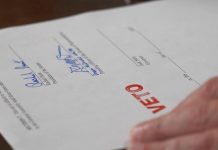






Gov. Laura Kelly has granted clemency to seven Kansans, issuing pardons to five and commuting the sentences of two others who she said demonstrated “strong signs” of rehabilitation.
“Granting commutations and pardons is not something I take lightly,” Kelly said in a statement.
“By vetting numerous applications through a careful and thorough process, it was determined that these individuals have demonstrated their commitment to making amends and positively contributing to society,” the governor said.
The governor last granted clemency in 2021 when she issued three pardons and commuted sentences of five others.
This week, the governor commuted the sentence of Lauren M. Holle, who has been in prison since September 2010 after she was convicted on charges related to the death of her newborn child in Marshall County in 2009.
She has already served 169 months of her 233-month sentence, and her earliest possible parole would be in January 2027.
Holle has already served more time than if her sentences on three separate charges had run concurrently rather than consecutively.
Documents with the commutation said Holle has paid “her debt to society and has shown that continued incarceration no longer serves the interests of justice and is therefore, no longer appropriate.”
The Fort Scott Tribune reported that on June 16, 2009, Holle gave birth to a child, wrapped it in a plastic garbage bag, and stored the baby in her vehicle’s back seat.
The newspaper reported that when her family sought medical attention for Holle because of bleeding, she gave physicians information leading to discovery of the baby in the car.
The newspaper reported that the coroner said the child was born alive but died because of a lack of proper care.
In other clemency actions:
Pardoned Jose Arellano, who was convicted in 2009 in Sedgwick County for possession of opiates, transporting an open container and failure to provide proof of liability insurance. He was sentenced to 12 months of probation. The charges have been expunged.
Pardoned Stephen P. Gontz, who was convicted in 2000 in Geary County of battery and intimidation of a witness. He was sentenced to 12 months of probation. Gontz has completed his sentence and the charges have been expunged. The governor cited his service in the military and good conduct during the last 25 years in granting the pardon.
Pardoned Jeffrey J. Gronewaller, who was convicted in 2001 in Reno County for theft. He was sentenced to 12 months of probation. Gronewaller also was convicted in 2008 in Reno County for forgery and conspiracy to commit forgery. He was sentenced to 18 months of probation. The forgery case has been expunged.
Pardoned James Valentine, who was convicted in 2004 in Harper County for aggravated indecent liberties with a child over 14 years old and less than 16 years old. He was sentenced to 36 months of probation. He was convicted in 2014 in Butler County for violating of the Kansas Offender Registration Act. He was sentenced to 24 months in prison. In pardoning Valentine, documents prepared by the governor’s office said Valentine “has committed his life to serving our country in the United States Army, and is now a decorated Army veteran, having received numerous honors and achievements for his service in Iraq and Afghanistan, including two Army Commendation Medals.” He was pardoned in both cases.
Pardoned Scottie Way, who was convicted in 1989, in Finney County for arson and two different counts of criminal damage to property. He was sentenced to four years probation. He also was convicted in 1992 in Finney County for burglary and was sentenced to 24 to 72 months in prison. Way has completed his sentences, and the cases have been expunged.
Commuted the sentence of DeShaun Durham, who was convicted in 2022 in Riley County for possession with intent to distribute marijuana. He was sentenced to prison for 92 months with three years of post-release supervision. Durham was 20 and had no prior convictions at the time the offense occurred.
The governor considered various factors to determine if the commutations and pardons were warranted, including but not limited to the nature of the offense, harsh sentences and the impact of the crime on victims or survivors.
She also considered demonstration of rehabilitation, criminal history, absence of disciplinary issues in prison, positive achievements and growth while incarcerated, and the ability to contribute to society following release.