



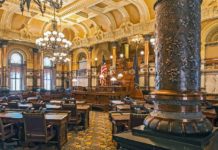



Gov. Laura Kelly’s nominees to the Kansas Board of Regents were sidetracked Monday when they were sent back to committee for more hearings.
Senate President Ty Masterson sent the nominations of former BNSF Railway executive Carl Ice, former Kansas City Kansas Schools Superintendent Cynthia Lane and Lawrence attorney Wint Winter Jr. to the Education Committee for more vetting.
The nominations had already cleared the Senate Confirmation Oversight Committee last summer, but senators had more questions, although any lingering concerns were not clear late Monday afternoon.
“A few senators had additional questions,” Masterson’s spokesman, Mike Pirner, said in a text message.
“Given the importance of the Board of Regents, the Senate is doing our due diligence by allowing the Education Committee to thoroughly review the nominees prior to a vote to confirm,” Pirner said.
All three nominees faced a hesitant confirmation panel last June when they were asked a variety of questions about their views on critical race theory and their political history. The panel waited two days before signing off on them unanimously.
Last summer, senators on the confirmation oversight committee expressed reservations about candidates’ views on critical race theory and their political involvement but let the nominations move forward.
At that time, Masterson acknowledged there were “some remaining lingering concerns,” but added there was effectively a trial period between June and when the full Senate had to sign off on the nominees this year.
There was no indication of whether the nominations being sent back to committee was a sign that they were in trouble, although it’s a rare move to send them back to committee for more hearings.
The governor’s office was not ready to comment on the procedural move.
But Senate Minority Leader Dinah Sykes said she didn’t see the need for sending the nominees back to committee, stressing that they already had passed out of the confirmation oversight committee unanimously last year.
“My colleagues are perfectly capable of reviewing those hearings, asking members of the committee about their experience, and meeting individually with the nominees before casting their vote,” Sykes said.
“This is an unnecessary and problematic pattern legislative leadership is enabling, and if we continue harassing these nominees and creating hurdles for them, we are not going to have qualified candidates willing to serve the people of Kansas.”
Republican state Sen. Molly Baumgardner, chair of the Senate Education Committee, said the follow-up hearing was a matter of asking “some clarifying questions” and to go back through their applications.
“Leadership is just wanting the Education Committee to circle back around and hear from the candidates again,” Baumgardner said
“I think there are just some questions to get some things clarified.”
Last summer, Winter faced questions about his political activities, although there’s no indication of whether that’s at issue now.
Winter has served as chair and secretary/treasurer of the Save Kansas Coalition, a 501(c)(4) nonprofit that raised money to oppose conservatives.
State records show that Winter started the group along with former Senate President Steve Morris in 2016. The group had the same address as Winter’s law firm.
Winter acknowledged last summer that he was still on the board of directors of the Save Kansas Coalition but said the group hadn’t met in more than a year.
He told senators in June that the group had a vote about 1 1/2 years ago to end all activity and wind down the organization.
During last summer’s confirmation hearing, Masterson quizzed each of the regents candidates about their views about critical race theory.
In answering the question, Ice told lawmakers he would listen, learn and engage people on the topic.
“I think that’s the right way to do things,” he said. “My first answer about something like this, sort of starts with that.”
Ice said when the issue comes up, he thinks about diversity and inclusion.
“Diversity and inclusion is important to me, to my family, to BNSF, to other businesses, to higher education, to people,” Ice said. “It is personal.”
The same question was asked of Lane.
Lane said the language of critical race theory was relatively new to her and she needed to understand more about the specifics of the debate.
She said educators need to ensure students graduate with an understanding of how to function in a diverse community by being critical thinkers, skilled problem solvers and effective communicators.
“These are the kinds of things I believe we should focus on together,” she said.
Winter said critical race theory should not be taught in state universities.
“Where we have the opportunity to teach not theories, but facts, we should teach facts,” Winter told legislators.
“In my view, we do in our society need to continue to fight for equal rights, but I think that will best be advanced by teaching the factual history of the long struggle in this country for equality,” he said.