



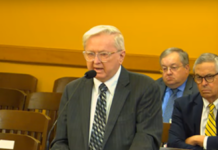



Republican state Sen. Mike Thompson’s drive to put limits on renewable energy development in Kansas is running out of gas.
Thompson, a critic of renewable energy, started the session introducing more than a half dozen bills aimed at limiting renewable energy development.
Thompson’s goal was to put restrictions on an industry he believes is imposing its will on communities across the state, although critics said the bills were flawed and would shut down an industry based on unsound science.
It wasn’t a new issue for the Kansas Legislature, but it may end the same.
As the Legislature reached its halfway point, many of Thompson’s bills have stumbled as they failed to get out of committee.
While no proposal is every truly dead in the legislative process, his proposals are now facing much longer odds than they did at the start of the session.
Out of the eight bills Thompson introduced this year, two are still alive: one ending the property tax exemption for new renewable energy developments and another bill requiring turbines to be fitted with light-mitigating technology.
The wind industry has fought back vigorously against Thompson’s bills, saying the restrictions would kill off an enterprise that’s invested $14 billion and made $1.6 billion over 20 years in payments through community contributions, taxes and landowner leases.
“There are eight pieces of legislation, which collectively are punitive and halt renewable energy development in the state of Kansas and even individually halt renewable energy in the state of Kansas,” said Kimberly Svaty, director of the Kansas Advanced Power Alliance.
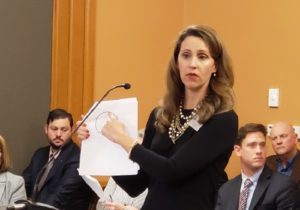
“It’s not so much that the concept is problematic,” she said, “it’s that there are poison pills embedded in the various bills that individually makes them extremely problematic.”
Thompson’s efforts were hardly a surprise given that the wind industry spent more than $100,000 trying to beat him in the 2020 election.
Thompson acknowledged the difficulty he’s faced recently on Facebook.
“I have been working to set safety standards for the past two years…and keep running into stiff opposition from the wind companies and their lobbyists and attorneys,” Thompson posted last week in a call to action on Facebook.
“Folks…you need to get educated on this stuff or the entire state will end up as one giant industrial wind and solar farm…and it will be too late,” Thompson posted Friday.
In an interview, Thompson, who doesn’t believe that human activity contributes to global warming, acknowledged that no bill may pass this year.
“I think it’s an education thing,” Thompson said.
“I’m willing to stay the course,” he said. “I’m not going to give up. I realize there are some people who just want status quo, but we’ve got a problem.
“I’m going to work until I start finding some solutions or get the parties together.”

Thompson’s efforts aren’t new to the Kansas Legislature.
Three years ago, the House utilities committee held several days of hearings on similar restrictions, which ultimately failed under a torrent of criticism that the bill was vague and stepped on the rights of property owners, among other issues.
This year, it’s been no different, although at times the meetings have gotten testy.
At one point, Thompson sought to strike testimony from a consultant for the wind industry because of a dispute over healthy sound levels for wind turbines.
He later said the consultant would no longer be allowed to testify because the senator believed the witness had misled the committee.
He later backed off the idea of banning consultant Chris Ollson from appearing again.
“I wanted to make sure that everyone knows it is not my intention to avoid the Open Records Act, so we are not banning the testimony from Mr. Ollson, at least online,” Thompson said during a committee meeting in mid-February.
“However, due to what I do believe was a misrepresentation of his testimony, that we are going to caution the committee if Mr. Ollson were ever to come back to be very cautious in how we regard his testimony in the future.”
Ollson told The Kansas City Star that the accusations were “baseless” and would discourage experts from testifying in front of the committee.
Then at another meeting on wind, there was an exchange with Republican Sen. Rob Olson of Olathe, who once chaired the utilities committee.
Thompson cut Olson off as the Olathe senator explained his opposition to one of the wind bills during a hearing, asking whether Olson was testifying or asking a question.
“I am making a comment here, which I have a right, I believe,” Olson said.
“You know, we had people all week say what they want for an hour, and I sat in here for a long time,” Olson said.
Thompson shot back, “This is my committee, and I’m saying get a question in.”
Meanwhile, Thompson’s bills have gradually been set aside as the session has progressed. Consider the fate of these bills:
- One bill allowing property owners to terminate their contracts with an energy company if a wind or solar project has not operated for at least three years died in a committee without a vote. The committee’s action – or lack thereof – raised eyebrows because the chairman didn’t get a second from another committee member to move the bill. The bill was not blessed by the Senate president to move on after last week’s deadline for bills to pass from their originating chamber.
- A bill voiding lease agreements between landowners and wind or solar developments after five years if a certificate of site compatibility or a conditional use permit has not been issued was pulled back when it appeared in jeopardy. Olson moved to table the bill during a committee meeting, but Thompson said he wouldn’t allow the motion under the committee’s rules – a move Olson still questions. Thompson pulled the bill back. The bill was not blessed by Senate leadership to stay alive after last week’s deadline.
- A third bill establishing setbacks for wind turbines from public buildings, airports, public parks and other landowners without turbines also failed to get out of committee after Thompson said he didn’t appear to have the votes to get it passed. The wind industry argued that the setbacks in the bill – 1 mile or 10 times the height of the wind turbine, whichever is greater – were so severe that they were more designed to kill off renewable energy development than to protect the public’s health and safety. Thompson pulled the bill as well after it appeared it didn’t have enough votes to pass. He promised it would return later when, and if, the timing was right. The bill was not blessed.
- A fourth bill that would have required solar and wind farms to be constructed on land zoned industrial also didn’t get out of committee. It also allowed neighboring landowners – 10% of the voters next to property rezoned for a wind or solar farm – to petition for an election to stop a project. The bill failed to get out of the local government committee and wasn’t OK’d to stay alive during the second half of the session.
Other bills that were not given the green light to continue past the session’s midpoint included one that would have compensated landowners whose property lost value because they lived near a wind or solar farm.
Another bill that would have required counties to approve any commercial-scale or limited-scale solar farm also did not advance.
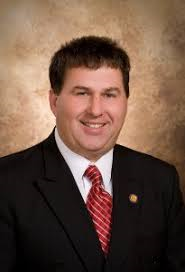
Olson said he thought the bills struggled because there’s just not as much opposition to renewables as Thompson might believe.
“I believe it had a high hurdle to pass – all these bills,” Olson said. “You’ve got a pretty robust wind energy group here in Kansas, and people want it.
“There’s not a big enough uproar by the people that have problems to make these changes,” Olson said.
“He’s got a few, and I’m sure they’re concerned,” Olson said. “I just don’t see the legitimate concerns of the people that own the property that live there.”
Republican state Sen. J.R. Claeys, another member of the Senate utilities committee, shared a similar view.
“The testimony that stretched into an all-out attack on renewable sources of energy wasn’t compelling to me,” Claeys said.
“We’ve studied this issue at length and certainly feel for those who have endured negative impacts in their specific situations,” he said.
“But I’m also concerned about the impact this legislation would have on the right of contract and the ability of county governments to negotiate with entities coming into their communities,” he said.
A Republican source speaking anonymously to be candid said the utility committee appears fatigued by the issue, as evidenced by the chairman’s failure to get a second on a motion to move one bill out of committee.
“The committee has lost its interest in the chairman and what he’s been doing all session,” the source said. “It’s very obvious his committee is exhausted.”
Republican state Sen. Mike Fagg of El Dorado said he hasn’t been convinced that the issue is one for the state to address, which was a similar argument made in the House utilities committee three years ago when it voted down wind turbine restrictions.
“The parts we’re trying to get into, I haven’t been convinced that’s something we need to be involved with,” Fagg said, explaining that other Kansans have to tolerate noise from traffic and trains near their homes.

“I know people are upset who have them,” Fagg said of the turbines, “but they need to be working with their county commissioners.
“If they’re not doing the job, they need to get somebody else,” he said. “That ought to be a county issue.”
Thompson blamed opponents of the legislation for throwing “all the mud against the wall they can and planting the seeds of doubt among the committee.”
“I’ve got to somehow remove those seeds of doubt,” he said. “That’s just part of the game and it’s part of the process.”
Svaty says Thompson has been intractable on the issue, something she believes has led to the struggle he’s had with his legislation.
“There are so many bills out there and there has really been no effort on the part of the legislator pursuing these bills to actually engage the industry and see what could be workable,” Svaty said.
Republican state Sen. Carolyn McGinn of Sedgwick chairs the local government committee where one of Thompson’s bills died after two days of hearings.
McGinn didn’t work a bill that would have allowed neighboring landowners to vote to stop solar and wind farm developments and would have only allowed them to locate on land zoned for industrial use – a problem in counties with no zoning.
The wind industry called the bill “reckless and improper,” saying it would eliminate wind and solar energy projects in Kansas.
“The author of the bill didn’t come with solutions so that all parties could agree,” McGinn said in explaining why she elected not to work the bill.
“If you’re going to bring a bill that is highly controversial without bringing solutions, I’m not going to run it,” she said.
For his part, Thompson said he’s requested input from various parties that would be affected by his legislation and has been ignored.
“I’m trying to work with these stakeholders that come and complain,” he said. “But they don’t want to do anything.
“I think a lot of these people just don’t want to do anything.”
Thompson doesn’t believe his legislation threatens the renewable industry in Kansas.
“I think they’re crying crocodile tears,” he said. “I think that they are putting on a show, whining like a bunch of people who are saying, ‘You’re going to run us out of business,’ when they’ve got 4,000 turbines in this state.
“They’re not out of business.”