





(UPDATED to correct SB 437 sted 473)
Senate President Ty Masterson blessed 23 bills that will remain in the mix when the Legislature returns from the turnaround break next week.
It is not believed that House Speaker Dan Hawkins blessed any bills. A spokesperson for the office did not respond to a text message Friday.
Last year, there were 24 bills blessed in the House and 12 blessed in the Senate.
Here are the bills blessed that Masterson blessed:
- SB 263: Establishing standards and requirements for active shooter drills conducted by public and accredited nonpublic elementary and secondary schools.
- SB 302: Requiring school districts to prohibit the use of personal electronic communication devices during instructional time and prohibiting any employee of a school district from using social media to directly communicate with any student for official school purpose
- SB 304: Establishing the Born to Invest Act requiring the Office of Vital Statistics to provide data to the office of the state treasurer for the distribution of informational materials regarding certain government-administered savings accounts.
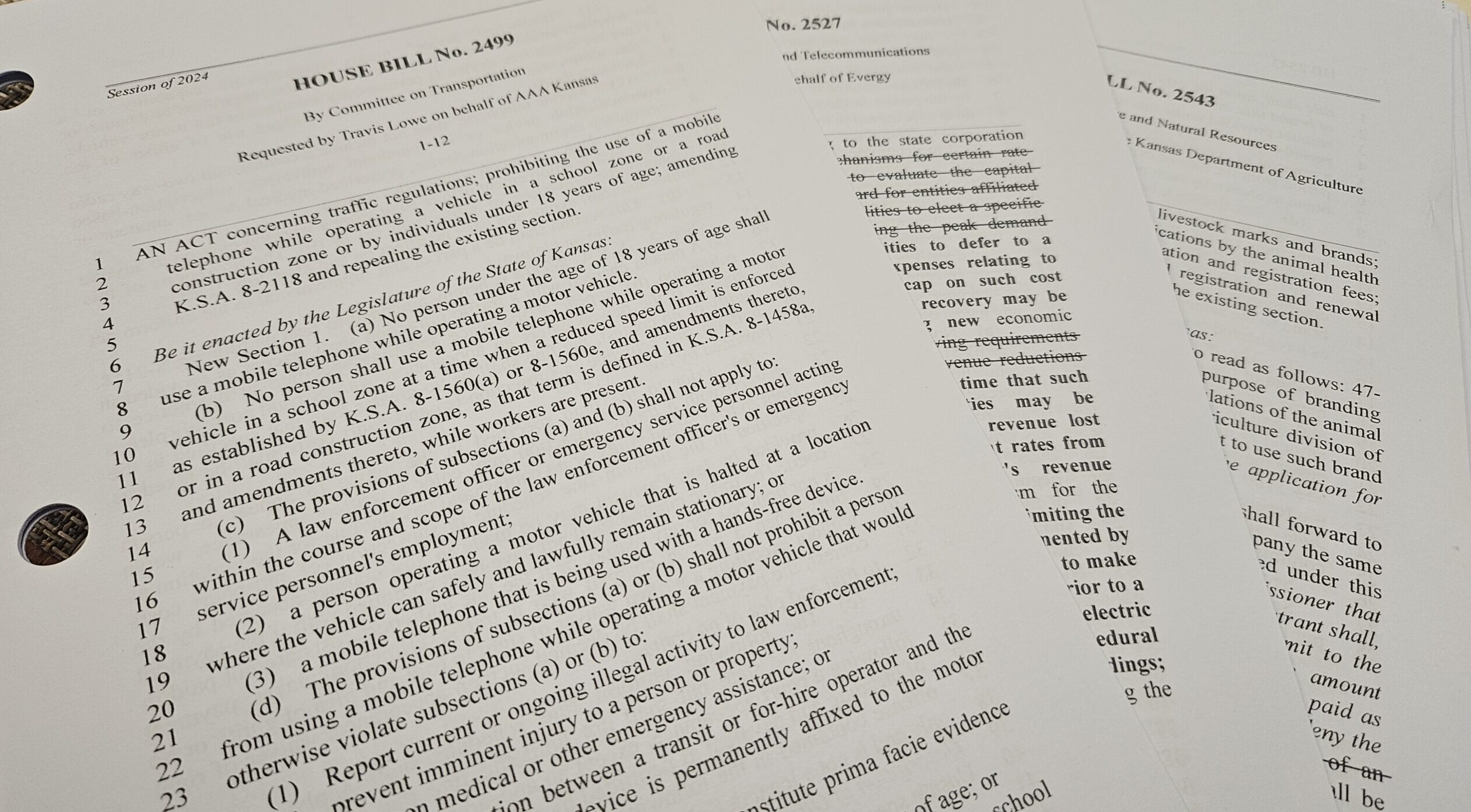
- SB 324: Prohibiting the use of a mobile telephone while operating a motor vehicle in school or construction zones and providing penalties for violations thereof.
- SB 339: Requiring school districts to provide at least 30 minutes of daily recess time for students in grades kindergarten through five and designating such time as part of the school term.
- SB 343: Requiring the state board of regents to adopt rules and regulations to prohibit state moneys from being allocated for certain low-earning outcome programs and prohibiting political subdivisions from allocating state moneys for certain low-earning outcome programs.
- SB 350: Enacting the age-appropriate school device act to establish safety standards and requirements for the use of school-issued devices in certain grade levels and authorizing parents to opt students out of certain uses of such device.
- SB 363: Requiring the Department of Health and Environment and the Kansas Department for Children and Families to enter into data-matching agreements with state agencies to verify eligibility for food and medical assistance and KDHE to submit certain data to the centers for medicare and medicaid services, prohibiting certain public assistance waivers or exemptions without legislative approval and self-attestation for purposes of determining eligibility for public assistance, limiting retroactive enrollment in medical assistance, immediately terminating eligibility for medical assistance upon confirmation of death of the enrollee, increasing the age limit for able-bodied adults without certain dependents and prohibiting certain exemptions from work requirements under the food assistance program.
- SB 382: Providing for the administration and proctoring of statewide assessments to virtual school students by such students’ virtual schools.
- SB 385: Establishing Erin’s law to require school districts to provide training and age-appropriate student instruction on the identification and reporting of signs of child sexual abuse.
- SB 404: Modifying the registration period for personalized license plates and authorizing county treasurers to charge increased fees for vehicle registration transactions.
- SB 415: Making certain violations of the residential landlord and tenant act subject to the remedies and enforcement provisions of the Kansas consumer protection act.
- SB 417: Establishing requirements for the development, construction, modification, maintenance, operation and decommissioning of certain industrial energy facilities and providing jurisdiction to the state corporation commission to control and permit such development, construction, modification, operation, maintenance and decommissioning of such facilities.
- SB 437: Establishing the technical college funding task force to design and make recommendations for a pilot outcomes-based funding model for Kansas technical colleges.
- SB 438: Requiring eligible boards of education to consider participation in the community eligibility program, providing a financial hardship exception from such participation and requiring the state department of education to assist school districts seeking such participation.
- SB 439: Enacting the utility Railroad Crossing Act and establishing a process and limitations for utilities to interact with railroad right-of-way.
- SB 440: Authorizing a special education pilot program that provides provisional accreditation to a private entity for the purpose of operating a special education teacher training program, allowing such entity to collect data from such program and providing requirements for full accreditation of such program.
- SB 441: Enacting the applied behavior analysis services in school act to authorize the provision of medically necessary behavioral health services by private providers in schools and requiring school districts to adopt policies for the provision of such services.
- SB 458: Requiring state assessments performance levels and cut scores to be based on the 2024 performance levels and cut scores.
- SB 478: Increasing the criminal penalties for assault or battery of a utility or communications employee.
- SB 491: Enacting the Haylee Weissenbach protecting students act to establish the office of education inspector general, authorize the education inspector general to conduct audits, investigations and reviews of educational institutions, require reporting of suspected professional and criminal misconduct by school employees and agents, require certain individuals to register on an educator misconduct registry, require criminal history record checks of school employees and agents and provide for civil penalties for violations of this act.
- SB 496: Requiring postsecondary educational institutions to provide annual training on freedom of speech, association and exercise of religion to certain individuals based on materials, programs and procedures developed by the state board of regents, in consultation with the attorney general, requiring the state board of regents to confirm that each such institution has complied with training requirements and authorizing the attorney general to bring an action to enforce compliance.
- SB 497: Adding kratom to Schedule I of the uniform controlled substances act and making conforming amendments to the definition of fentanyl-related controlled substance in the criminal code.