



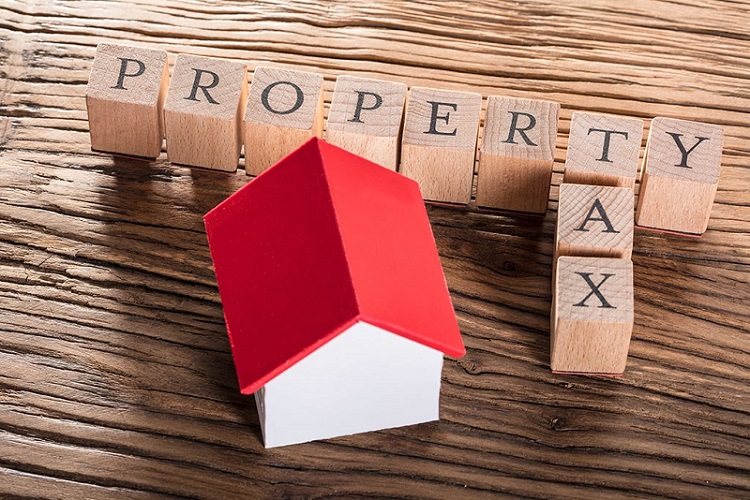
A proposal capping property tax assessments moved out of a Senate committee Wednesday as the Legislature takes its first steps toward addressing property taxes ahead of this year’s elections.
The Senate tax committee approved a constitutional amendment that would cap the taxable assessed property value at 3% with several limited exceptions, including new construction or improvements and if there is an error calculating the tax assessment.
The cap would remain with the property if it’s sold or transferred.
For tax year 2027, the final taxable assessed value of the property would not increase by more than 3% compared to the assessed value of the property for 2022.
The amendment, if approved by two-thirds of the Legislature, would have to be ratified by Kansas voters during this year’s primary election on Aug. 4.
The amendment is an attempt to respond to constituent complaints about rising property taxes, something lawmakers addressed nominally last year but couldn’t agree on a broader proposal to hold down property taxes.
Republican leaders in the House and Senate have expressed optimism that they will get something done on property taxes this year, although they ended at an impasse in 2025.
“The House and Senate will come together,” House Speaker Dan Hawkins said at the start of this year’s legislative session.
“Our task…this year is to bring our folks together, sit down and talk and figure out what we can do and we’re going to do that,” Hawkins said.
Senate President Ty Masterson said the way that the property tax system is now structured effectively taxes Kansans based on unrealized financial gains as their property taxes climb.
He said a constitutional amendment addressing property taxes – similar to what came out of the Senate committee Wednesday – is the best way to address the issue.
“Ultimately, it’s going to have to be something that the people decide,” Masterson said.
“The way property is assessed right now can’t be solved by a statute,” he said.
“We have to address the constitution,” he said. “That’s why we’re hoping to get something on the ballot this year that allows the people to vote on it.”
Masterson, who is running for governor, supports the constitutional amendment that passed out of the committee Wednesday.
The bill that came out of committee was opposed by the Kansas Farm Bureau, the Kansas Livestock Association, the Kansas Association of Realtors and the Kansas Building Industry Association.
“Quite frankly, this will shift the property tax burden within classes of property,” Farm Bureau lobbyist John Donley told the Senate tax committee in written testimony last week.
“While we applaud the intent of this constitutional amendment, we must oppose this proposal because it is a property tax shift, not a broad-based reduction,” he wrote.
The Farm Bureau, he said, “continues to be supportive of a broad-based reduction in
the statewide mill levy” of 20-mills. The 20-mills goes to schools.
“We feel that this would be a better approach to benefit all your constituents and lower their property tax burden,” he said.
Dave Trabert, CEO of the Kansas Policy Institute, presented the committee with a poll done by SurveyUSA showing that 75% of voters supported a limit on assessments while only 13% opposed it.
The poll, commissioned by the Kansas Policy Institute, surveyed 1,087 registered voters last September.
“There is robust support across all geographic areas of the state and all self-identified political viewpoints. Voter support isn’t just strong, it is skyrocketing,” he said.
The group did a similar poll but with a smaller sample size of 688 registered voters in December 2024 that found that 64% supported a limit on property tax assessments.
Mark Tomb, vice president of governmental affairs for the Kansas Association of Realtors, questioned how much of an impact the amendment would have on property taxes.
He said the amendment would give property owners the “false perception” that they will pay less in property taxes.
“However, assessed valuation is only part of the property tax formula,” he said.
“Local governments will still be able to raise the amount of revenue unencumbered by anything having to do with valuation increases,” he said.
The Kansas Chamber of Commerce testified as neutral on the bill.
Eric Stafford, vice president of government affairs for the chamber, said the bill is improved from last year because it limits the tax growth to no more than 3% annually.
“Limiting the growth in tax revenue is a much more holistic approach,” Stafford said.
“That said, our concern still exists that we had before,” he said. “We are simply concerned that commercial and industrial property owners could face a higher property tax through shifts by local government,” Stafford said.
“But a 3% limit on all property takes a step in the right direction compared to previous versions,” he said.
Last year, a constitutional amendment capping property appraisals at 4% for tax purposes died in the House. The House voted down the proposal 37-88, although it passed multiple times in the Senate.
The Kansas House approved a constitutional amendment placing a cap on property tax appraisals softer than one passed by the Senate.
The House voted 117-4 to approve an amendment proposing a system limiting appraisal increases for residential and commercial property to a rolling average of property values across the state or the current fair market value, whichever was less.
The Senate later gutted this bill and replaced it with the hard cap that died.
Republican state Rep. Adam Smith of Weskan, chair of the House tax committee, said he would entertain the new bill once it leaves the Senate.
“We’ll take another look at it,” Smith said. “I’ll be happy to look at it when it comes across.”
Smith declined to speculate on the bill’s chances in the House.
“You know what the vote was on the one last year,” he said. “If they made significant changes, I would assume it might get a few more votes.
“But we’ll have to see what kind of changes they’ve made once it gets over.”