




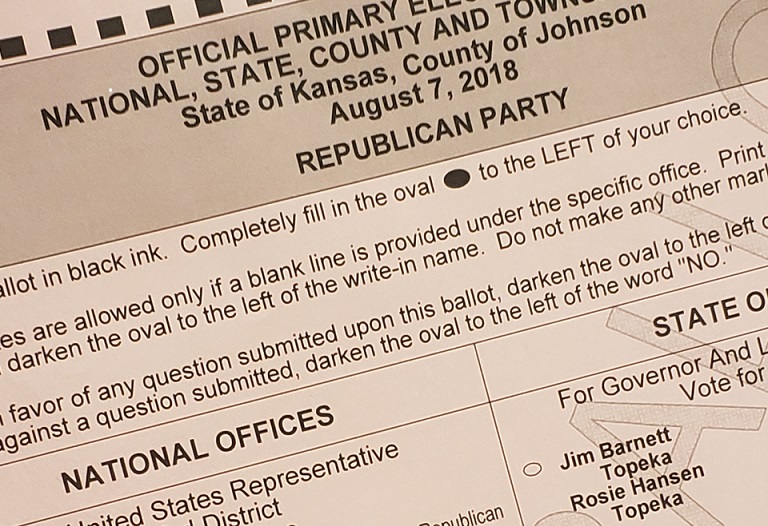
A nonprofit group that promotes voting by mail has sent 43,000 advance mail ballot applications to Johnson County voters that contain the wrong address of the local election office.
Johnson County Election Commissioner Fred Sherman said the Washington-based Center for Voter Information sent the personalized mail ballot applications with the incorrect address of the county election office.
The packet included a return envelope for people to sign and mail back to the Johnson County election office. But the return envelope included the wrong return address, Sherman said.
The return envelope listed the Johnson County election office address as 2102 E. Kansas City Road instead of 2101 E. Kansas City Road, he said. It also includes an address bar code that doesn’t include a ZIP code.
“We’re working with the U.S. Post Office to try to redirect these,” he said.
Sherman said he has been in contact with the Center for Voter Information about the snafu.
“There’s nothing they can do about it,” Sherman said. “Their mailer is out. They said they’re not doing any additional mailers.”
Tom Lopach, president and CEO for the Center for Voter Information, said his group immediately contacted election officials after the mistake was discovered.
“We regret this mistake and are making every effort to ensure that all Johnson County residents can use our forms to easily participate in democracy,” he said.
The prepopulated ballot application that’s at issue in Johnson County would have been barred by a state law passed by the Legislature in 2021 but that has since been blocked by a federal judge on constitutional grounds.
In the past, the Center for Voter Information has partnered to send out mail ballot applications with the Voter Participation Center, which is challenging the law.
Last year, U.S. District Judge Kathryn Vratil found that the law prohibiting the mailing of advanced ballot applications with personalized voter information violates the constitutional right to free speech and association.
The state argued that the personalized application prohibition was necessary to minimize voter confusion, preserve and enhance voter confidence, reduce the rejection of inaccurate ballot applications and reduce the risk of fraud.
However, Vratil dismissed the state’s arguments, especially as it related to voter fraud and whether a surge in ballot applications led to mistakes during the 2020 elections when almost a half-million Kansans voted by mail.
“Even if Kansas had a problem with election fraud, the personalized application prohibition is not narrowly tailored to prevent such fraud,” Vratil wrote.
“Defendants argue that a surge of ‘inaccurate and duplicate’ advance mail ballot applications decreased the efficiency of county election officials, which in turn increased the ‘opportunity’ for mistakes,” Vratil wrote.
“Even in a historically unprecedented election, they cite no evidence of a single mistake,” she wrote.
Vratil’s ruling is now on appeal to the U.S. 10th Circuit Court of Appeals. Oral arguments were heard in January. A decision has not been rendered.
It is possible that state lawyers may use the hiccup with the Johnson County ballot applications to supplement their arguments in favor of the law with the judges at the 10th Circuit.
In the appeal filed with the court, Republican Attorney General Kris Kobach argued that the law does not violate the constitutional right to free speech and association.
Kobach said that the plaintiffs challenging the law do not have a First Amendment right to fill out someone else’s advance ballot application.
“The application itself is not a forum for speech, and the act of filling in the name and address blanks on this official state form constitutes little more than non-expressive conduct warranting no constitutional protection,” the state attorneys argue.
“If there is any speech at all – and there is not – it is that of the voter (communicating a desire to receive an advance ballot), not a third-party like VPC,” the state argues, using shorthand to refer to the Voter Participation Center.
The state argued that the Legislature had an interest in enacting the law, saying its basis was “legitimate and reasonable.”
“These interests – avoiding voter confusion, facilitating orderly and efficient election administration, enhancing public confidence in the electoral process, and deterring voter fraud – are well recognized and appropriately calibrated to the challenged law,” the state argued.