





Another effort to start a new political party in Kansas launched Tuesday morning with a goal of backing “fusion candidates” who could represent more than one party on the ballot.
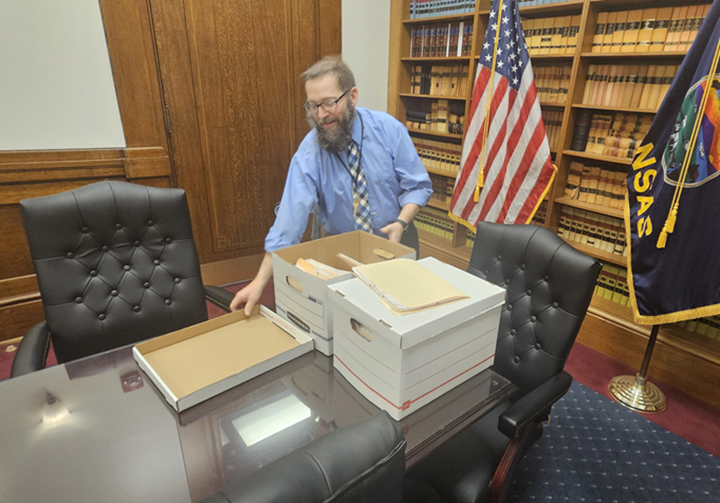
Leaders of United Kansas submitted about 35,000 signatures to the Kansas secretary of state’s office on Tuesday, wheeling several boxes of petitions in on a dolly.
They will need signatures equal to 2% of the people who cast ballots in the last governor’s race, which translates into 20,180 signatures.
The law says the counties have 20 days to validate the signatures when the petitions are sent to them. The law doesn’t specify what date the petitions must be sent.
The latest initiative comes after No Labels was recently recognized as a political party.
If United Kansas is recognized as a party, it will have to field a statewide candidate in 2026 that gets at least 1% of the vote.
The party’s chair, Jack Curtis of Topeka, and treasurer, Aaron Estabrook of Manhattan, delivered the petitions to the secretary of state’s office in Topeka.
The party’s vice chair is Sally Cauble, a former member of the state Board of Education.
“Kansans want a new opportunity,” Curtis said, adding that polls shows that half of Kansans identify as unaffiliated or independent.
“Right now, those folks don’t feel like they have a voice,” Curtis said.
“The parties are growing further and further apart, and so we are wanting to provide an opportunity in the middle,” he said.
Estabrook comes to the endeavor with a history of political experience, serving on the Manhattan City Commission and the Manhattan-Ogden Board of Education.
Estabrook also tried to create the Moderate Party of Kansas. The moderate party wasn’t created but later became a political action committee.
The United Kansas Party plans to nominate candidates for local and state office before June 3, the deadline for filing for office.
Curtis said the party is looking to back candidates for state legislative races, with an emphasis on employing the fusion method of voting.
Fusion voting allows multiple parties to nominate the same candidate for the same office in a general election.
While the two major parties nominate different candidates, third parties may cross over and endorse one of the major party candidates and “fuse” with them.
“It brings people more to the center if they have to moderate themselves to collect those votes,” Estabrook said.
“It broadens out the electorate and we believe over time it will moderate the parties themselves,” he said.
Supporters of fusion voting say it gives voters more choice, empowers minority parties and brings together a coalition of people with many different ideologies.
Curtis and Estabrook believe that fusion voting is constitutional in Kansas, although the secretary of state’s office still needed to research the issue.
In Kansas, in the 1892, 1894, 1896, and to an extent in the 1898 elections, the Populist Party and the Democratic Party would nominate the same individual to the same office.
So the person’s name appeared on the ballot twice.
After the Republicans swept the November 1900 election, in the 1901 session, they immediately enacted legislation to prohibit “fusion tickets.”
They barred anyone from accepting “more than one nomination for the same office” and said that “the name of each candidate shall be printed on the ballot once and no more.”
At that time, the candidates were nominated by convention, so the two political party leaders could agree on a fusion ticket.
The state has a law on the books that says a candidate’s name can only appear in the ballot once.
Here’s how it works from a modern perspective, using New York as an example of a state with a fusion system.
During the 2022 governor’s race in New York, Gov. Kathy Hochul appeared on the ballot for both the Democratic Party and the Working Families Party.
Her opponent, Lee Zeldin, appeared on both the Republican Party and Conservative Party ticket.
The Brennan Center for Justice at the New York University Law School reports that four states — Connecticut, New York, Oregon and Vermont — allow fusion voting.
States such as Connecticut and New York use a type of fusion voting where the ballot lists a candidate multiple times, once per party, according to Brennan.
This format gives voters the choice of voting for a candidate under two scenarios, as a Republican or Democrat and as a minor party nominee.
“This option, in turn, serves an important communicative function,” Lauren Miller, counsel for the Brennan Center’s Democracy Program, said in legislative testimony in Oregon last year on fusion voting.
“If a candidate wins an election with a significant portion of votes from the third-party line, those voters will have sent a clear message about their priorities that they could not have otherwise sent if faced with the choice of voting for a major party candidate or a ‘spoiler’ candidate,” Miller said in that testimony.
Fusion voting is a creature of the 19th century when it was a part of U.S. politics, particularly in the West and Midwest, according to a 2020 Idaho Law Review article exploring the issue.
“By fusing with one of the major parties, third parties were able to influence election results and thus public policy,” the law review found.
“At that time, the process of voting was different. Prior to the 1890s, citizens voted by dropping a ballot listing the candidates they had chosen in an actual ballot box.
“Typically, political parties printed the ballots which listed the party’s slate of candidates, although sometimes voters would create their own ballots.
“Under this system, the state did not participate in the determination of what groups constituted political parties or what candidates they could nominate.
“Parties that wished to fuse could lawfully list the same candidate on their ballots. And, in fact, cross-endorsing was an important part of the system.”