





(Will be updated as warranted)
A federal judge in Kansas on Tuesday blocked President Joe Biden’s administration from carrying out a new rule that prohibits discrimination based on gender identity and sexual orientation at federally funded schools.
U.S. District Judge John Broomes issued a preliminary injunction stopping the administration from enforcing the new Title IX rule challenged by Republican Attorney General Kris Kobach. Broomes is the third federal judge nationally to stop the rule.
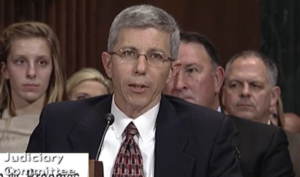
Broomes’ ruling extends to Kansas, Alaska, Utah, Wyoming as well as schools attended by the children in the plaintiff groups, Young America’s Foundation, Female Athletes United and Moms for Liberty. The order is believed to reach into all 50 states.
The Kansas attorney general put all Kansas school districts on notice that they must abide by the court’s injunction and that they are prohibited from changing any of the schools’ policies to reflect Biden’s Title IX transgender rule.
Two other judges in Louisiana and Kentucky have already enjoined the rule from being implemented in 10 other states. There are at least four other court cases addressing this issue
Similar to rulings in Kentucky and Louisiana, Broomes found that Title IX was intended to ensure equal treatment between men and women for admissions opportunities, scholarships and sports in education.
Broomes, appointed to the bench by former President Donald Trump, said in his 47-page ruling that the Biden administration was misapplying the law to cover gender identity and sexual orientation.
“The court finds that the unambiguous plain language of the statutory provisions and the legislative history make clear that the term ‘sex’ means the traditional concept of biological sex in which there are only two sexes, male and female,” he wrote.
Broomes said the government’s reinterpretation of Title IX “to place gender identity on equal footing with (or in some instances arguably stronger footing than) biological sex would subvert Congress’ goals of protecting biological women in education.”
The rule “would, among other things, require schools to subordinate the fears, concerns, and privacy interests of biological women to the desires of transgender biological men to shower, dress, and share restroom facilities with their female peers.”
Like in other states, the government argued that it relied on a 2019 U.S. Supreme Court ruling – known as the Bostock case – that found federal civil rights law protected someone from being fired because of their sexual orientation.
The Supreme Court concluded that discrimination on the basis of gender identity is a form of discrimination on the basis of sex under Title VII of the Civil Rights Act, which bars employment discrimination based on race, color, religion, sex and national origin.
Broomes drew a distinction between the Bostock case and Title VII and the new federal rule the government adopted as part of Title IX dealing with discrimination in education.
“First and foremost, Bostock involved a different statute, Title VII, which prohibits sex discrimination in employment,” Broomes wrote.
“Although the statutes are similar in that they both prohibit sex discrimination, there are notable differences,” he wrote.
“Significantly, Title IX includes several carve outs to the prohibition on sex discrimination that are not present in Title VII,” he wrote.
The Bostock case came about from employees of private businesses who were fired because of decisions they made as consenting adults regarding their private lives, and those decisions caused no harm in the workplace, he wrote.
“In that sense, Bostock can fairly be described as a live-and-let-live decision where employers were prohibited from interfering with their employees’ personal lifestyle choices when those choices had no bearing on the employees’ abilities to perform their jobs.”
The new Title IX rule is a different matter, he wrote.
By contrast, he said the federal government in this case is injecting itself into education, an area traditionally left to state and local governments and the schools themselves.
He wrote the government’s rule results “in the subordination of the interests of non-transgender students (many of whom are minors) in free speech, privacy, and safety to the interests of transgender students in expressing and conducting themselves in accordance with their individual notions of gender identity.”
Broomes wrote that the rule adopted by the U.S. Department of Education would open the door to boys falsely claiming they are women to gain access to girl’s bathrooms.
He said the department doesn’t explicitly authorize any policy to determine a student’s gender identity other than their own statement “and, in fact, dissuades a recipient from any documentation requirements, which could include a letter from a parent or coach.
“Given that, and the evidence before the court, it is not hard to imagine…an industrious older teenage boy may simply claim to identify as a female to gain access to the girls’ showers, dressing rooms, or locker rooms so that he can observe his female peers disrobe and shower,” he wrote.
Kobach predicted that the court order will affect thousands of schools across the nation since it applies to any member of one of the plaintiff groups that brought the lawsuit.
The organizations have until July 15 to notify the court which schools across the nation are affected.
“We have had many wins in court, but to me, this is the biggest one yet,” Kobach said.
“It protects girls and women across the country from having their privacy rights and safety violated in bathrooms and locker rooms and from having their freedom of speech violated if they say there are only two sexes,” Kobach said.