




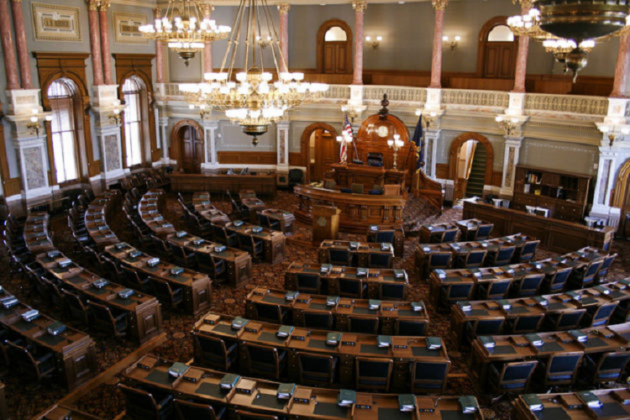
The Kansas House on Thursday restored a program that provides in-state tuition at higher education institutions for students who don’t live in the country legally.
The House voted 86-36 for a larger overall bill that bans immigrants living in the United States illegally from receiving most state or local benefits.
However, the House members agreed to amend the bill in a voice vote so it keeps the in-state tuition program that would have been ended under a Senate version of the bill.
But Democrats broke off the bill at the end after Republicans shut down debate on the overall bill before Democrats were ready.
The bill is now likely headed for a conference committee.
Regardless, the top House Democrat said his caucus was always going to oppose the bill, which had been supported in its original form by Attorney General Kris Kobach.
“The underlying bill was awful,” Democratic state Rep. Brandon Woodard of Lenexa said. “We were always a ‘no’ on the bill regardless of whether the amendment went on or not.”
He noted that one part of the bill prevents Kansans – whether they are here illegally or not – from getting out of jail on their own recognizance unless they remain incarcerated until they appear before a judge or pay a bail bond immediately.
Republican state Rep. Bob Lewis of Garden City brought the amendment to keep the in-state tuition program intact, saying there are students who are paying a price for their parents who may have come across the border illegally.
“I think everybody should be able to agree on something today, and that is our immigration system is confused,” Lewis said.
“We can’t seem to get together politically on a solution, but in the meantime we have complete innocents who are being harmed by that problem,” he said.
“It would surprise me if a 13- or 14-year-old who is in one of our high schools had voluntarily come across the border illegally,” he said.
Democratic state Rep. Cindy Neighbor of Shawnee said young immigrants brought to the country by their parents don’t want to be political pawns in a fight over immigration.
“They want the America dream. Denying this position would be a practical and symbolic step backward in the contentious immigration debate,” she said.
The bill now goes back to the Senate where there was an effort to save the in-state tuition program.
Senate Vice President Tim Shallenburger of Baxter Springs tried to remove part of the bill that ended the in-state tuition program when the Senate debated the bill.
The Senate voted 18-19 to reject Shallenburger’s amendment and passed the bill eliminating the program.
The in-state tuition program is open to someone who attended an accredited Kansas high school for three years or more, graduated from an accredited Kansas high school or earned a general equivalency diploma and sought to legalize their immigration status.
There were 310 students – 0.2% of the total student population – enrolled in state universities, community colleges and technical colleges who received in-state tuition in the program as of the fall of 2024, according to the most recent state data available.
The Board of Regents said there was no more recent information because the agency no longer collects that data.
Most of the students -180 – were enrolled in community colleges. Another 106 were enrolled at public universities, and 24 attended technical schools.
Most of the students – 102- were enrolled at Johnson County Community College, 46 attended Wichita State University, 26 attended Kansas City, Kansas Community College, 24 attended the WSU Campus of Applied Sciences and Technology, 21 attended Butler Community College and 17 attended Fort Hays State.
Democratic state Rep. Rui Xu of Westwood said the in-state tuition program seeks to help students who came to the United State at a young age, not aware of their immigration status and grew up here learning U.S. history and pledging allegiance to the flag.
“Denying these students in-state tuition doesn’t fix our immigration system, it doesn’t hold a single politician in Washington, D.C., accountable for creating it. All it does is punish children who are already here, already contributing and trying to build a future,” he said.
Republican state Rep. Jason Goetz of Dodge City shared a similar view.
“I think we all know we have immigration problems in our country and in our state. We do not have control of the oversight of all the policies, which are mostly federal,” he said.
“We do have oversight of Kansas and the fair treatment of our citizens. We can either compound the problem or bring needed hope to innocent children,” Goetz said.
“If you bring education, it creates a sense of belonging and that sense of belonging helps create meaning, and in that meaning a person can find a way to pursue the goals and dreams that God has put in their heart.”
Republican state Rep. Rebecca Schmoe of Ottawa, who carried the bill on the floor, said the bill protects people who would be punished for decisions they didn’t make.
“We are protecting those students who are actively seeking to continue their education, young people who are here, no fault of their own based, on decisions that other people made for them,” Schmoe said.
In the end, Democrats couldn’t support the bill.
“I want to be clear: Undocumented folks can already not access federal or state benefits under federal law,” said Democratic state Rep. Lindsay Vaughn of Overland Park.
“All this bill is doing is perpetuating an anti-immigrant sentiment at a time that our federal government is attacking and demonizing immigrants in our country,” she said.
“What’s happened to protecting the most vulnerable among us?
“What’s happened to celebrating the diversity of and the experience of people that come to our country?” she said.
Democratic state Rep. Nikki McDonald of Olathe accused the Republicans of trying to muffle the voice of the minority party in the Legislature.
“We were sent here to fully participate as advocates for those we represent,” she said.
“It is insulting and disrespectful. Do better.”