




Following the lead of the Senate, a House committee has tucked a measure into the higher education budget that would prevent state universities from asking job applicants about diversity, equity and inclusion.
The House Higher Education Budget Committee on Wednesday added language to the post-secondary education budget barring state universities from demanding job applicants to articulate their experience or commitment to diversity, equity and inclusion.
The budget with the proviso still has a long way to go.
It still needs to go to the House Appropriations Committee and ultimately the full House before it would have to be hammered out in a conference committee, although it could benefit from the fact that the Senate has a similar proposal.
The proviso language is similar to what was added recently in the Senate that barred state universities from demanding a “diversity-equity-inclusion oath” of job applicants, students and contractors.
However, the House proposal is different because it would not prevent state universities from asking about DEI if it was a matter of a job applicant’s expertise, scholarship and teaching background.
The House version also stipulates that nothing in the budget proviso shall be interpreted to allow public universities from restricting the academic freedom of any faculty member – another component that was not included in the Senate budget.
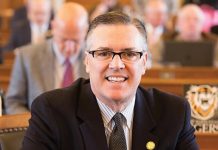
Republican state Rep. Steven Howe, chair of the House Higher Education Budget Committee, said he was trying to improve on the Senate’s version of the budget proviso and give the House a position when the legislation gets to a conference committee.
“The First Amendment prohibits public universities from compelling faculty to assent to specific ideological views or to embed those views in academic activities,” Howe told the committee.
“When government entities, including public universities, wish to disseminate an ideology, no matter how acceptable to some, such interest cannot outweigh an individual’s First Amendment right to avoid becoming the courier for such message,” he said.
“Rules that force an individual to declare a belief and to utter what is not in his mind, serve to strangle the free mind at its source,” he said.
Howe said many state universities are requiring prospective faculty to demonstrate a commitment to diversity, equity and inclusion, “often through a written statement that factors into hiring, reappointment, evaluation, promotion or tenured positions.”
He pointed to the University of Kansas, saying that for nearly every teaching position it appears that a prospective faculty member must provide a statement about their experiences in diversity, equity and inclusion.
He said Wichita State University lists experience in diversity, equity and inclusion under preferred knowledge and skills in faculty job postings. He said Kansas State some type of DEI statement for some of their jobs.
“Unfortunately, there does not appear to be any uniformity or consistency in how our institutions are using or even applying DEI statements,” he said.
“I’m concerned that some of them may run afoul of the First Amendment.”
Echoing themes expressed in the Senate Ways and Means Committee, Howe said DEI statements “can too easily function as litmus tests or loyalty oaths for adherence to prevailing ideological views on DEI.”
He said he was concerned that could be used to penalize faculty members who have dissenting opinions on matters of public policy.
A spokesperson from the Kansas Board of Regents did not respond to an email Thursday seeking comment on latest variation of the DEI budget proviso.
A week ago, the spokesperson for the regents said the agency was studying the implications of the Senate budget proviso.
“The Regents value diversity. As our state becomes increasingly diverse, it is imperative that all Kansans have equal opportunities for access and success at our colleges and universities,” Board Chair Jon Rolph said in a statement last week.
Democratic state Rep. Brandon Woodard of Lenexa said the committee needed to take more time to evaluate the bill and talk it over with the state universities.
“We have had every CEO of our institutions before us,and we haven’t asked them a single question on this issue,” Woodard said.
“We also have the ability, even after we conclude our budget work, to have hearings on these issues. I think there are more questions out there than answers.”
He suggested that the committee hold an informational hearing with the universities to get a better understanding of their hiring practices and how they include DEI.
Republican state Rep. Chuck Smith of Pittsburg questioned the need to push the proviso through so quickly.
“Is there a time frame where we need to have this done?” Smith asked. “I have heard from Pitt State’s president, but I would like to hear from the other presidents and see, ‘Will it hurt you? Will you lose money?’”