





A federal judge on Thursday sent back to state court a lawsuit challenging the repeal of the state’s three-day grace period for mail ballots to arrive at election offices after Election Day.
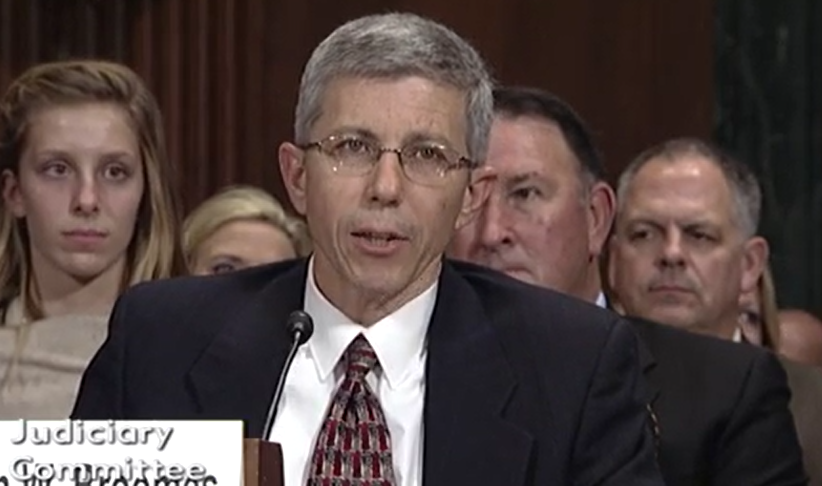
U.S. District Judge John Broomes ruled that the lawsuit brought by three civic groups should be returned to Douglas County District Court where it was first filed.
Secretary of State Scott Schwab tried to move the case to federal court but was denied in a nine-page ruling issued by Broomes on Thursday.
The case will now proceed before District Judge Carl Folsom III, who was appointed to the bench by Democratic Gov. Laura Kelly.
In federal court, the case would have played out before Broomes, a longtime oil and gas lawyer who was appointed to the bench by President Donald Trump in 2017.
A lawyer for the plaintiffs – Kansas Appleseed Center for Law and Justice, Loud Light and the Disability Rights Center of Kansas – praised the ruling.
“We are hopeful that this matter can be considered quickly in state court, and will request that the law be blocked prior to becoming effective in January 2026,” Teresa Woody said.
Broomes ruled that the secretary of state’s notice to move the case to federal court was not timely because it was filed more than 30 days after he was properly served with the initial petition.
Schwab argued that he was not properly served with the lawsuit under Kansas law on June 6 of this year. As a result, the secretary of state said his removal of the case to federal court 35 days later on July 11, 2025, was timely.
“Tenth Circuit and Kansas law are clear that merely sending a copy of the petition to a defendant without the accompanying summons is not sufficient to constitute service,” the state argued in its brief.
The plaintiffs disputed Schwab’s argument. The court agreed with the plaintiffs.
Schwab said when he was served with the lawsuit on June 6, the envelope he received
did not contain a copy of the summons. Plaintiffs said that they did include a summons.
Schwab also said that when he was served with an amended lawsuit on June 12, there was no summons included.
“After review of the relevant evidentiary materials, the court finds that plaintiffs effected proper service on Defendant Schwab on June 6, 2025, and therefore, defendants’ removal is untimely,” Broomes wrote.
The court held an evidentiary hearing Oct. 9 to help arrive at a conclusion about whether the lawsuits included a summons.
Ultimately, Broomes sided with testimony from the office manager at the law firm of the plaintiffs’ legal counsel. The office manager had worked as a legal assistant in law firms
for more than 35 years.
The office manager swore in her affidavit that she specifically remembered including the summons in both the June 6 and June 12 mailings.
The court found her consistent testimony persuasive because she laid out “a clear and steady process for how she, the only person charged with mailing the service documents, regularly engages in this practice.”
The case focuses on a law enacted by the Legislature this year that repealed a 2017 statute that gave voters a three-day grace period for their postmarked mail ballots to arrive at election offices.
A legal challenge to the repeal was filed in May, saying that eliminating the grace period was unconstitutional and disenfranchised Kansas voters.
The lawsuit said repealing the grace period would make it “virtually impossible for many voters” to cast a ballot by mail in an election.
The plaintiffs want the law repealing the grace period blocked before it starts in 2026.
They also want election officials ordered to count all ballots that are postmarked by Election Day and received within seven days after the election — “the time Kansas’s own election officials expect it will take a ballot to reach its office.”
The state had argued in its brief that the litigation raised issues that should be considered in federal court, not state court.
“Although plaintiffs assert Kansas state constitutional claims, the claims necessarily raise a substantial and disputed federal question that is a central and essential element of plaintiffs’ right to relief,” Schwab’s attorney, Bradley Schlozman, argued.
The state argued that the lawsuit required the resolution of a federal issue — whether allowing a post-Election Day grace period for receiving ballots conflicts with a federal mandate that there be a single Election Day for presidential and congressional elections.
The secretary of state contended that before a state court could declare the law unconstitutional under Kansas law, it would first have to decide whether the grace period is allowed under federal law.
Meanwhile, the U.S. Supreme Court is being asked to consider a Mississippi law that allowed absentee ballots postmarked on or before the date of the election to be accepted no more than five business days after the election.
It’s very similar to the 2017 Kansas law, which allowed ballots postmarked on or before Election Day to be accepted for three days after the election.
The 5th U.S. Circuit Court of Appeals ruled that the Mississippi law was preempted by federal law.
The court cited two constitutional provisions, including one allowing legislatures to set the time, manner and place of elections, but allowing Congress to alter those rules for federal elections.