






A proposal intended to keep environmental, social and corporate governance guidelines out of government investing and contracting decisions could cost the state’s pension system $3.6 billion in returns over a decade.
That was the testimony offered Wednesday by the top administrator for the state’s pension fund who took the rare step of testifying against a bill intended to ensure that business and investment decisions are based solely on financial interests.
The hit on the pension system potentially stands as an obstacle to whether the bill can ultimately pass as lawmakers look for ways to protect the retirement system from the fiscal fallout of the legislation.
Lawmakers were presented with changes in the bill that could potentially erase the estimated cost of the legislation.
The legislation focused on so-called ESG practices is part of a national debate that’s caught fire across the nation, especially from Republican lawmakers who fear that state money managers are using their political preferences to guide where investments are made.
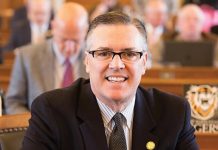
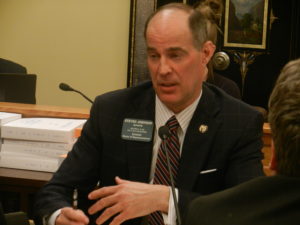
Treasurer Steven Johnson raised the issue while he was running for office last year and has been working behind the scenes in crafting the bill.
“Environmental, social and governance initiatives have long been debated in the public sphere,” Johnson said.
“More recently, players in the financial sector have taken up the ESG charge, which can blur the line between advancing policy initiatives and measuring return risk,” he said.
“If we’re focused on the highest returns, we can’t increase return by adding constraints,” he said. “Either adding ESG or non-ESG constraints could be detrimental to returns.”
The Legislature is taking two approaches to addressing ESG, although one proposal has significantly more momentum than the other.
A House bill – the front-running legislation – would bar state and local governments from showing favoritism to ESG, which includes making investment or contracting decisions based on whether a business is oriented to fossil-fuels, among others.
The bill also defines ESG to include abortion, gender reassignment services, or the manufacturing and sale of guns.
It would ban state and local governments from making contracting decisions with businesses based on their policies helping employees access abortion or gender reassignment services as well as whether they make or distribute guns and ammunition.
Lawmakers want to ensure that governments are only making decisions based on finances and not discriminating against a business because of their political proclivities.
A second bill in the Senate that has been broadly criticized in the Capitol would have banned wealth managers from “ideological boycotts” where they don’t invest in businesses because of political preferences. The bill would have blacklisted those fund managers.
The second bill in the Senate was seen as heavy handed because it effectively posed a government mandate on the private sector, something the Kansas business community cautions against as the debate over ESG has gotten underway at the Capitol.
The Kansas Chamber of Commerce urged lawmakers to walk a narrow line in not favoring any policy in responding to the ESG debate with legislation.
“Our members do not want to have government intervene and tell us what we can and can’t do and what positions we can and cannot take,” said Eric Stafford, the chamber’s lobbyist.
“Efforts to put penalties on businesses for certain actions or certain inactions depending on which perspective you’re coming from alter the free market, and so do ESG policies,” Stafford said.
“We have to be careful that we don’t come in as a reaction and alter the market to respond to the market that has been altered in the first place,” he said.
In his annual letter to company CEOs a year ago, BlackRock’s chairman, Larry Fink, made a splash when he signaled that ESG investing was a priority and further elevated the issue on the national stage.
“Stakeholder capitalism is all about delivering long-term, durable returns for shareholders. And transparency around your company’s planning for a net zero world is an important element of that,” Fink wrote.
“As stewards of our clients’ capital, we ask businesses to demonstrate how they’re going to deliver on their responsibility to shareholders, including through sound environmental, social, and governance practices and policies.”
The investment firm, he said, focuses “on sustainability not because we’re environmentalists, but because we are capitalists and fiduciaries to our clients.
“That requires understanding how companies are adjusting their businesses for the massive changes the economy is undergoing.”
BlackRock passively manages roughly $2.5 billion in a Russell 3000 index account for the state’s pension system, or 11% of the total state pension fund’s investment portfolio.
Last summer, former Attorney Derek Schmidt joined a group of attorneys general asking the chief executive of BlackRock to clarify whether it was using investor money to advance its political agenda related to energy policy.
The company has since pushed back, saying it does not boycott energy companies or any other sector or industry.
However, Stafford said the market may be headed in the opposite direction.
He cited media accounts that Vanguard was withdrawing from any kind of net-zero carbon emissions strategy because ESG wasn’t yielding any more return than traditional investing.
Falling market values have hurt the performance of many ESG funds as the central banks raised interest rates, spurring fears about inflation.
The first bill, backed by Treasurer Johnson and Attorney General Kris Kobach, has the most support, although the road ahead could still be challenging.
There are persisting questions to what extent the Legislature should require an investment adviser to tell their clients that ESG investing could limit their return on an investment.
The disclosure requirement is opposed by the Kansas Bankers Association, which believes the language “makes more of a political statement” than using a generally accepted financial statement.
“It is another mandate on business,” said Alex Orel, the KBA’s lobbyist.
Alan Conroy, executive director of the state’s pension system, pointed out Wednesday that the bill could prove costly, something that has lawmakers concerned.
Conroy told legislators in the House and Senate that wording in the bill would require the Kansas Public Retirement System to disqualify its investment managers.
The bill defines “fiduciary” in a way that prohibits wealth managers from being involved in any advertisement, statement, explanation, report or participation in coalitions, initiatives or joint statements on ESG regardless of whether or not it’s related to KPERS.
The pension system’s board of trustees would have to divest from existing financial positions with those investment managers, review what similar investment managers and funds are available that comply with the law and restructure the portfolio.
Conroy said the divestment leads to asset losses of approximately $1.14 billion due to the early sale of assets from illiquid investments.
He said it was estimated that it would reduce future investment returns by 0.85% based
on a restructured investment portfolio of mix of 60% equities and 40% bonds.
Over the next 10 years, the restructured portfolio is estimated to earn $3.6 billion less than the existing investment portfolio, he said.
Conroy has proposed amendments to the legislation that would negate that loss, and lawmakers are now considering them.
The bill is expected to have trouble passing the Legislature and getting the governor’s signature if the retirement system would take a $3.6 billion hit.
Cities voiced opposition to the bill out of fear that it would trample on their ability to make their financial decisions and how they do business.
“We have cities that may wish to base a decision on the fact that the other party adheres to or has rejected ESG guidelines,” said John Goodyear, general counsel for the League of Kansas Municipalities.
“The ability to contract is fundamental to the exercise of local control,” Goodyear said in written testimony.
“How or if a city wants to address those guidelines as they consider the parties with whom they contract should remain a local decision,” he said.
Democratic state Rep. Rui Xu of Westwood questioned how the bill might affect cities in his Johnson County district that have made agreements with Evergy to provide a bulk of their energy from wind farms.
“My reading under this bill…bans that practice,” Xu said. “My cities all of sudden will have to recontract or figure out what to do there.”
Zack Pistora, lobbyist for the Kansas Sierra Club, said ESG is nothing more than a strategy for assessing risk to improve a company’s financial performance of the investment.
“Who is coming up with this bill on ESG? Is it your constituents? Do your constituents really care about whether the government should interfere in a free market trying to come up with a better risk assessment?” he asked.
Tim Graham, lobbyist for the Kansas National Education Association, questioned what good any of the bills will do for retirees.
“Police officers, firefighters, state employees, teachers, educators and all other wage earners that depend on KPERS have all worked hard to earn their benefits,” Graham said.
“How do any of these bills not put their pensions in jeopardy?” he asked.
“I don’t see police officers, firefighters, state employees, teachers and other wage earners on KPERS coming up here and ask you guys to muck around in their system,” Graham said.
“I just don’t see it.”