





A year ago, three people you likely never heard of made headlines across the state.
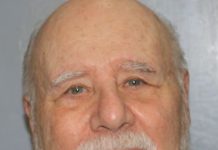
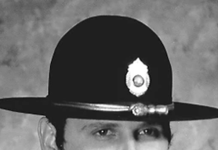
They ignited a storm in the law enforcement community when they paroled the murderer of Highway Patrol trooper Conroy O’Brien, who was shot twice in the head at close range during a traffic stop near Matfield Green on the Kansas Turnpike.
The Kansas Prisoner Review Board – Mark Keating, Jeannie Wark and CJ Perez – drew rebukes from law enforcement when last year it paroled Jimmie Nelms, who was convicted of murdering O’Brien in 1978.
Nelms, 78, was paroled several weeks after a March 6 hearing. When news of his parole broke in early May, it set off a furor from Topeka to Washington, D.C.
Highway Patrol Superintendent Erik Smith called the news a “gut punch.”
Gov. Laura Kelly said through a spokesperson that were was “no justification” for the decision.
Senate President Ty Masterson called it “unconscionable and wrong.”
U.S. Sen. Roger Marshall called it a “grave injustice and a slap in the face to law enforcement.”
At the time, the Department of Corrections issued a statement saying that the board believed Nelms was “able and willing to fulfill the obligations of a law-abiding citizen….”
Ultimately, the board reversed its decision without explanation, but the stage had already been set for the Legislature to make reforms.
A bill introduced last week – with a hearing scheduled in the Senate for Monday – would overhaul who sits on the Prisoner Review Board and add some provisions for enhanced notification when parole is considered for more serious offenders.
The bill also would eliminate available bed space at state prisons as a consideration for parole for serious offenders.
The board was created in 2011 when former Gov. Sam Brownback issued an executive reorganization order that abolished the old Kansas Parole Board.
The current board is appointed by the corrections secretary and serves at the secretary’s pleasure.
The old parole board was appointed by the governor, with the advice and consent of the Kansas Senate.
Under the new legislation, the Prisoner Review Board would be administered under the supervision of the corrections secretary.
But the new legislation removes the power of the corrections secretary to make those appointments and vests them in different elected officials.
The bill expands the board to five members from three. The bill sets out minimum standards that nominees to the board must meet.
The legislation calls for the board to be made up this way:
- One member with a minimum of five years of experience in law enforcement would be appointed by the governor, subject to Senate confirmation.
- One member with experience serving crime victims would be appointed by the governor, subject to Senate confirmation.
- One member with five years of experience as a prosecutor would be appointed by the attorney general.
- One member would be appointed by the Senate president and another would be appointed by the House speaker.
All members of the board would be required to have a minimum of five years of experience in a relevant field with knowledge of crime victims’ rights and associated issues.
They also would have to be knowledgeable of the criminal justice system and elements for successful reintegration into society and recidivism reduction.
The bill does not set terms of service for the board members.
The current three members of the Prisoner Review Board have more than 80 years of corrections experience in Kansas and nationally combined.
Two of them have been on the board for at least nine years.
The intent of the bill is to bring more transparency and accountability to the board, said Steve Kearney, who represents the Kansas State Troopers Association.
He said the bill also attempts to bring more depth of law enforcement experience to the panel.
Kearney said the current Prisoner Review Board is insulated because it’s appointed by the corrections secretary and is housed at the Department of Corrections.
When Nelms was paroled last year, the governor did not have the power to unilaterally reverse the board’s action.
“From our perspective, the board needs to be refined and the appointing authority needs to be changed so…that you have wider accountability and responsibility,” Kearney said.
“What we’re trying to do is create a board that is more diverse in terms of qualifications and experience with the criminal justice system overall like a prosecutor, a former law enforcement office and victim witness advocates,” he said.
The board is chaired by Keating, who was appointed to serve as chair in September 2024. He has 32 years’ experience in the field of corrections and criminal justice.
Keating was appointed as a member of the Prisoner Review Board in January 2016 by then-Corrections Secretary Ray Roberts.
Keating began his career in corrections in March 1992 as a parole officer for the Texas Department of Criminal Justice in Dallas, specializing in sex offender supervision and the revocation process.
In 1997, he was promoted to hearing officer for the Texas Board of Pardons and Parole, serving as administrative law judge in conducting administrative release preliminary and revocation hearings.
In Kansas, he worked as a parole officer in the Kansas City Parole Office. He worked at all levels of parole before accepting the position as director of sex offender management in the Corrections Department’s central office in 2005.
He earned a bachelor’s in sociology from Baylor University and a master’s in
criminology from Indiana State University.
Another member is Wark, who has served in the criminal justice system for 34 years. She began her career with the state Corrections Department in 1991 at Ellsworth Correctional Facility as a corrections counselor.
In 1993, she transferred to the agency’s Community and Field Services Division to work as a parole officer in the Kansas City and Lawrence parole offices.
Wark was promoted to parole supervisor in the Topeka Parole Office in 2005. In 2012, she was promoted to parole services specialist in the KDOC’s central office. She joined the Kansas Prisoner Review Board in January 2015.
She earned bachelor’s in sociology and gerontology from Kansas State University.
The third members of the board, Perez, has been employed by the Kansas Department of Corrections since 2000 and has more than 24 years of experience in the corrections and criminal justice field.
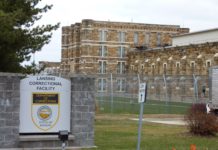
She started her career in May of 2000 at the Larned State Correctional Facility as a corrections officer.
She has held several positions within the agency, including working as corrections counselor where she worked with a specialized resident population focusing on goal setting to attain a successful reintegration back into a general population setting.
In 2013, Perez transferred to the Corrections Department’s central office as a prison rape elimination act program consultant, followed by work as the statewide contract jail manager, staff development trainer and most recently as the Prisoner Review Board administrator for the past six years.
Perez earned a bachelor’s in criminal justice studies and political science from Fort Hays State University.
Sage Hill was president of the Kansas State Troopers Association last year when Nelms was paroled.
He is now a lieutenant with the Kansas Highway Patrol and agreed to discuss the bill, but his comments do not reflect the views of the agency.
“The pain that we felt when that happened last year, it was just crazy,” Hill said in an interview.
“It was just absolutely insane that they would do that. Everybody was grossed out by it.”
Hill added, “We have to make sure that doesn’t happen again.”
“The framework of this bill, if successful, is going to absolutely accomplish that.”
Masterson, the Senate president, said he supported the bill.
He called it a “meaningful advancement for justice in Kansas.”
He said expanding the membership would ensure “a more balanced, qualified composition through updated appointment procedures.”
“Crucially, it strengthens victims’ rights. The bill mandates that parole hearings for serious crimes be postponed if victims or their families are not properly notified of the public comment session.
“This guarantees them a reliable opportunity to provide input in person or otherwise. It prioritizes their voices, respects their experiences, and enhances public safety.”