





State appeals court judges on Tuesday peppered lawyers seeking to make fusion voting legal with questions about whether the method was confusing and if it was an issue that should be decided in a courtroom and not at the Capitol.
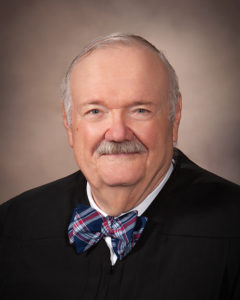
About a minute into oral arguments Tuesday, Judge Stephen Hill took on the lawyer for United Kansas, a new political party created in Kansas in 2024.
The United Kansas party was created with a goal of backing “fusion candidates” who could represent more than one party on the ballot, which led to a lawsuit challenging a 1901 law that banned this type of voting.
“Counsel, I’d like to ask a very fundamental question,” Hill started.
“Are you on the wrong side of 10th Avenue right now?” Hill asked, alluding to the Topeka thoroughfare that runs between the Capitol and the state’s Judicial Center.
“Shouldn’t you be across the street in that domed building asking for a change in the law, repeal the old law and bring something new?” he said.
The lawyer for United Kansas resisted the idea, saying the court has a duty to determine whether the law banning fusion voting was unconstitutional.
“The circumstances here are unique,” said Ori Lev, representing United Kansas.
“Dominant political parties have no incentive to change the laws that grant them an advantage and stifle competition in the state,” Lev told the court.
At that point, Chief Appeals Court Judge Sarah Warner cut in.

“Isn’t that a political problem, not a judicial problem?” she said.
Lev argued that courts may need to intervene if there is a structural issue that prevents a legislative solution.
“Fundamentally, our challenge is that this violates Kansans’ right to free speech and association under the Kansas Constitution, which was adopted at a time when fusion voting was widespread and commonplace,” he said.
“This is not a political question. It is a legal question that is appropriate before this court,” Lev told the panel of three judges.
“Sure, the Legislature could choose to repeal the law if it wanted to act against its own interests,” he said.
“But that would not negate this court’s duty to consider the legality of the constitutionality of the statute under the state constitution,” he said.
The case is centered on something called fusion voting, which allows multiple parties to nominate the same candidate for the same office in a general election with all the votes added together for a final tally.
While the two major parties nominate different candidates, third parties may cross over and endorse one of the major party candidates and “fuse” with them.
Organizers of the effort said fusion voting could help moderate Kansas politics and drive the state more to the political center.
Fusion voting is a creature of the 19th century when it was a part of U.S. politics, particularly in the West and Midwest, according to a 2020 Idaho Law Review article exploring the issue.
The issue of fusion voting dates back more than 100 years in Kansas when the Populist Party and the Democratic Party would nominate the same individual to the same office.
After the Republicans swept the November 1900 election, in the 1901 session, they immediately enacted legislation to prohibit “fusion tickets.”
They barred anyone from accepting “more than one nomination for the same office” and said that “the name of each candidate shall be printed on the ballot once and no more.”
The United Kansas lawsuit says the fusion voting ban violates the state constitutional guarantees of freedom of speech, freedom of association and equal protection.
Lev said fusion voting was common in 1859 at the time the Kansas Constitution was adopted.
He said, at the time, political parties could print their own ballots and multiple parties could have the same candidate for the same of office, although it led to fraud and corruption.
Warner cut in again.
“The fact that previously fusion voting was permitted in Kansas doesn’t tell us anything about whether the Legislature’s decision in 1901 to eliminate that practice was constitutional, does it?” she asked.
Lev said he thought that it did send a message.
“I think that its permissibility shines a light on the meaning of the Kansas Constitution, that adopters of the constitution in 1859 were familiar with fusion voting.
“I absolutely think it’s relevant to the constitutional question,” he said.
Lev said the Kansas Constitution was adopted in a different historical era, which is important in understanding how the state’s founders might have viewed the issue.
Later, Warner turned her attention to the possibility that fusion voting could create confusion with Kansas voters.
Confusion factored somewhat into District Judge Jared Johnson’s decision to dismiss the lawsuit when he found that fusion voting “incentivizes mischief” by allowing candidates to appear on the ballot multiple times as the nominee of different parties.
For example, Johnson said a major political party could create multiple minor parties to have its candidate appear multiple times using “valuable ballot real estate to promote their platform.”
Similarly, a fringe candidate could obtain multiple minor party nominations that suggest they have more widespread support than exists.
“It is difficult for this court to see a scenario where fusion voting would not cause voter confusion, at least for a time,” Johnson wrote.
“Fusion voting has been banned in Kansas for over 120 years, and is the exception, not the rule, across the country,” he wrote.
“Common sense would dictate that voters are not used to seeing candidates endorsed by multiple parties during a campaign or on the ballot.”
Lev noted that two states – New York and Connecticut – allow fusion voting. He said they provide the most relevant point to addressing whether fusion voting is confusing.
“Is there any evidence of voter confusion there? I’m not aware of it,” Lev said.
“And if the state is, they are free to bring that in as evidence on remand to establish that voter confusion is a legitimate interest,” he said.
But Warner pushed further.
“If I go in (to vote) and see the same name listed twice, what am I supposed to do?” she asked. “Do I vote for all of the times that name shows up? Do I vote for one? And if I vote for all, does that toss the ballot?”
Lev said the judge was underestimating the intelligence of Kansas voters, who he said were just as capable as voters in New York or Connecticut in understanding fusion voting.
Connecticut and New York use a type of fusion voting where the ballot lists a candidate multiple times, once per party.
Those states have a format that gives voters the choice of voting for a candidate under two scenarios, as a Republican or Democrat and as a minor party nominee.
Lev said there would likely be instructions on the ballot as well as educational campaigns by the state and political parties as well as sample ballots printed by the League of Women Voters and others.
“In the same way the voter understands how to vote on any ballot, they would understand how to vote on this ballot,” Lev said.
But Warner questioned the risk of confusing voters.
“Isn’t the danger of having a voter misunderstand and that person’s vote not be counted a danger that, from a policy matter, the state should be concerned about?” Warner asked.
Lev disagreed.
“I do not see any logical leap from I have a name listed twice on the ballot – one with the Republican Party and one the United Kansas Party – that is inherently likely to confuse voters any more than any other manner of voting,” Lev said.