




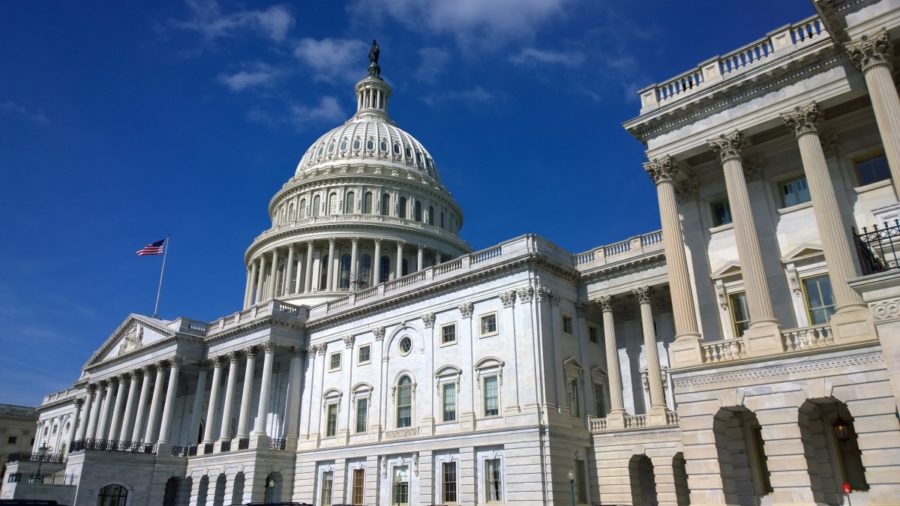
U.S. Senators on Wednesday probed and prodded three nominees for the federal bench in Kansas, asking them about a range of topics including their judicial philosophy, the local police raid of the Marion County Record and the 1998 master tobacco settlement.
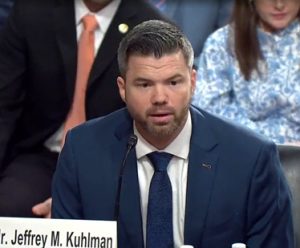
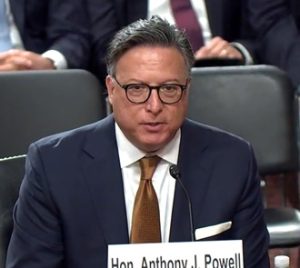
Kansas Bureau of Investigation Director Tony Mattivi, Solicitor General Anthony Powell and Great Bend lawyer Jeffrey Kuhlman appeared before the Senate Judiciary Committee for their confirmation hearing after they were nominated by President Donald Trump.
They generally glided through a series of questions without much difficulty compared to federal appeals court nominee Justin Smith, Trump’s personal attorney whom Democrats battered with questions about who he thought won the 2020 election.
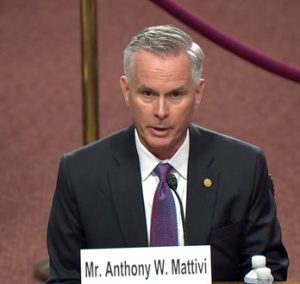
All three described themselves as originalists, meaning they interpret the constitution based on the meaning at the time it was adopted. They also described themselves as textualists when interpreting the law.
Democrats didn’t focus on much of their current work, although Mattivi and Kulhman were asked about the 2023 local police raid on the Marion County Record that drew national attention and criticism over a violation of press freedoms.
The search of the newspaper’s office appeared to arise from questions about how a newspaper reporter gathered information that a local business owner, who was applying for a liquor license, had lost her driver’s license over a drunk-driving offense. There were allegations that the information was “illegally obtained.”
Two special prosecutors who reviewed the raid said that the newspaper hadn’t committed a crime and the search warrants signed by a judge had inaccurate information. Ultimately, Marion County agreed to pay about $3 million and apologize for the raid.
In a statement widely reported at the time, Mattivi said he believed the freedom of the press “is a vanguard of American democracy.” His statement also said that members of the media are not “above the law.”
“The KBI is entrusted to investigate credible allegations of illegal activity without fear or favor,” the agency said. “In order to investigate and gather facts, the KBI commonly executes search warrants on police departments, sheriff’s offices, and at city, county and state offices. … No one is above the law, whether a public official or a representative of the media,” Mattivi was quoted at the time as saying in The Kansas City Star.
Illinois Democratic Sen. Dick Durbin asked Mattivi whether the KBI had any role in the raid on the Marion County Record and whether the agency made any changes on how it conducts any investigation involving the media.
He also asked how Mattivi, as a judge, would assess whether to sign a warrant involving the media.
“The media reports at the outset of this event talked about the KBI being involved in the raid and, in fact, even represented that the KBI led the raid,” Mattivi told Durbin.
“Ultimate facts determined that was not the case at all,” he said. “There was no KBI agent present on the raid.”
Mattivi said he had to be careful discussing the event, explaining there was still pending litigation.
But he emphasized that the KBI was not party to any of the litigation following the raid.
“I think that demonstrates conclusively what the KBI’s involvement in the raid was,” he said.
He called the freedoms afforded by the First Amendment as a “foundational underpinning of our society.”
“I believe that the press is absolutely protected under the First Amendment,” he said. “At the same time, I believe that press is not above the law nor is any individual.
“I don’t believe those are mutually exclusive. I believe they both can be true. I believe they both are true. That would be my stance on the bench.”
Kuhlman said he was retained after the raid to represent the Marion County Sheriff’s Office and the Marion County officials who were potential defendants.
He said his clients were the ones who entered into the agreement to settle a lawsuit for $3 million.
He said there are other cases still pending and he had to be cautious about what he could say about the case.
“If fortunate enough to be confirmed, I believe the First Amendment is a foundational principle of our Constitution. I’m a strong believer in it,” he said.
“I will apply the binding precedent regarding the First Amendment fairly and faithfully.”
Durbin asked Powell about comments he made about the 1998 master tobacco settlement between 46 U.S. states, five territories, the District of Columbia and the four largest tobacco companies.
Durbin praised the settlement, saying it has reduced smoking among children and stopped merchandising to children. He said he thought the settlement made a difference for country.
The tobacco industry agreed to pay out more than $200 billion as part of that settlement and new marketing restrictions that included a ban on billboard ads and cartoon mascots.
“I wondered if there was anyone across America who would stand up and speak out against that settlement. It turns out that was you,” Durbin told Powell.
Durbin quoted Powell saying, “It’s not politically correct to criticize the tobacco settlement, but I am not willing to junk 500 years of common law in exchange for a pot of gold.”
Powell said his primary complaint with the tobacco settlement was related to excessive attorney fees.
“There were provisions in the settlement agreement, which provided for huge monetary payments to the attorneys general local counsel and it far exceeded what would have been reasonable for attorneys to receive in terms of pay,” he said.
Powell said local counsel received $27 million in fees in the settlement and “literally the only thing they did was file the complaint.”
Durbin followed up, saying Powell’s quote didn’t mention attorney fees. He asked Powell if he opposed the settlement.
“My principal complaint, senator, was opposition to the attorney fee provision,” Powell said.
The nominations now before the U.S. Senate could be potentially the last for many years.
President Trump’s already named three of the state’s six judges: Holly Teeter, Toby Crouse and John Broomes. He will now get to appoint all six in Kansas.
Former President Joe Biden had a chance to fill a seat that came open when U.S. District Judge Julie Robinson moved to senior status.
But the Biden administration fumbled the appointment away when the president nominated federal prosecutor Jabari Wamble, the son-in-law of Democratic Congressman Emanuel Cleaver of Missouri, to fill Robinson’s seat.
Wamble later withdrew, and the Biden administration never moved forward with another nomination to fill Robinson’s seat.
The Biden administration initially appointed Wamble to the U.S. 10th Circuit Court of Appeals, but he ultimately didn’t make the cut after he was not rated by the American Bar Association.