
Republican state Sen. Larry Alley of Winfield plans to count the number of senators who might be interested in calling a special session to address property taxes, although he’s running into a serious roadblock.
In an email to Republican senators early Wednesday afternoon, Alley said he discussed a new property tax proposal with Senate President Ty Masterson on Tuesday night.
He planned to count the number of interested senators and provide that number to Masterson.
But late Wednesday afternoon, Senate Majority Leader Chase Blasi tried to quell speculation about a special session in a letter to the Republican caucus.
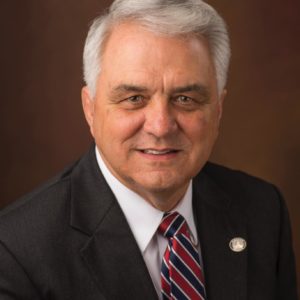
“Looking ahead, while there is broad agreement on the goal of further property tax relief, the current reality does not support a productive outcome through a special session,” Blasi wrote in the letter.
“There is not a two-thirds consensus in each chamber, nor alignment with the governor, on a singular path forward,” Blasi wrote.
“Let us spend our time working with our colleagues across the rotunda to build a bicameral solution.
“Accordingly, I will not be signing any petition to convene a special session or advocating for one under these circumstances,” he said.
Alley and two other Senate committee chairs – Rick Billinger of Goodland and Caryn Tyson of Parker – are pitching a proposal that calls for eliminating the state’s 20-mill property tax levy for schools and replacing it with a statewide three-quarter cent sales tax.
They also have proposed a bill that would eliminate the need for legislative approval before a county can vote on a countywide sales tax as well as a vote on a constitutional amendment to cap property values at 3%.

Alley said Masterson asked how many senators would sign a request for a special session. Alley said he couldn’t answer the question because he had only sent out the proposal to other senators earlier in the day Tuesday.
In the email, Alley – the former Senate majority leader – asked senators to text or email him about their intentions for a special session. Alley said he would report that number back to the Senate president.
“This count will be just for the Senate, and only on the three subjects identified,” Alley wrote, alluding to the proposal to eliminate the 20-mill school levy and the other two components of the proposal.
“As you know, we can’t control what the House will do, so this will be just for the Senate,” Alley said.
“This count will be communicated to the president,” Alley wrote.
“If the number is sufficient to call a special session, we will draft the document for each of you to sign and notarize,” he wrote.
The idea of calling a special session at this point in time is considered a long shot, especially with the primary election now three months away.
The governor can call a special session, although she’s expressed no interest in calling one. Or two-thirds of the Legislature could call a special session, something that’s only been done once in Kansas history.
A special session would potentially distract from efforts to hold on to the GOP supermajority in the fall with more — and perhaps negative — headlines about property taxes with the election so close.
Masterson hasn’t quite shut the door on a special session, saying Tuesday that the Senate will act if the House has the votes for a special session – something most believe is highly unlikely.
A Republican source suggested the ideas proposed by the group of senators weren’t serious.
“There is without a doubt a property tax crisis in Kansas driven by local units of government’s unchecked spending, which Kansas Democrats seemingly encourage to grow unabated,” the source said.
“This crisis demands serious conservative policy solutions and, sure, a special session should be considered.
“However, ridiculous and unserious policy proposals from career politicians — like sending sales taxes skyrocketing to among the highest in the nation – only shifts the problem from one tax to another and is far from a conservative solution,” the source said.
Blasi said the accomplishments of the Legislature should not be overshadowed by the property tax debate.
“In the weeks since adjournment, there has been considerable noise — across traditional media, social platforms, and from gubernatorial candidates — about what did or did not occur during the 2026 session,” Blasi wrote.
“The record, however, speaks for itself. Through your leadership, the session was a clear success: 157 bills were enacted into law, including 20 that required our Legislature’s supermajority to override gubernatorial vetoes.
“We should not allow a ‘glass half empty’ narrative to overshadow these accomplishments. Together with our partners in the House of Representatives, we advanced a strong, principled agenda.”
He pointed to legislation passed since 2022 that has cut taxes for Kansans, including a bill that Gov. Laura Kelly signed into law in 2024 that cut taxes by about $1.2 billion over three years.
The Legislature also passed a bill signed by the governor that eliminated the state’s 1.5-mill property tax levy that funds maintenance and renovations of some state buildings.
Lawmakers also passed a bill that gradually moves the state to a single tax rate as income tax revenues beat inflation.
The bill gradually cuts individual income taxes to 4% when the state generates $5.96 billion that come from income taxes plus inflation.
Republican state Sen. Stephen Owens of Hesston said he was hesitant about a special session because there was no consensus on property taxes.
He questioned the value of making another stab at passing a 3% cap on property values.
“We have sent that to the House so many times and they’ve rejected it,” Owens said.
“I don’t understand why that would still be part of the conversation at all,” he said.
“There are some interesting ideas, but I’m very hesitant to call a special session when there’s no consensus on what we should do,” he said.
“At this point, I am very hesitant, but I am still technically undecided,” he said.