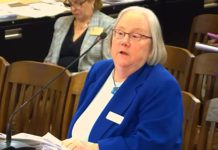



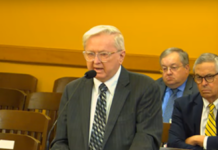


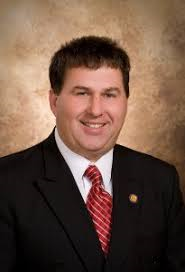
Republican state Sen. Rob Olson, chair of the Federal and State Affairs Committee, says he regrets not moving the medical marijuana bill out of his committee this year and is promising to have a proposal ready for next session.
“Unfortunately, due to the heavy load of the committee, I regret and take responsibility for not getting the measure across the finish line,” Olson said.
The Olathe lawmaker plans to ask for six hearings during the interim so a bill can be ready to go at the start of the 2023 legislative session.
“I am proud of what has been accomplished since the beginning of this session, but not convinced that we have been able to fully take into account all the complexities presented by all the patients, experts…and agencies that will be responsible to regulate the recommendation, cultivation, production, distribution and safe consumption of substances that come from the cannabis plant.”
A conference committee last took up the medical marijuana bill on April 28, hours before the Legislature’s veto session ended.
There seemed to be some hope coming out of a conference committee that the House and Senate could agree on a bill, although there were still issues that needed to be worked out.
A bill was drafted in the Senate, and it was similar in many ways to the one that passed in the House last year. Here’s a side-by-side comparison of the two bills.
While House and Senate negotiators agreed to many aspects of a broad bill, there was not enough time to work out any differences as the session came to an end.
Olson said it was difficult to find consensus on a bill.
“There are so many different groups,” he said in a recent interview. “Every time you think you’re making progress, then these groups start fighting.”
The House and Senate agreed on the tax rate, how the revenue would be distributed, the fees for patients and some general agreement on the conditions that would qualify for using medical marijuana and the restrictions on treatment.
The conference committee, among other things, couldn’t work out differences on license fees for retail dispensaries, distributors, cultivators, testing facilities and processing facilities.
The Senate had proposed higher fees covering two years.
For instance, the Senate proposed charging retail dispensaries $20,000 for an initial application and a renewal plus an $80,000 for a biennial license fee.
The House had proposed $5,000 for an initial application fee and renewal and $40,000 for an annual license fee.
There also was some debate over a House proposal for the Kansas Board of Regents to establish a pilot medical marijuana program before next January.
The Board of Regents was to pick a company to administer the pilot program by joining in a partnership with one or more state universities to cultivate, test, process, distribute and research medical marijuana.
The company was to make recommendations to state health officials about best practices for regulating a medical marijuana program in Kansas.
Senate negotiators said they would need to take a deeper look at the pilot program, which would start a year before medical marijuana would be sold statewide.
Olson said he feared the pilot program would give the company selected to run the pilot program a competitive edge in the sale of medical marijuana.
There are 37 states that now allow medical marijuana, according to the National Conference of State Legislatures.
Eighteen states have enacted measures to regulate marijuana for adult nonmedical use.