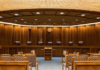





A new set of congressional districts is raising questions over the membership of the panel that screens applicants for the Kansas Supreme Court.
When the Legislature passed a new congressional map, it moved Lawrence into the 1st District and part of Wyandotte County into the 2nd District.
The effect of those changes filtered down to the Supreme Court Nominating Commission, where a member has been moved out of his existing district.
There are no current openings on the Kansas Supreme Court so there is time for the nominating commission to work out the issue.
The congressional maps are also being challenged in court, which could resolve the issue of representation on the commission without any action.
“We’re looking at it carefully. We’re trying to figure out what the best approach is,” said Gloria Farha Flentje, chair of the Supreme Court Nominating Commission.
“We don’t want to disenfranchise anybody that we shouldn’t, and we also don’t want to do something that is inappropriate,” she said.
There are nine members on the commission, five lawyers and four nonlawyers.
Four lawyers and the four nonlawyers represent each of the state’s congressional four districts. The ninth person – a lawyer – is elected by lawyers statewide.
Lawrence lawyer Terry Campbell, who was elected by his peers in the legal community to represent the 2nd District, has now been moved to the 1st District with the new maps.
He would now be grouped together with Garden City lawyer Gerald O. Schultz, who was similarly elected by lawyers to represent the 1st District.
State law is somewhat ambiguous about how Campbell would be affected.
The law that governs membership on the commission doesn’t address the possibility that a member could be drawn out of their congressional district.
The law says that any commissioner who “changes his place of residence” to a district from which they weren’t elected or appointed shall no longer be a commissioner.
Flentje notes that the law suggests that a commissioner would have to move out of the district, not just be legislatively drawn out.
“Nobody’s moved. It sounds like it takes action by the member,” she said.
“When the Legislature put these statutes together on the Supreme Court Nominating Commission, I don’t think anybody thought about, ‘Well, what if we redistrict them out?’
“So, there’s nothing that addresses that,” she said. “We’re looking at it and doing a little research, and we’re trying to figure out where we’re going to go.”
The commission is now seeking an attorney general’s opinion on the issue.
Later this year, Schultz is up for reelection after serving one term.
And Linda Weis of Manhattan, an appointee of former Gov. Sam Brownback, is nearing the end of her second term and her position will be filled by Gov. Laura Kelly.
The commission is now in the process of having attorneys update their information in the attorney registration database based on the new congressional district legislation so the commission can run the correct voting list for the next election.
If a lawyer leaves the commission, the chief justice of the Supreme Court appoints someone to fill the unexpired term until the following July when a special election would be held for a lawyer to serve out the term.
It would be up to the governor to appoint someone to fill the unexpired term if a nonlawyer leaves the commission.