


(Updated to include comments from other lawmakers)
It’s over.
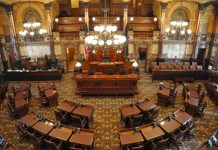
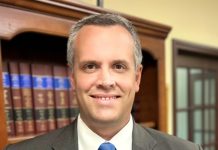
House Speaker Dan Hawkins announced late Tuesday that the battle to collect enough signatures to call a special session to address redistricting was over.
He said he was disappointed that lawmakers would not get the chance to draw new election boundaries for members Congress, change a law addressing gender marker changes on driver’s licenses and provide oversight of federal health care money.
“I’m writing you today to express my disappointment for our 78 colleagues who will not get the chance to vote on redistricting, a fix to SB 180, and legislation establishing accountability for the Rural Health Transformation funds in a special session,” Hawkins said in an email to the Republican caucus.
“Addressing these issues was clearly a priority for a super majority of our caucus,” Hawkins said in the email obtained by the Sunflower State Journal.
“As I’ve said before, timing is everything,” Hawkins said in the email. “Rest assured, while these three issues won’t be addressed in a special session, they all remain of utmost importance and will be considered at a later date.
“Thank you to everyone who engaged in thoughtful conversations throughout this process. I look forward to working with each of you come January to achieve our shared goals.”
Lawmakers had set Friday as the date for holding a special session, but with each passing day it appeared more and more unlikely.
In addition to redistricting, lawmakers would have likely considered limits on gender marker changes on driver’s licenses and new oversight over how the state spends its estimated $1.5 billion share of money from the new Rural Health Transformation Program.
It was always believed that the House was between six and eight votes short of the 84 signatures needed to call a special session, a number Hawkins’ email seemed to confirm.
Senate President Ty Masterson recently announced that he had signatures from two-thirds of his chamber to call a special session.
Masterson, who is running for governor, said the Kansas Senate delivered for President Donald Trump and will continue pressing that agenda forward during the 2026 session.
He said he would make redistricting a top priority when the Legislature meets in 2026.
“President Trump asked Republicans to fight for fair maps and for America’s future,” said Masterson, who would stand to gain from a Trump endorsement in the GOP primary.
“We did our part — and we’ll keep leading the charge here in Kansas.”
The president ignited a national redistricting battle when he called on Republicans to redraw congressional districts in Texas to gain five additional seats in the U.S. House.
Texas, Missouri and North Carolina redrew congressional maps to enhance Republicans chances of getting elected to Congress next year.
Together, they could add seven Republican seats.
California voters were headed to the polls Tuesday to ratify a new redistricting plan in that state that could have added five Democratic seats.
And Virginia had already moved ahead to redraw lines in a way that it could have boosted the chances of electing two to three Democrats.
Meanwhile, The Associated Press was reporting that the Senate leader in Indiana – where the Trump administration put on a full-court press to draw new maps – said there weren’t enough votes to draw new election boundaries.
The top Democrat in the House, Brandon Woodard, noted that Kansas was the first state to have turned back efforts at mid-decade redistricting.
“Tonight’s announcement is a testament to the people of Kansas making it crystal clear that they oppose any attempt, by any party, to cheat the system by drawing new Congressional districts,” Woodard said.
“In Kansas, we use Census data and public input each decade to draw new maps, not pressure from any White House,” he said in statement.
Any new map drawn in Kansas would have likely targeted the 3rd Congressional District represented by Kansas lone congressional Democrat, U.S. Rep. Sharice Davids.
Any new maps would have likely carved up Johnson County – the anchor of that district – two or three ways.
“For months, extreme Republican legislators in Topeka have been scheming with D.C. politicians to silence Kansas voices,” Davids said in a statement.
“Today, we’ve won the first round in this fight against gerrymandering, but their plan to cheat the system isn’t over.,” she said.
“They’ve made it clear they’ll do anything to hold onto power, but I’ve been just as clear: voters should choose their representatives, not the other way around.”
Nevertheless, Republican state Rep. Pat Proctor of Leavenworth said he believed the issue was not going away.
“I would have preferred that we call a special session to consider redistricting, but make no mistake, we are going to vote on a redistricting bill,” Proctor said in a text message.
“With blue states from California to Virginia gerrymandering their states to stop President Trump’s America First agenda, Kansas has an obligation to the nation, and every Kansan who voted for that agenda, to fight back.
“I have no doubt redistricting will be the first order of business when we convene in January,” he said.
Opposition to any new redistricting plan had already been mobilizing.
The Kansas Fair Maps Coalition announced Tuesday it collected more 3,400 signatures, postcards, and emails from Kansas citizens urging lawmakers to stop the redistricting push.
A rally had been planned for Friday, the day the Legislature had targeted for a special session.
“We are pleased that our elected officials finally listened to the people of Kansas,” said Laurel Burchfield, advocacy director for the Mainstream Coalition.
“Changing the maps mid-decade to rig the system in their favor is wrong. What Kansans want is for their leaders to work together on the things that matter the most for Kansas families — like lowering costs, making healthcare affordable, and improving our economy.”