




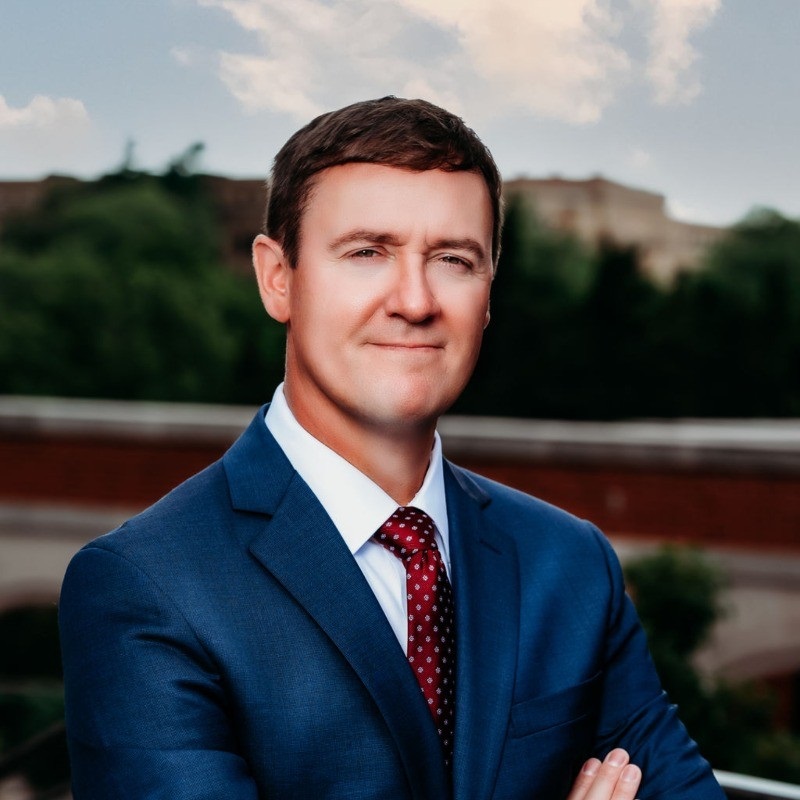
A federal public defender with a deep military legal background who once represented Guantanamo detainees charged with war crimes is President Joe Biden’s pick for a seat on the U.S. 10th Circuit Court of Appeals.
The president on Thursday morning announced his intent to appoint Rich Federico to a seat on the Denver-based appeals court to fill the seat of Mary Beck Briscoe, who has taken senior status.

Kansas has two seats on the appeals court. The other is held by former Kansas Supreme Court Justice Nancy Moritz.
A 2002 University of Kansas Law School graduate, Federico started with the Kansas Federal Public Defender’s office in 2017 after working as an assistant federal public defender in Portland, Oregon.
He’s a senior litigator and assistant federal public defender in Kansas. He’s described as a running enthusiast who likes to read, coach youth sports and root for KU.
He graduated from Indiana University with a bachelor’s degree in journalism in 1999 and he received a master of laws from the Georgetown University Law Center in 2012.
He’s also served in the U.S. Navy in the Judge Advocate General’s Corps and is a captain in the Navy Reserve JAG Corps.
He served as a prosecutor and a public defender for the Judge Advocate General’s Corps from 2002 to 2015.
He has been a military judge for the Navy Reserve Trial Judiciary since 2019, and he served as an appellate defense counsel from 2015 to 2019.
During his career, Federico was assigned to represent Guantanamo detainees charged with war crimes who were tried by military commissions.
He served assistant defense counsel for a Yemeni detainee charged in a joint, capital trial for plotting the Sept. 11 attack, according to his LinkedIn profile.
He also was the lead defense counsel for an Afghan detainee charged with providing material support for terrorism, his online profile shows.
At one point, he represented Mohammed Kamin, who was accused of joining al-Qaeda and learning how to make detonators for roadside bombs and transporting weapons to be used against U.S. forces that invaded Afghanistan after the Sept. 11 attack.
Three years ago, Federico defended a soldier stationed in Kansas who had been accused of sharing bomb-making instructions to fellow “radicals” and plotted to blow up cell towers and news stations.
The soldier later pleaded guilty to distributing instructions for making explosive devices over social media.
Federico argued in that case that the soldier was charged with sharing information that was available to anyone on the internet within minutes.
In 2013, Federico authored an article for the Berkeley Journal of Criminal Law that said Congress should abolish the death penalty for unique military, nonhomicide offenses.
“Military necessity does not require keeping the death penalty on the books as an eligible punishment for unique military offenses,” he wrote.
“Capital punishment for these crimes is unusual, excessive, and especially ripe for procedural failure in a military justice system with an abysmal record in the modern era,” Federico wrote.
He contended that the availability of a “harsh, alternative sentence” such as life without eligibility for parole met the needs for punishment.
He said a life sentence without parole “significantly lessens the military necessity of keeping death on the books for unique military offenses.”
A life sentence without eligibility for parole, he wrote, “completely incapacitates a person convicted of committing a unique military offense from again committing the same or similar offense.”
The remaining justifications for the death penalty in the military, he contended, “are retribution and the preservation of good order and discipline in the armed forces.”
“These justifications are no longer necessary, nor lawful, for unique military offenses when a death sentence for these crimes would be ‘unusual,'” he wrote.
“Once the justifications are removed, combined with the existence of (life without parole) as a harsh, alternative punishment for the most severe unique military offenses, there is no lawful purpose for keeping these offenses death-eligible.”
Three years ago, Federico signed onto a letter from the Federal Public Defender’s Office decrying the state Senate’s decision not to confirm Gov. Laura Kelly’s state appeals court nominee because of his work as a public defender.
The Federal Public Defender’s office sent a letter to every state senator saying that Carl Folsom III – now a district court judge – was unfairly maligned for his work as a public defender when the Senate voted down his nomination to the Kansas Court of Appeals.
The Biden administration had originally nominated federal prosecutor Jabari Wamble for a seat on the 10th Circuit appeals court, but later reversed course and nominated him for a seat on the U.S. District Court in Kansas.
Wamble later withdrew his candidacy after he failed to get rated by the American Bar Association for either position.