





(Updated to include recommendation to full Senate)
State appeals court nominee Lori Bolton Fleming on Monday morning navigated questions about judicial philosophy, agency regulations, attorney shortages and how to define a woman.
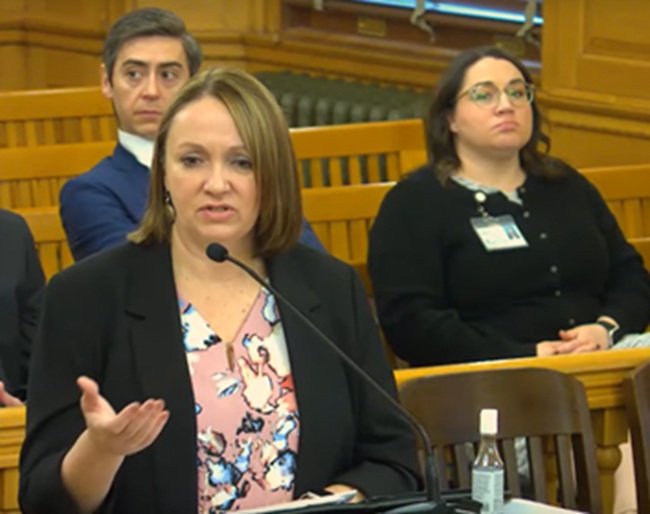
Fleming, a district judge appointed by Gov. Laura Kelly to sit on the Kansas Court of Appeals, appeared before the Senate Judiciary Committee where she fielded a variety of questions during her confirmation hearing.
The Senate Judiciary Committee recommended Fleming to the Senate for approval.
Fleming told senators that judges apply laws, don’t make them and that she uses an originalist approach in interpreting law.
She said she prefers to defer to the Legislature in interpreting the law.
She also said judges should acknowledge binding legal precedent but added that they have a separate obligation to make their own rulings and point out where they disagree.
Republican state Sen. Kellie Warren of Leawood, chair of the Senate judiciary committee, asked Fleming directly about how she would define a woman.
“Courts don’t make law,” Fleming said.
“If the executive branch or the legislative branch has created a law or an administrative order that answers that question, it’s not really before the court to answer that,” she said.
“We leave that through the people through the elected representatives,” she said. “That’s certainly not an issue that has come up in front of me.”
Another senator asked Fleming a question about the implications of a 2023 law that requires any state agency, school district or local government that collected vital statistics for public health, crime, economics or other topics to identify each individual as either a male or female at birth.
The attorney general sued the Department Revenue and the Division of Motor Vehicles when it refused to change the policy for allowing transgender Kansans to change their gender markers on driver’s licenses. The case is now at the Court of Appeals.
Fleming said she wasn’t familiar with that law enacted by the Legislature and had not followed the case. She also was hesitant to address the case specifically for fear that it could interfere with her ability to hear it in the future.
“Generally speaking, we defer to the work of the Legislature,” she said. “We only interfere in that, especially constitutionally, if there is a clear violation of the constitution.
“If the public doesn’t agree with the work they’re doing, they have a remedy at the voting box,” she said.
“As judges, we don’t make law. We don’t modify law. We simply apply the law, or we send it back to the Legislature for further consideration.”
Warren also tried to gauge how much latitude state agencies should be given in making public policy.
She cited a 2021 Supreme Court case that found that an agency ruling within its area of expertise is entitled to some deference.
“Are there circumstances that would entitle an agency any level of deference in its legal interpretation under Kansas law?” Warren asked Fleming.
Fleming said that was a complex issue to address, adding that she didn’t want address any particular case out of fear she would have to recuse herself in the future.
“It depends on what happens in this body,” Fleming said.
“As far as agency regulations, that’s always a difficult area because sometimes there will be a conflict with case law or there will be a conflict with what the Legislature has done,” she told the Judiciary Committee.
“Should an agency have a greater power than an entire Legislative body or a branch of government?” she asked.
“If you look at separation of powers that is a legislative function. Agency law, I’m not sure it should necessarily receive deference.”
In deciding cases, Fleming told the committee that she starts from the idea that lawmaking emanates from decisions made by voters.
“The vast majority of time when I look at the law the Legislature has created, it’s clear and I can just apply it,” she said.
But in cases where words can have different meanings or statutes conflict, Fleming said she uses “originalism” where she goes back in time when the law was enacted to understand the legislative history and what was trying to be accomplished at that time.
Fleming was first named to the bench by former Republican Gov. Sam Brownback in the 11th Judicial District in 2012.
She is now the chief judge for the 11th Judicial District, which includes Cherokee, Labette and Crawford counties.
Before she became a judge, Bolton Fleming served as an assistant county attorney in Crawford County before specializing in legal research and writing for Spigarelli Law Firm.
She then practiced with the Wilbert and Towner law firm, working on criminal, civil, juvenile, business, adoption and probate cases.
Bolton Fleming graduated from the Washburn University School of Law in 2001, where she served as the editor-in-chief of the Washburn Law Journal.
She earned a bachelor’s in music education from Pittsburg State University in 1996.
Before joining the legal profession, Bolton Fleming served as an elementary music and English teacher at Fort Scott High School and Leavenworth Public Schools.
Fleming recently served on a task force that documented a shortage of lawyers in rural Kansas, noting that there are more attorneys practicing in Kansas City, Missouri, than all of rural Kansas.
Fleming was asked what she was doing on a grass-roots l to address that problem.
“One thing you have to keep in mind is that our shortage is not unique to our profession, it’s actually occurring in a number of different professions,” she said.
She said there is a young professional group in southeast Kansas that supports all professions.
She said attorneys interviewing for jobs in southeast Kansas are welcome to visit the courthouse and meet the judges and attorneys.
She said the local bar association has events welcoming new attorneys.
“What we’re finding is that people have a lot of questions about living in a rural community if they’ve never done,” she said.
“Just meeting people that live there and have raised their families there has been very helpful,” she said