



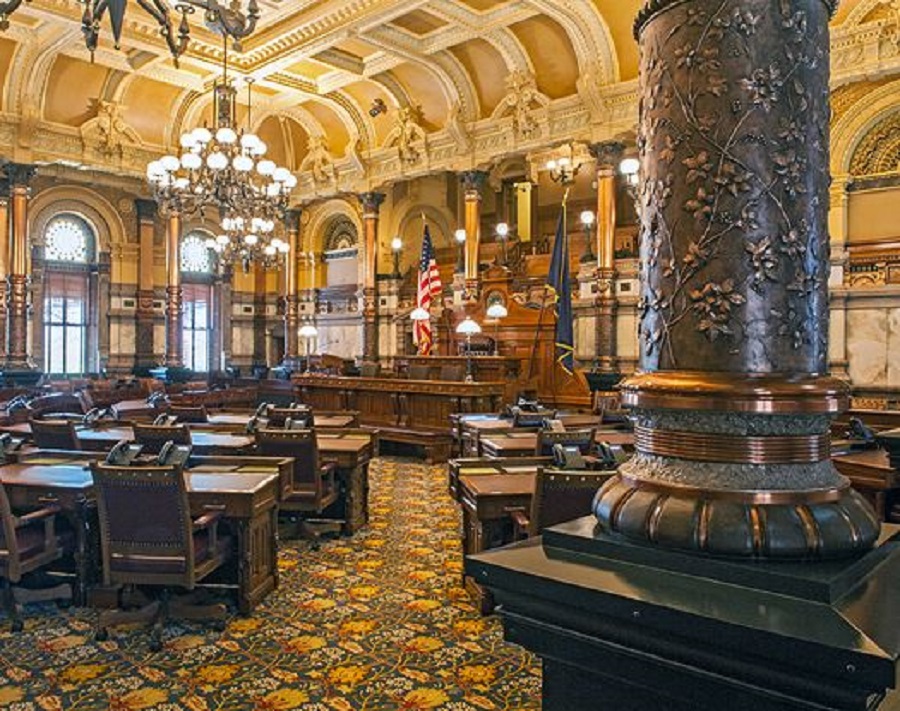
As testy as the climate was in the House last week, the Senate had its own eyebrow raising moment when a Democratic senator questioned the ethics of a Republican colleague on the floor.
In a chamber where decorum establishes that senators direct their remarks to the senator chairing the proceeding, Democratic state Sen. Patrick Schmidt of Topeka took a rare route to criticize Republican Stephen Owens of Hesston.
Schmidt tried unsuccessfully to amend a bail bonding bill with what was described as the “OWENS Act,” short for “Official Watchdog Enforcement of No Self-Dealing.”
He tried amending a bill that, among other things, would have required courts to make available a warrant to the bail bonding agent who posted bail for someone with a felony offense who didn’t appear in court.
The goal was to help the bail bonding agent locate the missing person and force them to appear in court. The bond is forfeited when the criminal defendant doesn’t appear. The bill passed the Senate 31-9.
Schmidt never mentioned Owens by name. But the amendment was clearly directed at Owens by naming the bill after him. Owens has been in the bail bonding business for more than two decades.
Schmidt’s amendment – determined not to be germane for a “variety of reasons” – would have barred lawmakers from voting on matters in which they or their family had special interests.
“I raised questions during committee on this bill because unfortunately we have members of this body that have direct interests,” Schmidt told the Senate.
“I believe that, like Caesar’s wife, we should be beyond reproach in all our dealings, in all our bills and all our amendments,” he said.
The move was seen by some as extraordinary since Robert’s Rules of Order directs against maligning the motives of other members, and it’s the chamber’s custom and precedent not to mention other senators by names in a negative way.
“The Senate is to work for Kansans. Unfortunately, there were instances of members administering personal attacks designed to disrupt decorum and respect for the institution,” said Senate Majority Leader Chase Blasi.
“Credit to our caucus for putting the people’s work over political games, keeping us on track, and passing 63 bills in just two days,” Blasi said.
Democrats generally agreed in principle with Schmidt but didn’t necessarily agree with how the matter was handled. The Senate’s top Democrat, Dinah Sykes, declined comment.
Owens said Schmidt’s tactics were out of bounds.
“To specifically call out a member in the Legislature in an amendment is not appropriate and breaks many of Robert’s Rules of Order,” Owens said in a statement.
“It is equally inappropriate to waste the Revisors’ Office time preparing and introducing dozens of amendments that require you to be ruled out of order and deleterious,” he said.
Schmidt stood by his actions.
“I was elected to do things by the people of the 19th District,” Schmidt said.
“I would say that self-dealing does not poll very well. I’m sorry if some of my colleagues don’t share my interest in taking on that issue.
“I’m not going to be concerned about taking it on when I see it.”
The Senate debate came two days before House debates were disrupted by an incident involving Republican Rep. Nick Hoheisel and Democratic Rep. Ford Carr on the floor that was preceded by race-related comments Carr made at the podium.
The Owens amendment was one of seven consecutive amendments that Schmidt unsuccessfully tried to tack onto the bill – also rare for a legislative debate.
On the sixth amendment, Republican state Sen. Kenny Titus of Manhattan said the amendments were an intentional effort to delay Senate proceedings and asked the chair not to entertain any more of them.
Schmidt was allowed one last amendment before no more were accepted.
“I was trying to make a point about the contents of that bill and I hope that people heard my point even if they weren’t so fond of the style that I made it in,” he said.
Republican state Sen. Kellie Warren of Leawood immediately pushed back on the OWENS Act amendment, saying that there are legislators with various professional backgrounds – lawyers, physicians, veterinarians teachers, farmers – in the Senate.
Warren said that the amendment would make it so that no one could serve in the Legislature given that even a tax bill would affect anyone who pays taxes.
“This is body is a citizen Legislature. We come from all walks of life here in the Kansas Senate,” Warren said on the floor.
“All of our constituents know what walk of life we come from, who we are. We are accountable to the constituents who send us here,” she said.
Owens testified for the bill in committee. In his written testimony, he acknowledged in bold type that he had been in the bail bonding business for more than 25 years.
“As a citizen Legislature, we are required to provide for our families outside of our political office. We are the called to vote on issues that impact us all directly and indirectly,” Owens said in statement.
“If I own property, should I vote to reduce property taxes? If a legislator is a veteran, should they vote on veteran issues?” he asked.
“If a legislator has family on KanCare, should they vote for Medicaid issues? The list goes on and on,” he said.
Owens said he asked Senate leadership if they felt it was a conflict that should keep him from voting on the bill. He said they did not.
Senate President Ty Masterson said he would maintain the Senate’s tradition of decorum.
“The Kansas Senate has always been a body that maximizes decorum and order,” Masterson said in a statement.
“It elevates the level of debate and prevents personal animosity from developing, given the significant subject matter that comes before us and the wide range of opinions on those topics.
“On my watch as president, we will maintain those important traditions, in both letter and spirit,” he said.