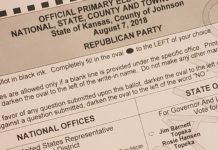







A federal judge on Friday agreed to block a new state law that bans anyone who does not live or not domiciled in Kansas from mailing advance mail ballot applications to Kansas voters.
U.S. District Judge Kathryn Vratil issued a preliminary injunction halting the law, which also bars mailing any advance mail ballot application that has been personalized with the voter’s information.
The law will be halted until the case is concluded, which will likely take months. The law was not set to start until Jan. 1.
“This is a victory for our clients VoteAmerica and the Voter Participation Center and for voters in Kansas,” said the Campaign Legal Center, the group that brought the litigation.
“The enjoined law would have restricted our clients’ programs assisting KS voters to vote by mail,” the center posted on Twitter.
“Voter participation nonprofits are crucial for democracy. Their work must be protected.”
A spokesman for the attorney general said the ruling is being reviewed
The injunction had been sought in a federal lawsuit brought by VoteAmerica and the Voter Participation Center, which contended those restrictions stifle political speech and activity in violation of the U.S. Constitution.
The lawsuit says the bill passed by the Legislature prohibits the groups from employing their most effective means of persuading voters to engage in the democratic process -mailing advance mail ballot applications to registered Kansas voters.
In a 46-page opinion, Vratil dismissed the state’s claim that the bill prevents voter fraud because it limits the number of advance ballot applications that each Kansas voter may receive.
The state had argued that when a voter receives more than one ballot application, it invites fraud, which it has a strong interest in avoiding.
“Defendants’ argument has superficial appeal, but it actually boils down to an issue of
administrative efficiency,” Vratil wrote.
“The state employs a rigorous process to make sure that no voter can receive a duplicate mail ballot. Apparently, these procedures are highly effective.”
Vratil noted that the state presented no evidence of any voter fraud caused by advance
voting by mail, or a single instance in which a voter received duplicate mail ballots.
Vratil noted that when she asked the state’s lawyer about the evidence that supported the state’s premise for passing the law, he responded that the state had no legal duty to present evidence of its rationale for enacting the law.
During the hearing, Vratil was bewildered by the response, saying she never heard of an instance where a court would take a state’s arguments on its face, suggesting that it would make the whole court process irrelevant.
The judge further found that the state had not shown that the law was narrowly tailored to prevent voter fraud.
“The record contains no evidence that out-of-state entities are more likely than in-
state entities to encourage voter fraud or that (the law) is necessary to prevent Kansas voters from receiving duplicate mail ballots.
“Plaintiffs will likely demonstrate that (the law) impermissibly restricts their ability to engage in protected First Amendment activity and that it is not narrowly tailored to serve the admittedly compelling state interest of preventing voter fraud.”
Vratil said the law went well beyond the state’s constitutional authority to regulate elections.
The law “involves direct regulation of communication among private parties who are advocating for particular change — more voting by mail, especially in under-represented populations,” Vratil wrote.
“HB 2332 significantly inhibits communication with voters about proposed political change and eliminates voting advocacy by plaintiffs and other out-of-state entities, based on the content of their message and the residency of the advocate.”
Company officials said their methods, which include prepopulating ballot applications with personal voter information, were the best way to foster voter participation.
Daniel McCarthy, vice president of finance and operations for VoteAmerica, told the court that the law would make it “almost prohibitive” for his organization to offer voter services under the state statute.
VoteAmerica, a California-based 501(c)(3) nonprofit, targets low-propensity voters who may be less affluent or ignored by the political parties.
VoteAmerica says a key component of its messaging is providing voters with information and resources to complete their applications for mail and absentee ballots.
VoteAmerica’s absentee and mail ballot tool delivered personalized advance mail voting applications to Kansas voters by email during the 2020 election cycle.
At least 7,700 Kansas voters used VoteAmerica’s absentee and mail voting tool during Kansas’ most recent elections to receive a personalized advance ballot application.
McCarthy said VoteAmerica is all about reducing the burden for prospective voters, a key element in its mission to encourage more people to vote.
Tom Lopach, president and CEO of the Voter Participation Center, said that voters tend to be more responsive when the profile information is added to the application.
An estimated 69,577 Kansas voters submitted an advance mail voting application
provided by the Voter Participation Center to their county election official in the 2020 general election, court records show.
The federal lawsuit is separate from a broader legal challenge filed in state court that challenges not only the law blocked on Friday but another new law that makes it illegal for Kansans to knowingly falsely hold themselves out as election officials.