





A constitutional amendment that would tweak the language in the document to ensure that noncitizens are not allowed to vote is now headed to voters.
The Kansas Senate, with bipartisan support, voted 37-3 to approve the amendment. The amendment now goes to the voters in November 2026. The bill passed 90-28 in the House.
Critics called the legislation political grandstanding and said there was no substantive basis for adjusting the language in the constitution.
The supporters said the constitutional language needed to be refined to ensure noncitizens could not vote.
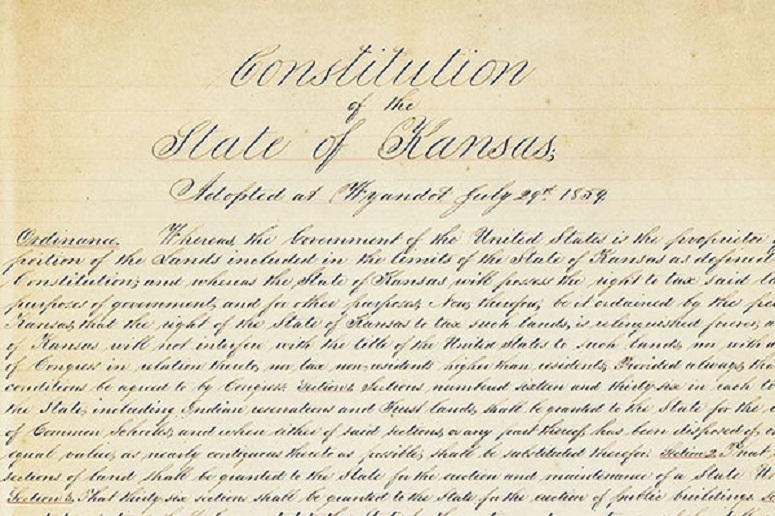
As currently written, the Kansas Constitution says that “every citizen of the United States who has attained the age of 18 years and who resides in the voting area in which he or she seeks to vote shall be deemed a qualified elector.”
The proposed amendment would rework the language so that the constitution would explicitly say that no person shall be a “qualified elector” – or voter – unless they are a citizen of the United States.
Even in the Senate where it had overwhelming support, there were skeptics about the need for the amendment including those who supported the measure.
“I do not think noncitizens are voting in our elections,” said Dinah Sykes, the top Democrat in the Senate.
Asking if the issue was such a problem, Sykes pushed to move the amendment up to 2025 for a public vote. It was rejected by the Senate.
Democratic state Sen. Ethan Corson of Fairway directly asked whether there were noncitizens voting in Kansas elections.
“It’s difficult to say,” said Republican state Sen. Mike Thompson of Shawnee.
He cited recent data where the secretary of state matched the names of people in Kansas who had active temporary drivers licenses with the voter rolls to determine how many noncitizens might be voting in Kansas.
There were about 38,000 people in Kansas who had active temporary drivers licenses and were not citizens as of December.
Out of the state’s more than 2 million voters, state officials found 202 potential matches when comparing a temporary driver’s license list to the voter rolls.
About 120 of those were false positives, and 85 warranted additional investigation, according to the secretary of state’s office.
Twenty-one of the 85 had a voting history and would require even further investigation to determine citizenship status.
“It’s not a high number but even one, particularly in a small election in a municipality where votes can be determined by a handful of qualified electors, it is important to ensure that it is citizens that make those decisions,” Thompson said.
Corson said noncitizen voting is a problem that Attorney General Kris Kobach is responsible for addressing.
“We’re supposed to have a cop on the beat. That cop is supposed to be the attorney general,” he said.
“We’ve got an attorney general that’s asleep at the wheel and is not prosecuting these folks who shouldn’t be voting and apparently voting in some of our elections,” Corson said.
“I would urge this body to reinforce with the attorney general that he needs to get on the job,” Corson said
Republican state Rep. Pat Proctor of Leavenworth, chair of the House elections committee, sponsored the bill.
He said the language in the constitution does not explicitly ban noncitizens from voting.
“What they put in our constitution was that every citizen could vote,” he said.
“They did not put in our constitution – and it is nowhere in our statute currently – that only a citizen could vote,” he said.
During the House debate, Democratic state Rep. John Carmichael said the amendment was the result of two out-of-state groups – the Opportunity Solutions Project and Americans for Citizen Voting – lobbying for a measure he didn’t believe was necessary.
“I think it’s pretty obvious what this is really about,” Carmichael added.
“It’s by a bunch of out-of-state lobbyists who are making money traveling around the country, stirring up trouble where there’s not a problem, and raising money on the backs of people who contribute to their organizations based upon nothing but rumor, innuendo, suggestions and untruths,” he said.
“I don’t want any part of supporting that,” he said.
House Speaker Dan Hawkins called the amendment “much-needed.”
“We will join other states that have passed similar amendments that set a clear standard for citizens-only voting,” Hawkins said.
“This amendment is truly a great step forward for election integrity and security,” he said.
Last year, eight others states, including Missouri, overwhelmingly passed similar amendments.
Voters in those states agreed to adjust language in their constitutions to say explicitly that only citizens can vote.
The amendments that were approved in those states – Idaho, Iowa, North Carolina, Oklahoma, South Carolina, Wisconsin, Kentucky – won by no less than 62% of the vote.
For instance, Iowa changed the word in its constitution so that it reads “only a citizen of the United States” can cast a ballot, as compared to reading “every citizen of the United States” who meets voter requirements can cast a ballot.
And in Oklahoma, voters approved a constitutional amendment that defined eligible voters as “only citizens of the United States.”