




The state’s top banking regulator on Tuesday renewed concerns over how the state oversees a new type of financial institution that allows affluent investors to borrow against alternative assets that can be hard to turn into cash.
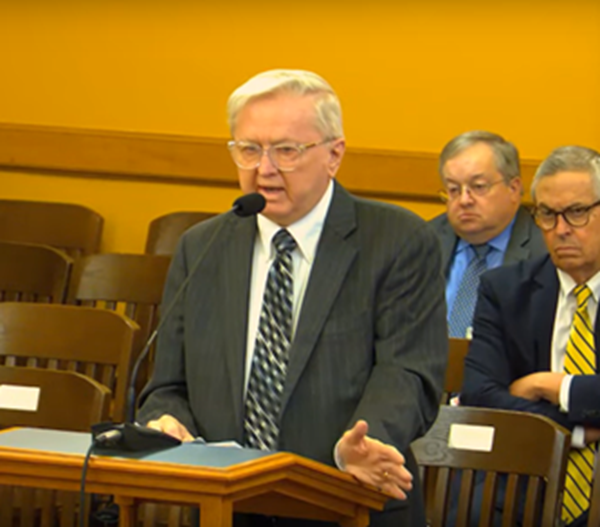
David Herndon, the state’s banking commissioner, said he still had reservations about the regulatory elements of a state law that fostered the startup of a company called Beneficient Fiduciary Financial LLC, which is the first of its kind in Kansas.
Beneficient is what is known as a Technology-Enabled Fiduciary Financial Institution – also known as a TEFFI. Kansas is believed to be the only state that has authorized a TEFFI. It has drawn criticism from at least one lawmaker based on critical media reports.
The Legislature created the TEFFI in 2021 with the goal of giving sophisticated investors the ability to liquidate alternative assets such as venture capital and private equity that aren’t easily converted to cash.
Herndon has expressed concerns about regulating not only Beneficient, but any company that might enter the market as this new type of institution.
“Since the TEFFI legislation was introduced, I have repeatedly expressed concern of some of the regulatory components contained in the act,” Herndon told a panel of legislators on Tuesday. “Those concerns remain and, in some cases, have deepened.”
“To be clear,” Herndon said, “my concerns exist for any entrant into the TEFFI marketplace as the TEFFI legislation is not specific legislation for (Beneficient) but rather legislation that will govern any future TEFFI.”
Herndon said it’s still impossible to conduct a “meaningful safety and soundness examination,” which evaluates the soundness of an institution’s assets and the effectiveness of its internal operations, policies and management.
Herndon said those type of examinations are done on regulated banks.
He said state law prevents his office from conducting an examination to consider earnings as a component of an examination and assigns a goodwill asset as a capital component, which departs from the Uniform Financial Institutions Rating System.
Herndon said his office has conducted three examinations of Beneficient Fiduciary.
He said one exam focused on information technology systems and compliance with the Bank Secrecy Act and anti-money-laundering laws.
The scope of the third examination consisted of reviewing the company’s administrative and operational practices and procedures as well as a review of selected transactions.
The latter examination evaluated potential areas of risks pertaining to the company’s business model and to the state.
Herndon said state law prevented him from disclosing the results of those examinations other than to say they were presented to the company’s board of director and top managers.
He did have a word of caution about Beneficient Fiduciary’s parent company.
“Concerns exist about several negative press reports involving BFF’s parent company Beneficient, federal regulatory actions taken against Beneficent, the freefall of Beneficient’s publicly traded stock, public statements by Beneficient as well as its accounting firm regarding the company as a going concern.”
Herndon noted that his agency only regulates the subsidiary, not the parent company or any of its other subsidiaries.
“We’ve only examined BFF and only have limited knowledge derived from public filings and statements about the other subsidiaries and the support that they might need from the parent company,” he said.
“But by the very nature of traditional business models, a parent company should provide strength and support to its subsidiaries,” he said.
Derek Fletcher, president and chief fiduciary officer for the Hesston-based subsidiary, acknowledged that the company has run into difficult times.
“Many emerging companies, particularly those that are pioneering a new industry and new products and services, are going to meet challenges and headwinds, and we’re no exception,” Fletcher told lawmakers.
“There have been challenges and headwinds, but I can tell this committee is the organization as a whole, not only our colleagues in Hesston but in Dallas as well, are committed to delivering to the industry, committed to being safe and sound,” he said.
While Fletcher said the company was not averse to a “safe-and-sound” standard that Herndon raised, he noted that a TEFFI is a different line of financial service.
“The concept and the connotation that we can take traditional principles and apply those automatically to new industry really kind of misses the point of the unique nature of the assets and the operations,” he said.
He suggested that there are safety-and-soundness principles that can be adopted that could be applied to the business. He said the company is open to those discussions.
Beneficient Fiduciary is a subsidiary of Dallas-based Beneficient, which has drawn critical coverage from the Wall Street Journal.
The company has sued the newspaper for defamation.
The newspaper has examined the parent company’s relationship with GWG Holdings, a financial-services firm that sold bonds to retail investors.
The idea, the newspaper reported, was that GWG would raise the money and Beneficient “would put it to work.”
“Beneficient would use money from GWG’s investor base to acquire stakes in private-equity funds and other high-flying assets, giving rank-and-file investors access to markets typically off limits to them,” the newspaper reported.
“The first funds from GWG to Beneficient, $50 million, landed in June 2019. As far as board directors were concerned, Beneficient would use the money to expand the business, former directors said,” the newspaper reported.
“Instead, it kicked off what became one of the biggest financial blowups to strike retail investors in years,” the newspaper reported.
The parent company’s stock on Tuesday was trading at 74 cents a share, down from its 52-week high of $16.50 a share.
The parent company also reported in its July quarterly report that it received a “Wells Notice” from the staff of the enforcement division at the Securities and Exchange Commission.
“A Wells Notice is not a formal allegation or a finding of wrongdoing, but is a preliminary determination by the staff to recommend to the SEC that a civil enforcement action or administrative proceeding be brought against the recipient,” the company said in its report.
“The company maintains that our actions were appropriate and intends to vigorously defend this matter, including by making a Wells submission to the SEC, engaging in further dialogue with the SEC Staff, and contesting any allegations of wrongdoing.”
After the meeting, Fletcher said there has been no development since that filing. He said it does not affect the subsidiary in Kansas.