




Gov. Laura Kelly’s emergency declaration to prepare for the World Cup in Kansas City expired Tuesday without action from the Legislature.
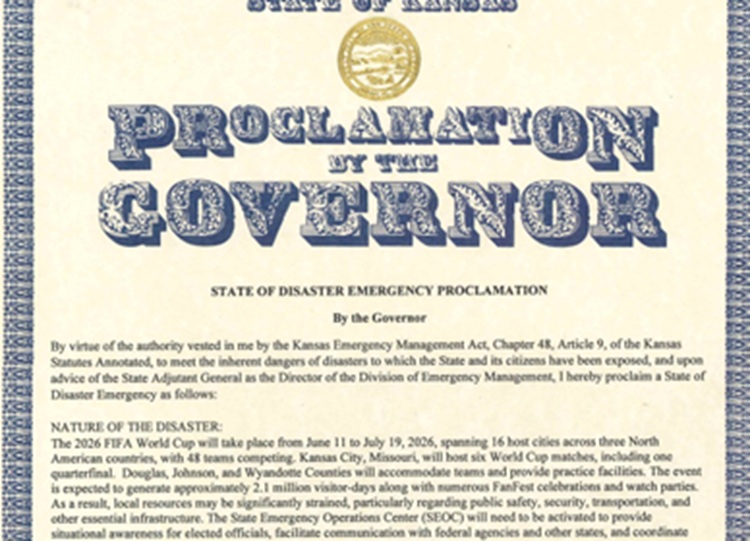
The governor declared a state of disaster Feb. 9, which administration officials said was legally necessary to ensure the state can prepare, coordinate and respond effectively to an emergency at World Cup events if necessary.
The declaration expired Tuesday. State law gives the governor the power to call a 15-day state of disaster emergency and gives the Legislature the power to extend it for multiple periods of 30 days at a time.
The power to extend the emergency rests with the Legislative Coordinating Council if the Legislature is not in session. The Senate was out of session during the turnaround break Thursday through Monday. The House was out of session Friday through Monday.
The governor asked the Legislative Coordinating Council to convene to address the matter and it didn’t, which means the governor and the Legislature will have to find another way to address the matter.
“The administration will continue discussions with legislators to extend the declaration to ensure the state has the appropriate resources needed to maintain the safety of Kansans and visitors during the World Cup,” Kelly spokesperson Olivia Taylor-Puckett said.
Last week, the House approved the declaration 121-2. The state-of-disaster emergency declaration for Douglas, Johnson and Wyandotte counties would have extended through July 30. But the issue hit a road block in the Senate.
There was some angst among Senate Republicans about extending the emergency declaration through this summer.
Some Republicans were fearful of giving the governor the type of authority she exercised during the pandemic when she tried to control the spread of COVID-19.
It led to the Legislature rewriting the state’s emergency management laws at the time.
The resolution was on the Senate calendar to be debated last week, but senators passed over the bill. The Senate majority leader said the votes weren’t there for it to pass.
Senate President Ty Masterson said in an interview Tuesday that the Legislature wasn’t turning its back on the governor’s request.
“We’re trying to evaluate, do we really need it?” Masterson said.
“And why do we need it so soon?” he said, adding that visitors won’t start arriving until May.
Masterson said lawmakers are looking at creating an exemption in the emergency management statute that addresses some kind of major event as an alternative to what might be considered a “disaster” for deploying emergency readiness resources.
“I get a little nervous calling it a disaster,” he said, adding that it’s about a sporting event.
“I think we’re going to have a solution come out. It just not going to be what flew out of the House,” Masterson said.
He said the conversations are now focused on creating a statutory provision that he said would be more appropriate for what the state is addressing with the World Cup.
Masterson said he’s had conversations with the governor’s office about the declaration.
“They would like to it see it fly through, but we’re still working on a solution,” he said.
“I’m comfortable we’ll have a solution this session,” he said. “The session will be over in early April, plenty of time for World Cup.”
Kelly administration officials said the declaration is legally necessary to ensure the state can prepare, coordinate and respond effectively to an emergency if necessary.
The declaration sets in place the legal structure to coordinate local, state and federal resources for preparing emergency management activities needed to ensure the public safety of Kansans and visitors coming to the Kansas City area for the World Cup.
The declaration allows the state to seek assistance from other states if necessary.
The Kelly administration said existing state law provides significant legislative guardrails to ensure balanced governing during emergency proclamations.
“This is a technical step to support infrastructure and security needs, as well as local communities during this exciting and extensive event,” Kelly’s spokesperson Grace Hoge said in a statement last week
Under the declaration, the emergency management department is authorized to activate the State Emergency Operations Center at a level required for a major international event.
It allows the state to coordinate with federal agencies, including the Department of Homeland Security, the Federal Emergency Management Agency and the FBI.
It also clears the way for the state to “pre-position” state resources to ensure rapid response capability.
The declaration also enables the Kansas National Guard to prepare for and support security, transportation and missions that cannot be performed under normal training authorities.
“Without an extension, these authorities will lapse,” Kelly said in the letter.
“This would significantly limit Kansas’s ability to coordinate with local jurisdictions, federal agencies, Missouri, and other states as necessary during a high-visibility event that requires unified planning and operational readiness.”
About 650,000 are expected to visit the Kansas City area for the World Cup this summer, including many who are anticipated to stay on the Kansas side of the state line.
Further there are four teams setting up base camps – their “home away from home” for training and hotel accommodations – in the Kansas City area.
Algeria is forming a base camp at Rock Chalk Park at the University of Kansas in Lawrence.
Two other teams – England and Argentina – are setting up base camps in Kansas City, Missouri. The Netherlands will have a base camp in Riverside, Missouri.
Kelly said that although no matches will occur in Kansas, “our state will host international teams, training sites, and large-scale fan events, and will absorb a significant portion of the regional visitor impact
“The Kansas City metropolitan area is expected to experience unprecedented visitor volume, and Kansas communities will face substantial demands on public safety agencies, emergency medical services, transportation networks, and critical infrastructure.”
She said these conditions meet the statutory definition of a “disaster” in state law, which includes events that create extraordinary strain on public safety and essential systems.