






(Updated to include comments from the Kansas Catholic Conference)
Cracks are starting to appear in support of a bill that would ban cellphones during instructional time in public and private elementary and secondary schools.
When the bill was first introduced earlier this month, it had the support of more than two-thirds of the Senate, including the chamber’s president and top Democrat.
It also had support from the House speaker and the governor.
But there are questions emerging about part of the bill that would ban cellphones not only during instructional time in public elementary and secondary schools but in accredited private schools as well.
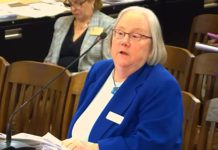
“Since when do we dictate to private schools what they can and cannot do?” said Republican state Sen. Renee Erickson, chair of the Senate education committee.

“I have a hard time putting mandates on private schools when they don’t receive the resources and benefits that public schools do,” Erickson said.
“It is a key point for me and I’ve made no secret of that,” she said.
Senate Majority Leader Chase Blasi, a lead sponsor of the bill, said debate over the legislation should not pit public schools and private schools against each other.
“The thousands of Kansas students attending accredited private schools are just as affected by cell phone use as students in public schools,” Blasi said in a statement.

“This issue isn’t about public versus private education; it’s about confronting a growing mental health crisis and declining cognitive development,” he said.
The bill, he said, “helps students re-engage with their classrooms instead of their screens.”
There are 122 accredited private schools for the current 2025-2026 school year.
Advocates of the bill say that private schools accredited by the state Board of Education are subject to all rules and requirements for accredited public schools, including all federal laws, state laws and state regulations.
They say accredited private schools are required to give state assessments and follow the educational standards set by the State Board of Education, but each system can select their own curriculum.
Erickson said private schools can choose how they are accredited and that it doesn’t necessarily have to come from the state.
“In this case, they have no choice,” Erickson said of the cellphone bill. “In this case, they have no option, no out. They have to comply.”
Blasi sat on a state education task force that was created to develop guidance for addressing the nonacademic use of phones in public school classrooms.
The task force recommended school districts implement a policy for students to store personal electronic devices in a secure location inaccessible to them during the school day.
The task force also recommended school districts “develop robust safety and emergency procedures” that don’t depend on students contacting authorities or family with personal electronic devices or school-issued devices.”
The task force report included findings of a 2024 study showing that 72% of high school teachers, 33% of middle school teachers and 6% of elementary school teachers believe that students distracted by cellphones in class is a major problem.
Cellphone bans started years ago amid worries that students were using the devices to facilitate drug deals.
In 2009, 91% of public schools nationally prohibited cellphone use, which fell to 66% in 2015 before rising again to 76% in 2021, according to health care think tank KFF.
The bill has the support of the Kansas Catholic Conference, which called it a “good piece of legislation that will benefit all Kansas families and students,” including students who attend private and public Catholic schools.
Chuck Weber, executive director of the Kansas Catholic Conference, said Catholic schools have limited cellphone use during instructional time.
He said those policies have reduced noise and distractions for students. “Time spent in school is sacred and should be focused on learning.”
Kansas Family Voice didn’t testify on the bill when it was heard in committee last week and has not publicly commented on the legislation
But Brittany Jones, president of Kansas Family Voice, said the group does have reservations about applying the bill to private schools.
“We don’t think that private schools who are not receiving government money (and) they’re functioning independently mostly of the government should not have mandates on them that are not necessary for the basic functioning of the schools,” she said.
“I think it’s a good thing. I think it’s beneficial,” she said about the overall idea of banning cellphones in schools.
“It is not necessary for the functioning of the schools, and so we would prefer that provision came out,” she said.
“We think this bill is generally a great bill and a fantastic idea,” Jones said.
But the private school provision, she said, “is creating heartburn for quite a few people, and I think that would be a really sad reason for the bill not to get done.”
There has already been some division on the bill among education groups.
The Kansas National Education Association and the Kansas State Board of Education are neutral on the bill.
The Kansas PTA and the Kansas Association of School Boards oppose the bill.
“Kansas PTA supports the work of districts to engage students in learning and to minimize distraction,” the group said in written testimony to the Senate education committee.
“Use of personal electronic communication devices, however, is an issue for locally elected school boards and district leadership,” the group said.
“Many Kansas school districts already have policies or guidelines in place, intentionally crafted with the input of local stakeholders.
“This proposed state mandate cancels the voices of these parents, teachers, administrators, and students across the state.”
The bill would require each school board and the governing authority of an accredited private elementary or secondary school to adopt policies overseeing the use of personal electronic communication devices during instructional time.
Those policies shall include:
- Prohibiting students from using or accessing personal electronic communication devices during instructional time, which is defined from the start of the school day until dismissal at the end of the school day on the school premises. It includes any classroom, structured or unstructured learning setting, recess, lunch or passing period.
- Requiring personal electronic communication devices be turned off and securely stored away from the student in an inaccessible location during instructional time.
- Establish procedures and disciplinary actions for violations of those policies.
- Authorize exceptions for students to use personal electronic communication devices under certain limited circumstances. An example would include a device approved by a licensed physician as a medical necessity to support a student’s health or wellbeing.
The bill requires each school board and governing authority of an accredited private elementary or secondary school to certify to the state Board of Education by Sept. 1 that they have adopted cellphone policies as detailed in the legislation.