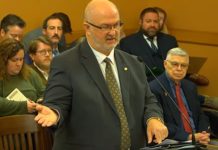




The Kansas social services secretary said Wednesday that the state’s payment error rate for food-assistance benefits had dipped to 7.5% for the first four months of the current fiscal year as officials try to dodge penalties that would be levied by the federal government.
Laura Howard briefed Gov. Laura Kelly and leading lawmakers Wednesday on new food-assistance data for the first four months of the federal fiscal year that began last October.
The state needs to get its payment error rate to under 6% to avoid penalties imposed by the federal government, which could be $20 million with the current error rate of 7.5%
“We have been working aggressively to reduce our payment error rate,” Howard told the State Finance Council on Wednesday afternoon. “This is the No. 1 priority.”
Starting in October 2027, the state will have to start matching food-assistance benefits based on its payment error rate, which assesses the accuracy of state eligibility and benefit determinations for households that receive food-assistance benefits.
The payment error rate measures the accuracy of eligibility for the benefit as well as the amount of the benefit based on a sample of about 90 payments each month or more than 1,000 over a year.
It gauges whether errors are made in items like income and shelter costs. It also relates to whether information is submitted accurately by the beneficiary.
The error rate can relate to over- and underpayments of the benefit. It’s not necessarily related to fraud.
Traditionally, food assistance benefits have been fully federally funded, but the One Big Beautiful Bill laid out progressively higher state matching requirements for the program based on a state’s payment error rate.
If the payment error rate remained at the levels seen the last few years, the state could be responsible for paying between $40 million to $60 million of those costs, although that’s looking less likely now.
The error rate for federal fiscal year 2024 was 9.98%, down from 12.07% in 2023. The average error rate nationally was 10.93% in 2024. In 2025, the state’s error rate was 9.2%
In 2019 the state had an error rate of 7.1%, in 2018 it had an error rate of 5.86% and in 2017 it had an error rate of 3.85%.
A legislative audit from earlier this year found that staff turnover, complex federal rules and inconsistent verification efforts had contributed to the rising payment error rate.
For 2023 and 2024, auditors reviewed about 300 errors that contributed to the state’s payment error rate and were related to miscalculating an applicant’s income and resources.
Over those two years, the Department for Children and Families attributed about half of the errors to its staff. The agency said its staff was responsible for 51% of the errors in 2023 and 45% in 2024.
The agency attributed the other half of the errors to applicants, including information related to items staffers may not have verified in their review of individuals’ applications.
Over two years, about 84% of the errors resulted in overpayments to Supplemental Nutrition Assistance Program recipients, including 113 payments to households that did not qualify for food assistance benefits.
The other 16% were underpayments, the audit said. The average overpayment was $292 per month while the average underpayment was $111 per month.
Howard said she is working to get the state in a position where it faces no penalties.
“I have the goal to get us to a zero liability for the state. I can’t guarantee that today,” she said. “What I can tell you is that we are making very good progress with our plan.”
Howard said her agency has adopted new performance metrics for employees in an effort to reduce the error rate.
She said the state also joined the National Accuracy Clearinghouse.
The clearinghouse is a new nationwide system checked with new applications, benefit recertifications and when household members change in order to prevent beneficiaries from receiving duplicate benefits.
The clearinghouse conducts mass matching on a monthly basis for states to ensure no household is receiving duplicate food-assistance benefits.
“We’re meeting the goals that we set in terms as far as where we thought we’d be at this time,” Howard said.
“We’re continuing to put things in place to address the kind of errors that we’ve seen,” she said.
“I can’t make a promise today, but I’m optimistic of our progress,” she said.
“You have the 100% commitment of our team to do everything we can to get that down to that 0% liability.”
Lawmakers voiced concern about what will happen if the state fails to get its error rate below 6% and how to pay for the estimated $20 million in penalties.
Outgoing House Speaker Dan Hawkins warned that it would be difficult to get the Legislature to approve $20 million to address the penalties assessed for a high payment error rate.
“I’ve got to tell you, if you have over a 6% error rate and you come in and ask for $20 million, that’s going to be a pretty tough ask when you shouldn’t even have to worry about it,” he said.
Senate Majority Leader Chase Blasi asked Howard where the money would come from if the state is sanctioned for a high error rate.
Howard said the penalties would mean that the federal government would pay a smaller share of the benefit costs, which total about $400 million.
“States will essentially be on the hook to provide that share of those costs if the error rates are not down,” she said. “We’re not the only state struggling with this issue right now.”
The audit said that during 2024, only eight states – Idaho, Nebraska, Nevada, South Dakota, Utah, Vermont, Wisconsin and Wyoming – had payment error rates less than the federal requirement of 6%.
Sixteen states had payment error rates similar to Kansas, ranging from 8.1% to 10%.
At that point in time, the audit said 20 other states had error rates of 10.1% or higher.
Howard said the state won’t know the impact for sure until next February or March because there’s a lag in when the data comes in.
Starting in October 2027, states may elect to use their error rate for federal fiscal years 2025 or September 2026.
Beginning in October 2028, and for each subsequent year, the payment error rate from three fiscal years prior will determine the state’s penalties.
Kelly called the way the federal government evaluates the error rates “absurd,” noting that there are 180,000 Kansans who receive food-assistance benefits and it reviews only 90 cases a month.
“I really think that the feds ought to take a look now, with the new technology and all kinds of things that we have, if there’s a different way to do this so that they’re not putting the states through this uncertainty and the potential expense,” she said.
“Until the feds change the way that they do this, I think it’s going to be a roller coaster for a long time.”