




Senators on Monday delayed the confirmation of Gov. Laura Kelly’s appointment to lead the Kansas Department of Wildlife and Parks.
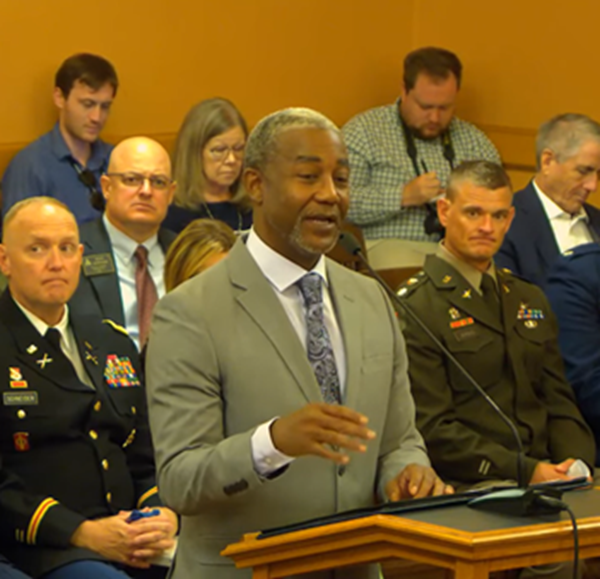
Christopher Kennedy was peppered with a range of questions about relocating employees, managing the state’s deer population, new regulations for fire extinguishers on boats and the use of eminent domain.
After nearly 45 minutes, the Senate confirmation oversight committee still had more questions to ask and agreed to continue the proceeding to another date within the next 10 days.
“There are still questions that haven’t been answered,” said Senate Majority Leader Larry Alley, chair of the Senate confirmation oversight committee.
Kennedy came to Kansas from the Missouri Department of Conservation, where he was the assistant director for diversity and inclusion.
He also worked as the agency’s regional fisheries supervisor from 2007 to 2020 and as a fisheries biologist from 1996 to 2008.
He has a bachelor’s in fisheries biology from the University of Arkansas at Pine Bluff.
Senate President Ty Masterson said he heard more about Kennedy than any of the other three nominees who were tentatively confirmed Monday and sent to the full Senate for final approval.
He questioned Kennedy about new regulations that would require Kansas boat owners to replace their fire extinguishers every 12 years.
It was a regulation that started with the U.S. Coast Guard.
Masterson expressed concern about the cost that would be imposed on boat owners, which Kennedy said would run about $36 every 12 years.
“I don’t know if any of you all have actually seen a boat catch fire and what that means if you don’t have a fire extinguisher on that boat,” Kennedy said.
“Part of our job is to ensure the safety of our citizens as they utilize the resources that they have available to them,” he said.
“Having a fire extinguisher that works is very, very important,” he told the Senate confirmation committee.
Kennedy said he didn’t define the life of a fire extinguisher in the regulations. He said labels on most fire extinguishers give them a life of 12 years.
“I’m a label follower,” he said. “Whether I’m spraying chemicals, we should read the label. If we’re utilizing fire extinguishers, we should read the label.”
Kennedy said he understood the cost of having to replace a fire extinguisher, but said that amounted to about $3 a year to protect the safety of boat owners.
Masterson questioned how many thousands of boats might be subject to the new requirement.
“It may be $3 a year, but it’s $36 over how many thousands of boats?” Masterson asked.
Masterson said the rule might need to come under a new regulation that gives lawmakers oversight of rules and regulations adopted by state agencies.
The law passed last session requires the Legislature to ratify rules if the anticipated compliance costs passed on to businesses, local governments or individuals exceed $1 million for the first five years of implementation.
The governor vetoed the bill but was overridden by the House and the Senate.
Senate Majority Leader Larry Alley asked Kennedy how he might use eminent domain as the wildlife and parks secretary, a power that the Legislature tried unsuccessfully tried to remove last session.
Alley asked Kennedy when he might believe it’s necessary to use that authority and if he would use that power to expand hunting, fishing, camping and other outdoor recreational opportunities for public use.
“My first goal is to protect fish, wildlife of the state for the citizens and to educate and give our citizens access to the resources needed to recreate,” he said.
“When I think of public resources, they are few and far between in the state of Kansas, especially as we get on the eastern side of the state where our populations are high, our public resources are very low,” he said.
He said there are residents who don’t believe there are enough public areas where they can hunt and fish.
“I’m a common man, and I’m looking out for the common man,” he said.
“Within our constitution,” he said, “every citizen has the right to hunt and fish within this state, and I would do everything I could to ensure they have the opportunities to do so.”
“But it’s a team sport,” he added.
“There are certain authorities that are allowed to me, but when I think about conservation as a whole, it’s not on one individual.
“The Legislature has to work in that process. Our governor works within that process. The people, our staff should be engaged in that process to decide what is appropriate,” he said.
Alley also Kennedy about what he would do about what the senator characterized as an over population of deer destroying farm crops.
Kennedy disagreed that the state’s deer population is exploding. He said state biologists don’t believe that the deer population in Kansas is out of control.
“It’s different depending on what part of the state you look at,” he said.
In western Kansas, the deer population is decreasing, not increasing, he said.
But as you move east, he said, the deer population tends to increase.
Republican Sen. Rick Billinger of Goodland asked Kennedy whether he planned to move staff from out-state Kansas to Topeka.
Billinger said there have been concerns expressed that Kennedy might plan to relocate employees to the state capital.
Kennedy said he has not had any conversations about moving staff from their current positions at any of the agency’s regional offices.
He said most leadership positions should be in Topeka, although there were some positions dealing with operations that should remain in outlying offices.
Kennedy said he had no desire to disrupt the agency with a reorganization that would cause people to move their families and homes.
“I personally have lived through reorganizations that required to people to move, and they were somewhat disruptive,” he said.
“I would think very carefully about creating an atmosphere where had that much disruption, especially if it influences the amount of work we get done for our citizens,” he said.
In other action at Monday’s meeting, the committee recommended these nominations to the full Senate for confirmation:
- Kerrie Lonard as the state’s child advocate. Lonard had been appointed as the child advocate in 2021 when the governor signed an executive order creating the Office of Child Advocate. The Legislature has now put the office into statute. Previously, Lonard had worked for Kansas Legal Services in Topeka for nearly 14 years, serving as both a staff attorney and managing attorney. As managing attorney, she supervised a staff in providing legal assistance to members of the public, often in areas of family law and child-in-need-of-care cases. Lonard has a bachelor’s in social work from the University of Kansas and a master’s in social work and a law degree from Washburn University.
- Herbert Iams to the state Banking Board. He was president of Kansas Bankers Association Insurance Inc. from 2002 to 2019. The company was formed by the KBA in 2002 as a separate for-profit subsidiary. He also was the director of risk management for the Kansas Bankers Association from 1983 to 2002 and assistant director of risk management for the KBA from 1982 to 1983. He earned a bachelor’s in business administration from Washburn in 1974.
- Paul Schneider, Brigadier General, Kansas National Guard. Schneider’s military career started when he enlisted with the 2nd Battalion, 130th Field Artillery Regiment in Hiawatha, Kansas, in March 1987 as a split option enlistee while a junior in high school. He received his commission in the Army National Guard as a field artillery officer after graduating from Officer Candidate School in 1994. Schneider participated in Operation Iraqi Freedom in 2004-2005 and Operation Spartan Shield in 2021. During his service, Schneider’s commendations included a Legion of Merit, a Bronze Star Medal, a Meritorious Service Medal and an Army Commendation Medal, among others. Schneider attended Kansas State University, where he graduated with a bachelor’s in journalism and mass communications. He later received a master’s in information technology management from Webster University. Schneider has also earned master’s in strategic studies from the U.S. Army War College.