






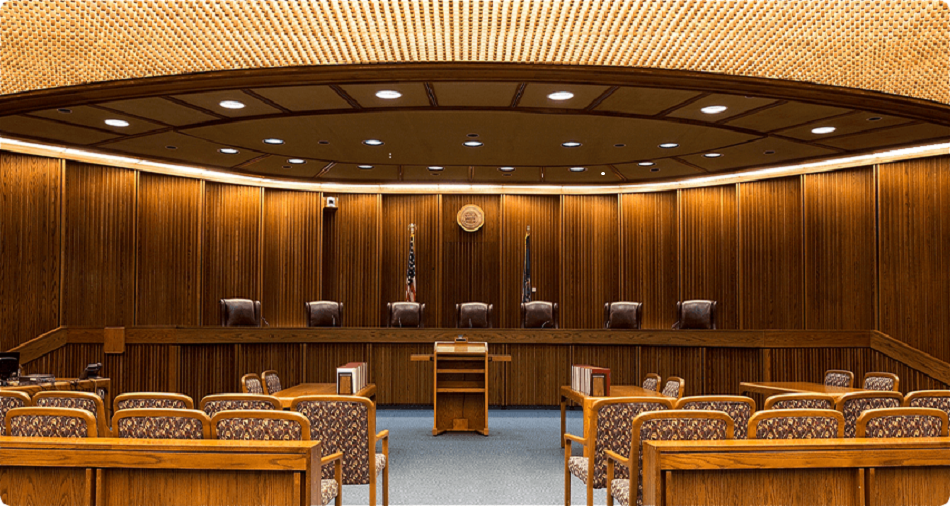
The battle over picking justices for the Kansas Supreme Court took a new turn Tuesday when Senate President Ty Masterson introduced a proposed constitutional amendment that calls for the election of justices.
Masterson introduced the bill in the Senate’s Federal and State Affairs Committee, which is exempt from deadlines requiring bills to pass in their chamber of origin.
He introduced a second amendment that would call for the governor to appoint justices to the Kansas Supreme Court with confirmation of the Kansas Senate – similar to how U.S. Supreme Court justices are chosen.
His goal is to let the bodies decide between the two amendments.
If passed, either amendment would go to voters on Aug. 2, the same date that Kansans will be asked to approve another constitutional amendment – known as Value Them Both – that would ensure abortion is not a protected state constitutional right.
“We already have Value Them Both on the (ballot) this year, and I’d like to see not just life, but liberty and pursuit of happiness on the ballot,” Masterson said.
“I’d like our body to have discussions around whether it’s a federal model or elections,” Masterson said. “We need a new system.”
Kansans for Life said it was focused on passing the amendment, while other observers believe that a judicial selection amendment might only boost conservative turnout even more this summer and aid the amendment.
Masterson acknowledged that a constitutional amendment on judicial selection could help the abortion amendment, which will be decided shortly after the U.S. Supreme Court renders a decision in a Mississippi case that could reverse Roe v. Wade.
“I don’t think it hurts it any,” Masterson said. “Any time you have a subject matter on the ballot, the more people that come out, the better.”
Lawmakers have long tangled over the process for picking Supreme Court justices in Kansas, which employs a nominating commission to screen applicants.
The commission is made up of five lawyers and four nonlawyers. The lawyers are chosen by their peers. The nonlawyers are appointed by the governor.
Supporters say the process is a transparent method for picking the most qualified judges.
Critics say the process is undemocratic, handing a vast amount of power to a group of people who are not elected and tend to pick judges who lean left.
Over the years, Republicans, including Masterson, have made repeated attempts to repeal the current process.
Former Gov. Sam Brownback tried to change the process for Supreme Court justices when he was governor and failed.
He successfully got the nominating commission process eliminated for appeals court justices, an easier task since the appeals court appointments were set by statute.
Three years ago, the Senate effectively voted on a proposal that called for moving the state to a federal model where the chief executive appoints the justices and they are confirmed by the state Senate.
In May 2019, Masterson secured 28 votes to pull a proposed amendment out of committee that would have moved the state to the federal model.
The Senate is more conservative than it was in 2019, which suggests that the idea of a federal model could get passed in the Senate.
However, Masterson added a new wrinkle with allowing Kansans to elect state Supreme Court justices.
The idea of electing judges was floated in some circles late last year and early this year before the session began.
“The polling I’ve seen, direct elections is more popular with the people,” Masterson said in a recent interview.
“I want a system that’s not so undemocratic,” Masterson said. “I want a free and open selection of judges.”
The Kansas Bar Association on Monday reaffirmed its support for the current process.
“The current judicial selection process is the most comprehensive and exhaustive method available for determining the qualifications of applicants to these important judicial posts,” the KBA said in a statement.
Most states – 39 in all – use elections as some part of their selection process at some level of court, according to the Brennan Center for Justice.
Of the 38 states where elections are used to select judges to the high court, judges are appointed by the governor and reselected in unopposed retention elections in 16.
The Brennan Center reports that Supreme Court justices are selected in contested nonpartisan elections in 14 states.
In eight other states, judges run in contested partisan elections, including New Mexico, which uses a hybrid system that includes partisan elections.
The Brennan Center noted that judicial elections can lead to pricey races for seats on a court that nationally has reviewed everything from the state responses to COVID-19, governors’ emergency orders, workers’ compensation, discrimination and abortion, not to mention redistricting.
A Brennan Center analysis shows that the 2019–20 election cycle was the most expensive ever for Supreme Court races nationally with nearly $100 million spent on those campaigns.
This Brennan Center reported that overall national spending in judicial elections set a record of $97 million, or 17% higher than the previous record set in 2004 – adjusted for inflation.
“This unparalleled spending speaks to the power and influence of state supreme courts, which often fly below the public’s radar,” Douglas Keith and Eric Velasco wrote for the Brennan Center.
Masterson said spending should take a backseat to how Kansans want to pick their judges.
“If that is the way the people want to be governed, then the cost is somewhat secondary,” Masterson said Monday.
“I am more interested in finding out what the pulse of this caucus is in relation to the public sentiment,” he said.