





A Senate committee on Monday rewrote a property tax bill approved by the House that lowers the threshold for when a protest petition could be used to stop local governments from spending more in property taxes than they did the year before.
The Senate tax committee approved a bill allowing voters to reject a budget that spends more in property taxes than it did the year before plus the Midwest consumer price index up to 3% more, whichever is less.
The House version of the bill set a little higher threshold, giving residents the ability to stop local government budgets that raised 3% more in property taxes from the year before.
Unlike typical protest petitions that initiate elections, the bill allows taxpayers to sign a protest petition to veto a local government budget that raises more in property taxes than it did a year earlier if enough voters sign the document.
The Senate bill allows for a protest petition if it’s signed by at least 10% of the registered voters as of Jan. 1 in the taxing jurisdiction where the protest petition was filed.
If the petition is successful, the local government budget would be returned to the same level of property taxes it collected the year before.
Legislative analysts said that would mean that 34,471 signatures would need to be collected from registered voters in Sedgwick County to veto a county budget that exceeded the property tax limit.
Likewise, 46,729 signatures would be needed to reject a property tax increase for Johnson County, 8,061 signatures would be needed to reject a budget in Douglas County, 5,736 signatures would be needed in Leavenworth County, 3,985 would be needed in Riley County, 2,133 would be needed in Montgomery County and 1,565 would be needed in Cherokee County.
Those numbers only reflect 10% of the registered voters in those counties as of Jan. 1.
Fewer signatures would be needed to challenge budgets in smaller jurisdictions, like cities, school districts, fire districts and sewer districts. Unlike the House bill, the Senate bill would apply to school districts.
The Senate bill is different from the House version, which set the number of signatures required to get a protest petition at no less than 5% of the voters who cast a ballot in the last general election for secretary of state in the local taxing jurisdiction where the budget was approved.
Democratic state Sen. Ethan Corson of Fairway tried to raise the bar for the number of signatures that would be needed to get a protest petition.
He proposed increasing the threshold to more than 50% of the registered voters in a taxing jurisdiction to initiate a protest petition. The committee voted down his proposal.
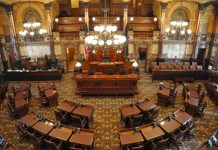
Corson said the Senate would never impose a 10% spending threshold on itself where just four senators out of 40 could reject the chamber’s budget.
“We would never operate in that manner,” Corson said.
He also said the Legislature would not allow 10% of state voters – about 200,000 – to reject a budget.
“I just do think there’s a tyranny-of-the minority issue with this legislation,” he said.
He noted that local officials have all been elected by their residents and “have come together and passed a budget that they think reflects those values.”
“I don’t think there’s ever been a situation where government operates that way, where 10% of the people can block everything,” Corson said.
The House bill allowed local governments to take in new revenue with some exceptions, including new real property that’s annexed, property that’s changed in use, or expiration of tax breaks where the property returns to the tax rolls.
Also, additional property tax revenues that will be spent on bonds for obligations that existed before July 1 of this year would be included in the calculation of the budget.
The Senate bill eliminates the exceptions, which drew concerns from cities.
Sedgwick County had asked that all property tax increases attributable to bonds – not just bonds existing before this July 1 – be included in the calculation for the property tax limit so it could retain its AAA bond rating.
“The residents of Sedgwick County benefit from our AAA bond rating, which reduces the cost of all bonds we issue by lowering the interest rates we pay,” County Commission Chair Jeff Blubaugh told the committee in written testimony last week.
There was an effort in the committee to include an exception for bonding in the bill, but it was unsuccessful.
Corson said he felt that it was unfair for local governments to pay more interest for bonds because Wall Street gets nervous about how a revenue cap might affect local governments’ ability to repay borrowing.
However, Republican state Sen. Caryn Tyson of Parker, chair of the Senate tax committee, said bonding was an exception to a local government tax lid that was repealed several years ago because it wasn’t effective.
The bill limiting local tax revenues is part of an effort this legislative session to limit property taxes.
The Senate has already approved a constitutional amendment that would cap the taxable assessed property values at 3% with several limited exceptions, including new construction or improvements and if there is an error calculating the tax assessment. The bill passed 30-10.
A House committee last week sent the bill to the chamber.
As originally proposed, the amendment would have gone to voters to ratify during this year’s primary election.
As amended in the House, the measure would go on the ballot during the general election.