




As the clock passed midnight, lawmakers took one last unsuccessful stab early Saturday morning to approve a constitutional amendment that would limit rising property values.
As the clock approached the new day, Senate President Ty Masterson introduced a constitutional amendment that he thought would meet the House demands to cap property values using a rolling average or fair market value, whichever is less.
Masterson took a bill from last year – HCR 5008 – and used that as a vehicle to add language calling for a rolling average as a cap on property tax values. The time period for the rolling average would not have been identified by the Legislature until later.
The amendment would have been placed on the November 2026 ballot, giving the Legislature time in 2027 to draw up the details of the enacting legislation with the goal of starting the new policy in 2028.
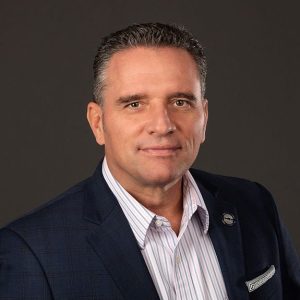
“The House has been crying for that,” Masterson said of a cap based on a rolling average. “They want a chance to vote on it, so I’d like to send it to them.”
“This is a real opportunity,” he said.
“The House has been asking for a rolling average as a limitation. This is an opportunity to send it,” he said.
The amendment, however, included language that would have allowed the Legislature to provide for limits on any class or subclass of property, which House members seized on as a cap that they have been opposing all along.
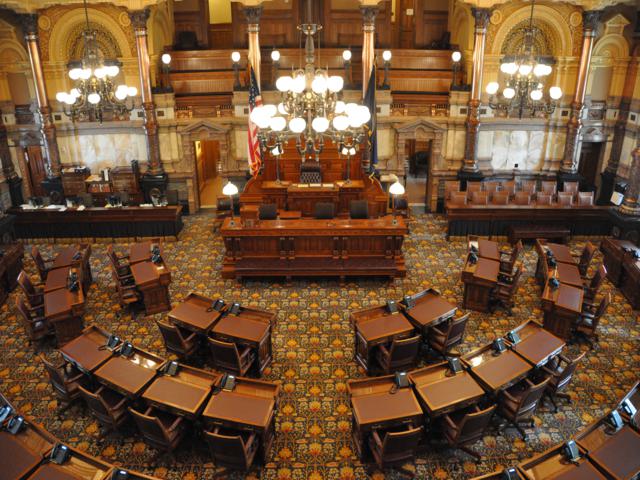
The midnight-hour proposal came as the Legislature was nearing adjournment and Democratic and Republican members of the House started filtering into either side of the Senate chamber, leaving Masterson feeling like he was in a “dance-off.”
“Starting to feel like I got a little gang standing behind me getting ready to go against the other side,” he said with a laugh.
Democratic state Sen. Ethan Corson of Fairway, a candidate for governor this year, questioned the timing of Masterson introducing the amendment.
“Here we are at 12:02 with another gimmick,” Corson said.
“If the majority party had put as much time into crafting a real solution on property taxes than they have into playing these political games, we might actually be able to provide real, meaningful, immediate property tax relief for Kansas families,” he said.
“We had four months to do it,” he said. “Obviously, leadership in the majority party hasn’t been able to get it done.”
The proposal came hours after the Legislature passed a separate bill that limits how much local government, excluding schools, could raise from property taxes. The bill heads to the governor. Now adjourned, the Legislature can’t override a veto.
The House also had revisited a separate constitutional amendment earlier in the evening capping assessed property values at 3%, but it failed like it had twice previously.
The Senate passed Masterson’s plan 27-12, but minutes later it died in the House on a 59-62 vote.
Republican state Sen. Jeff Klemp of Lansing supported the bill.
“I am very pleased that we have moved something through this body that allows the taxpayers – the same ones who elected us – to have a say,” Klemp said.
“A majority of doors in every county have been asking for relief from the pain of property tax,” he said.
Masterson said he expected the House to vote the amendment down.
“I felt their tax chair was disingenuous from the beginning, ” Masterson said.
“There’s not been a single amendment that we’ve sent them that dealt with constitutional property tax limitations that he has helped get across the line.”
“I don’t think they want any type of limit on property tax period – at least that number of Democrats and Republicans that were together against it,” he said.
Republican state Rep. Adam Smith of Weskan, chair of the House tax committee, explained his opposition to a hard cap on property values.
“Property tax relief is serious. I understand that as much as anybody,” Smith told the House before voting on the amendment.
“There’s a reason I oppose any option that allows a hard, fixed percentage cap,” Smith said.
“The reason is that is property tax relief for some at the expense of others,” he said.
“If you’ve got a property that’s increased 20, 25, 30% value, you’re going to get tax relief,” he said.
“But who’s paying for it? Where is that money coming from?” he asked. “It comes from other taxpayers that have zero to 5% increases. They don’t get the advantage of the big decrease in their valuations like the larger ones do.”
Earlier in the evening, Smith complained that the Senate wouldn’t hear a bill that included using a rolling average to set a cap property taxes.
Smith made the comments as the House took up an amendment limiting property value increases to 3%.
“How many times has the Senate voted on the rolling average? Never,” Smith said. “If the Senate wants a constitutional amendment to address property values, we sent them a good resolution.”
Smith was referring to a constitutional amendment the House passed last year that was similar to the amendment that Masterson introduced late Friday night.
“They would do this same exact motion over there if they wanted to,” Smith said hours before the Masterson proposal.
“I’m not sure why we have to vote on yet again their proposition, when they haven’t voted on ours once.”
Dinah Sykes of Lenexa, the top Democrat in the Senate, called the late-night attempt a “slap in the face of Kansans” because of the broad nature of the amendment, including the wording that allows the Legislature to put limits on any class of property.
“This amendment is a last-minute Senate Hail Mary attempt to pass property tax relief without any real plan to provide substantial property tax relief to the people of Kansas,” Sykes said.
“Here we are again at the end of another session with the majority party failing on their promise to voters to provide relief and ease the hardships Kansans are facing,” Sykes said.
“Kansans deserve better than a last-minute, half-baked constitutional amendment that we didn’t even have the language on before we came on the floor at 11:45 p.m.,” she said.
“If this is good policy, why are we pushing it to pass in the dead of the night?” she said.
Sykes questioned Masterson about the explanation statement on the amendment. She pressed Masterson for the wording of the ballot explainer detailing what a “yes” or “no” vote meant.
“I want word for word the language that Kansans would have on the ballot in November saying what a “yes” vote means and what a “no” vote means,” she said.
Masterson eventually provided that wording on the Senate floor. But Sykes was unsatisfied.
“This is not true relief,” she said.
“This is trying to push something through at the last minute that we don’t know the ramifications and, honestly, trying to get around making sure that Kansans have a vote in how they’re valuations are determined.”
Republican state Sen. Ron Ryckman of Meade said he thinks everyone wants property tax cuts, but added, “I just have a problem with midnight.”
“I understand the last minute, trying to get something over to the House,” Ryckman said. “But my concern is that I like to know for sure what I’m voting on. So, I have a lot of problems with this.”
Masterson, who also is running for governor, said he had been working for “weeks and months” to come up with a plan for cutting property taxes. “There have been multiple serious attempts.”
He said Republicans were left scrambling after it appeared that the House had killed the last bill shell that could be used for a property tax bill.