




(UPDATED to reflect House action)
As the legislative session ground toward an end late Friday night, the Kansas Legislature approved a bill that’s intended to keep property taxes in check, although even its supporters questioned how much of a tax break it will give homeowners.
The Senate voted 27-13 to pass a bill creating a process where voters could sign a protest petition when local governments spend more than they did a year earlier plus the Midwest consumer price index up to 3% more, whichever was less.
The bill was passed 87-44 in the House. Even if passed by both chambers, the governor could still veto the bill, and the Legislature would not be able to override it after lawmakers adjourn.
This bill was similar but significantly different from one Democratic Gov. Laura Kelly vetoed earlier this week.
The bill creates a process where voters could sign a protest petition blocking a local government from spending more than they did a year earlier plus the Midwest consumer price index up to 3% more, whichever was less.
Typically, protest petitions are used to initiate elections. This type of protest petition would veto a local government budget outright if it’s signed by enough voters.
The bill set the threshold for a protest petition at 10% of the voters who cast a ballot in the last election for secretary of state. The bill also would exempt school districts from the cap.
The bill includes some exceptions to the revenue limits, including debt service payments on bonds, property that’s annexed and the expiration of tax breaks when the property returns to the tax rolls.
The bill keeps a new process enacted in 2021 that requires local cities and counties to hold a public hearing and vote when they wanted to collect extra revenue from a so-called windfall that could come with increased property values.
The proposal was very different from the Senate’s efforts to cap property value assessments at 3%, which the House rejected three times including again Friday night as the legislative session was within hours of coming to an end.
The House has been reluctant to agree to a constitutional amendment capping assessed property values, preferring a softer cap based on a rolling average of property values over a fix period in time.
Even with perhaps a breakthrough within reach on property taxes, supporters of the bill in the Senate were lukewarm even as it passed with a two-thirds majority. The bill is not a constitutional amendment and only needs a majority for passage.
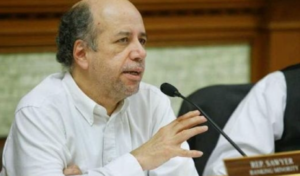
Democratic state Rep. Tom Sawyer of Wichita, who led the charge against bills capping assessed property values, supported the bill approved in the House on Friday night.
“This is property tax relief,” Sawyer said. “We need to encourage local governments to hold down spending, and this does that.”
The debate in the Senate on Thursday night showcased three candidates running for governor, with Republican Senate President Ty Masterson supporting the bill and Democratic state Sens. Ethan Corson and Cindy Holscher opposing the bill.
“This is what the House is asking for,” Masterson said. “This is not the vehicle I would want. But it is something. This does set a lid and starts to mitigate increases.
“We cannot honestly say to our constituents we passed a meaningful property tax relief,” he said. “But it is starting to set a lid that I hope in the near, near future we are able to trim back and make it a real meaningful lid.”
Corson questioned whether the bill would provide significant property tax relief. He called the bill “poorly crafted” and “sloppily done. He criticized a bill that would give a minority of voters the power to block a local government’s budget.
“This is really almost a shell game,” the Fairway senator said.
“We don’t have any sense of what this is going to do for Joe or Jane Kansan,” he said.
“This is what happens when you squander a whole legislative session passing more bills about third-grade recess than providing the people of Kansas with actual property tax relief,” he said.
Republican state Sen. Cary Tyson of Parker, chair of the Senate tax committee, said the Senate worked “diligently” on tax policy but blamed the House for killing tax proposals sent over by the Senate, namely a cap on assessed property values.

“They took our assessment limit and blew it up,” Tyson said.
“Didn’t even vote to go to final action on it. Didn’t even take a roll call vote on it. But they’re saying they worked in good faith. They did all these things that are so wonderful. They keep blaming the Senate,” she said.
Tyson said she talked to a former county commissioner in the House who she said didn’t understand the difference between limits on assessed property values and limits on revenues raised by local government.
“Didn’t even realize what they’re voting on,” she said.
“Is this perfect?” she asked. “Absolutely not. Is it good enough for now? Yes. It is something to get across the threshold. It is a revenue limit,” she said. “Is it as much as this body would want? Probably not.
“But does it keep the train moving? Absolutely it does.”
She said a limit in property assessments would help every property owner by restricting out-of-control property valuations. She said a limit on property value assessments and local government revenues would have meant “true” property tax relief.
“This legislation is not perfect, but it is the camel’s nose under the tent, and it is needed for taxpayers.”

Democratic state Sen. Cindy Holscher of Overland Park also opposed the bill.
“I’m tired of gimmicks,” she said. “We’ve been here for the entire session and once again we have another bill in front of us that that will not deliver actual property tax relief.
“If this body was actually sincere in delivering, we would fulfill our obligation in terms of completely funding special ed as well as general education,” she said.
“Instead, we have once again neglected our obligation in doing so, which will then mean that those funds will have to be filled at the local level, which means that property taxes likely go up.
“That is not what our voters had in mind when they sent us here and they asked for property tax relief,” she said.

In an ironic twist, Republican state Sen. Mike Thompson of Shawnee joined Democrats and a handful of other Republicans in voting against the bill.
He said his constituents have been clamoring for property tax relief and he “desperately” wanted to answer their demands.
“Here we are tonight left with a bill that is so watered down it provides relief in name only,” he said.
“As much as I want to support this bill or some kind of property tax relief, I also want to retain credibility with my constituents who have been looking to me to fight for that relief,” he said.
“If this passes our floor,” he said, “when they continue to receive massive increases in their property tax bills, I will not be able to adequately explain why I voted for this.
“I know you can’t let the perfect be the enemy of the good, but this is bad and ugly,” he said.
“The Senate has done its best. Others have dropped the ball.”