




Reforms tightening the regulations of the middlemen who manage prescription drug benefits for insurers and employers passed the Legislature on Tuesday with advocates saying it will keep prescription drug prices under control for Kansans.
The Senate voted 32-8 to pass a bill supporters say will hold down drug prices, help independent pharmacies compete and address concerns about pharmacy benefit managers that have drawn increasing attention nationally from regulators as well as state and federal lawmakers.
The House passed the bill 104-17 across party lines Monday night. The legislation regulating pharmacy benefit managers – also known as PBMs – now goes to the governor.
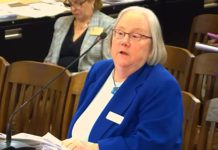
“There is no regulation on these PBMs, and they are billion-dollar companies,” said Republican state Sen. Brenda Dietrich of Topeka, chair of the Senate’s financial institutions committee.
“We needed transparency. We needed regulation. We needed auditing, and we needed to have some way to look at what PBMs were doing in regards to our local pharmacies.”
Opponents say the bill imposes price controls and subsidizes the insurance industry that will later raise prices anyway. They objected to a $10.50 drug dispensing fee and questioned why businesses subject to a federal law that sets minimum standards for self-funded health plans were exempt.
“Kansas Employers for Affordable Healthcare is disappointed in the passage of this legislation, particularly the pill tax provisions,” said Andrew Wiens, who represented the group at the Capitol.
“We’re proud to have fought on behalf of Kansas small businesses, employees and families who will ultimately bear the cost of the pill tax,” Wiens said.
“Moving forward, we will work to keep our members informed as these costs show up in higher premiums and out-of-pocket expenses,” he said.
The bill would impose a tighter set of regulations for pharmacy benefit managers, which serve as a bridge between drug manufacturers, pharmacies, health plans and patients.
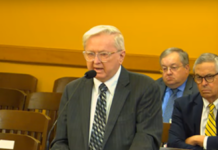
“Unfortunately, it’s a federal-government enabled monopoly and it hurts us consumers, it hurts our constituents,” said Republican state Sen Bill Clifford of Garden City.
“I’m tired of them having this monopoly power. It’s about time we acted,” he said.
Pharmacy benefit managers have been around since the 1960s.
They negotiate rebates and price discounts with drug manufacturers, process insurance claims, reimburse pharmacies for drugs dispensed to patients and craft drug benefit plans that include developing a list of the covered drugs.
Insurers pay pharmacy benefit managers to manage their prescription drug benefits, which includes negotiating rebates, managing the list of covered drugs and dealing with prescription reimbursements.
But pharmacy benefit managers have come under a microscope in recent years from regulators and lawmakers, who blame PBMs for the rising cost of drugs and directing patients to their affiliated pharmacies while hurting independent pharmacies.
It’s a complicated and divisive issue that policymakers at the federal and state level are struggling to address as they respond to the public’s call for lower prescription drug prices.
It’s an issue that’s drawn more than 400 local pharmacists wearing white lab coats to the Capitol this session to lobby for a bill that they said would keep them open.
“We need reform,” Republican state Rep. Angela Stiens of Shawnee told the House on Monday.
“We need to bring accountability to a system that operates in the shadows, often at the expense of taxpayers, patients and local pharmacies,” Stiens told the House early Monday evening.
“At its core, this is about protecting access to care, lowering out-of-pocket costs and making sure the system works for our patients, not just the middlemen,” she said.
Federal regulators said in a 2024 report that PBMs exert “substantial influence over independent pharmacies, who struggle to navigate contractual terms” they impose.
The report said those pharmacies find the contract terms “confusing, unfair, arbitrary, and harmful to their businesses.” Between 2013 and 2022, about 10% independent retail pharmacies in rural America closed.
The country’s top three PBMs — CVS Caremark, Express Scripts and OptumRx — manage 79% of prescription drug claims for about 270 million people, federal regulators said.
A separate congressional report from 2024 found that PBMs “have intentionally overcharged or withheld rebates and fees from many taxpayer-funded health programs.”
The report found that “PBMs have sought to use their position to artificially reduce reimbursement rates for competing pharmacies.”
The report concluded that in these taxpayer-funded health programs, PBMs “use their position as middlemen to steer patients to the pharmacies they own rather than pharmacies that may have closer proximity or provide better care.”
There also have been legal issues, in Kansas and nationally.
Last month, the Federal Trade Commission settled a lawsuit with one of the nation’s largest pharmacy benefit managers, Express Scripts Inc., and its affiliated companies.
The settlement required Express Scripts to adopt fundamental changes to its business practices that increase transparency and are expected to reduce patients’ out-of-pocket costs for drugs like insulin by up to $7 billion over 10 years.
The FTC alleged that the PBM artificially inflated the list price of insulin drugs by using “anticompetitive” and “unfair” rebating practices that hurt patients’ access to lower list price products for drugs.
Five years ago, then Kansas Attorney General Derek Schmidt reached a settlement with Centene Corp. regarding pharmacy benefit management practices for the state Medicaid program. He reported recovering $27.6 million.
The settlement was the result of a yearslong investigation into the company’s business practices undertaken by Schmidt’s office after a separate investigation in Ohio revealed PBMs were overbilling that state for their services.
In general, Schmidt accused the company of failing to satisfy its obligation to represent the state’s best interests in negotiations with other companies that supply drugs to the state Medicaid program.
Insurance Commissioner Vicki Schmidt, a Republican candidate for governor this year, lobbied for the bill in the Legislature.
She celebrated passage of the bill Tuesday.
“This week, the Kansas Legislature chose to put patients over politics and profits,” Schmidt said in a statement.
“No longer will Kansas let PBMs threaten the pocketbooks of patients, the livelihoods of local businesses and the viability of rural communities,” she said.
Nationally, all 50 states have passed legislation to regulate pharmacy benefit managers, although the scope of those regulations vary widely, according to the National Academy of State Health Policy.
Critics say that PBMs emphasize making money through practices such as “spread pricing,” holding on to drug manufacturer rebates and sending patients to their affiliated pharmacies – three issues the Kansas legislation attempts to address.
In 2022, Kansas enacted a law that required the licensing of PBMs. There are currently 54 licensed PBMs in Kansas, but the insurance commissioner said the law gives state regulators little ability to oversee them and address consumer complaints.
The bill approved by the Legislature does several things:
- Bans so-called “spread pricing,” the difference between the lower rate a PBM pays for a drug to the dispensing pharmacy and the amount it charges insurers for that drug. The difference is the profit made by the PBM. The insurance commissioner said that because there is no requirement to disclose those differences, employee health plans likely pay higher costs that don’t reflect the actual cost of their medications. Just 16 states ban spread pricing.
- Implements new data reporting requirements for PBMs. The bill requires annual and quarterly data reports to be submitted to the Department of Insurance. The department could use the information – along with information from health plans – to verify that the rebates were being passed through to the health plan. Among other things, PBMs would have to report the difference between how much they pay pharmacies for prescription drugs and the amount they charge the health plan as well as the methodology for calculating the cost to the health plan.
- Requires PBMs to charge a health plan the same amount for prescription drugs as they do a pharmacy. The bill prohibits PBMs from reimbursing a pharmacy or pharmacist any amount less than the National Average Drug Acquisition cost for the prescription drug at the time it’s dispensed plus a dispensing fee of not less than $10.50 – the same rate that Medicaid charges for dispensing fees. Supporters of the bill said it assures that patients can fill prescriptions at pharmacies of their choice, rather than being steered to pharmacies affiliated with the PBM. The bill also prevents PBMs from paying an affiliated pharmacy more than a local pharmacy.
- If a PBM violates the law, the insurance commissioner could impose a fine of not more than $1,000 for each and every violation. The bill would remove the limit of $10,00 for those violations.
The Legislature’s action comes weeks after Congress approved several new regulations related to Medicare Part D patients and PBMs that included measures decoupling PBM compensation from drug prices and requiring PBMs to pass through 100% of rebates to employer health plans.
Critics of the bill have seized on the $10.50 dispensing fee, calling it a “pill tax.” They said it would be passed on to small businesses and their employees.
They also questioned why the bill exempts self-funded health plans that are subject to regulation under a federal law that sets minimum standards to protect individuals enrolled in those plans.
“You may think that you’re helping, but Senate Bill 20 is misguided at best,” said Republican state Rep. Beverly Gossage of Eudora.
“When your local municipalities, school districts, small businesses and neighbors get their increase in October…I hope that you can tell them that you joined me in voting no,” Gossage said.
Lawmakers said the bill could potentially cost Johnson County government $8 million.
County officials said the bill as introduced would have had that impact, but they said a further analysis showed the county could face $300,000 in extra expenses from the dispensing fee.
Republican state Sen. Jeff Klemp of Leavenworth agreed with the premise of the bill to improve transparency of pharmacy benefit managers. But the dispensing fee was an issue for him.
“I have some concerns with establishing a fixed professional dispensing fee,” he said.
“While well-intended, it could have unintended impacts on consumers, employers and health plans,” he said.
“I do believe in transparency and fairness are better achieved while allowing reimbursement structures to be shaped through a more market-based approach, supported by strong oversight and transparency.
Gossage noted that fiscal analysts estimated that it would cost the Insurance Department about $6 million to enforce the new bill, although the agency questions the accuracy of the estimate.
She asked Dietrich why certain self-funded health plans were exempted from the bill.
Dietrich said those plans are already regulated by the federal government and they asked to be exempted from the bill because of fear of increasing rates.
“That really was their request. It was honored in committee,” Dietrich said.
There were a couple unsuccessful attempts to remove the dispensing fee from the bill, with lawmakers worried that it could be passed on eventually to the customer.
But supporters of the legislation say that eliminating spread pricing and coupling it with passing the drug rebates through to the consumer means the $10.50 fee could be canceled out.
“It seems counterintuitive to add $10.50 and lower costs,” said Republican state Rep. Kristey Williams of Augusta. “But what’s happening right now? Are your insurance costs going down?”
As the largest PBMs become more vertically integrated with health insurers, retail, mail-order and specialty pharmacies, Williams suggested there would be cost savings to be found.
“Nobody wants to drive insurance costs up. Certainly, I don’t, and neither do you,” she said.
But she cited a study of more than 9 million prescriptions from 2020 through 2023 that found employer drug costs increased 30% but the reimbursement amount for pharmacies was minus 3%.
“Those that are supporting this bill aren’t trying to make enemies of PBMs or insurance companies. We need them. They’re our partners,” she said. “But we want fair, transparent partners.
“This is not a free market, it’s not a fair market,” she said. “If it were, we wouldn’t be here.”
The votes on the bill marked differing views voiced by the two likely candidates for insurance commissioner this fall.
House Speaker Dan Hawkins voted against the bill Monday. The top Senate Democrat, Dinah Sykes of Lenexa, voted for the bill.
“Pharmacies and patients across Kansas are facing a crisis,” Sykes said.
“Kansans are unable to afford the high prices of their medications and many pharmacies are struggling to keep their doors open because of the below-cost reimbursement,” she said.
“Senate Bill 20 stands up those corporations, putting Kansans and Kansas local businesses first,” she said.
“We must stop protecting the huge corporations that are profiting off of our suffering and are manipulating our health care industry to make themselves another buck.
Hawkins, who has 30 years of experience in the insurance industry, said in a statement a couple weeks ago that he objected to the $10.50 dispensing fee.
“There’s some good stuff in that bill, but one thing I’ll never get behind is the $10.50 pill tax it implements,” Hawkins said in a statement.
“Quite frankly, it shocked me when I saw that my opponent voted to increase insurance premiums for her constituents — it will affect every single person.
“Kansans are concerned with prescription costs and imposing a $10.50 per prescription tax will not lower prescription costs — it’ll raise them,” he said.