






The Kansas Legislature on Thursday passed a new 10-year transportation program aimed at tackling $18 billion in transportation needs statewide.
The House passed the bill 112-3 and the Senate later passed the legislation 37-2. The bill now goes to the governor.
It is the state’s fourth multi-year transportation program passed since 1990s.
The new $10 billion plan relies on no new funds although it depends heavily on the state ending the transfer of sales tax dollars from transportation to general state spending.
The state has redirected more than $2 billion out of the transportation program during the last decade to make up for deficits blamed on deep income tax cuts.
Gov. Laura Kelly has promised to end the transfers by fiscal year 2023 if revenues stay even, which may be difficult as the economy stumbles amid the coronavirus pandemic.
There are provisions in the bill that are intended to protect the money from being transferred to general state spending although there are questions about their effectiveness.
At one point during the session, lawmakers considered a constitutional amendment that would have locked up transportation funding.
However, lawmakers were reluctant to limit their ability to make spending decisions, especially if the state runs into a financial crisis because of the coronavirus pandemic.
The plan approve by the House is significantly different from the last plan because major road projects will be added to the program over years, giving the state the opportunity to respond to evolving transportation demands.
When the last plan was approved, the Transportation Department identified $2 billion in major expansion and modernization projects up front.
The new plan calls for identifying up to $1.2 billion in projects at the outset and putting them in a pipeline for development work such as engineering, design and right-of-way acquisition.
Gradually, those projects will be scheduled for construction, and more projects will be identified for the development pipeline every two years instead of all at once at the start.
The proposed plan also provides a new method for distributing money across the state for major projects.
It requires the transportation department to develop metrics that will establish a spending range for each of the agency’s six districts over 10 years.
The bill would require half of the $2.3 billion allocated for modernization and expansion projects to be spread across the state’s six transportation districts.
The new plan – like the last the program – pledges to spend at least $8 million on transportation in each county during the next 10 years.
The bill allocates $5 million for rail, $11 million for public transportation and $5 million for aviation.
It also includes $5 million for broadband construction for the first three years of the transportation plan and $10 million for each year after. It also includes $2 million for transportation technology development.
Lawmakers also worked out differences over how contractors will be expected to deliver major construction projects.
Highway contractors had pushed back against so-called alternative delivery, which moves the state away from the traditional design-bid-build format for highway construction.
State transportation officials want to move to a delivery process where design and construction are rolled together and submitted as one bid instead of proceeding in segments.
Advocates of alternative delivery say it saves times and money.
Opponents say it risks cutting out smaller contractors that might not have the staff and expertise that would be required if an alternative delivery method was used.
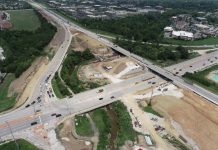
The state used a so-called design-build process — where the design and construction were packaged together — to rebuild the interchange at Interstate 435, Kansas 10 and Interstate 35 in southern Johnson County.
Transportation officials said the process used in that project reduced construction time by a year and netted the state 12% more construction for the project.
The House and Senate agreed on a plan that would set aside about $300 million for alternative delivery projects during the first three years of the plan. Another $200 million for alternative delivery would be allocated starting 2023.
Alternative delivery would restricted to projects of $100 million or more. It would not include preservation projects.
The bill also would provide $200 per person for driver’s education scholarships for anyone under 30 who doesn’t earn more than 200% of the federal poverty level.
The driver’s education program would sunset after three years to give the Legislature an idea of how it’s working.
The new plan also adds $5 million a year for three years for a short line rail improvement fund for qualified railroad track maintenance.
The state would match money from the short line railroads 70% to 30%.