


State lawmakers plan to seek another election audit of a Kansas county that didn’t fully cooperate with a recent examination that was undertaken in 2022 and 2023.
Members of the Legislature’s audit committee plan to seek another elections audit in Ford County after officials there didn’t give state auditors access to the information they needed to complete their work.
The Legislative Post Audit Committee plans to decide on a scope of the new audit at its next meeting.
State auditors had intended to review 15 counties when they did their election audit, but officials in Ford and Chase counties didn’t provide all of the information auditors sought to review.
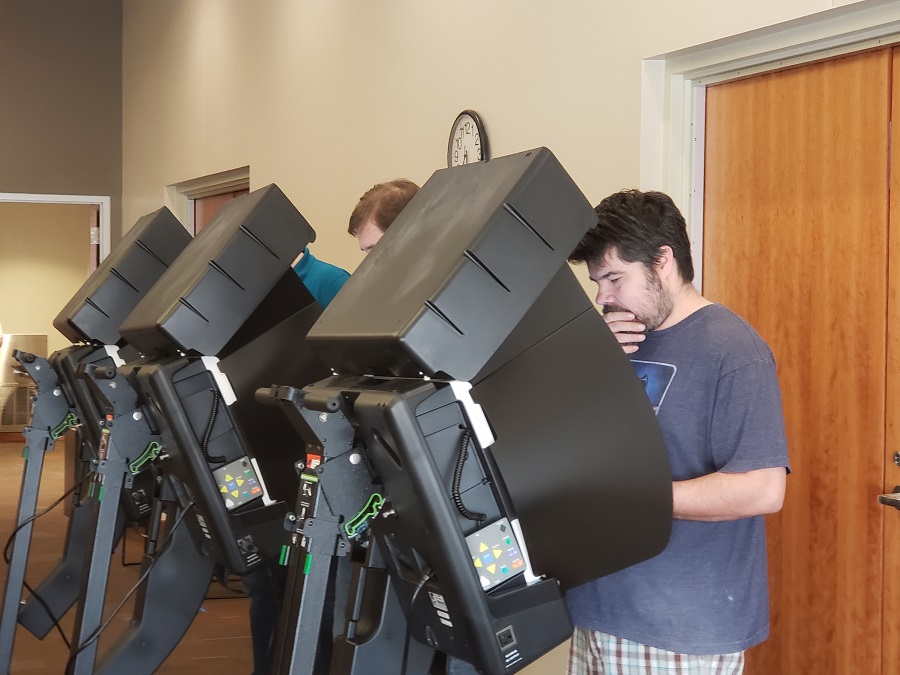
Auditors wanted to know whether county election offices had adequate policies and practices to ensure the accuracy and security of voting machines, ballots, storage units and devices used to tabulate votes during elections.
They reviewed 13 counties, but in Chase County and Ford County they couldn’t verify their practices because officials there sealed most of their 2022 election documents.
Lawmakers were more sympathetic to officials in Chase County where the county clerk said it had been their practice to seal the documents immediately after each election.
The Chase County clerk said that policy has since been changed. Republican state Sen. Caryn Tyson said Chase County appeared to make an inadvertent error.
For each county, auditors intended to review their written security policies, as well as available documents to verify what the counties did in practice in 2022.
At the start of their work, the auditors said they asked all the counties to not discard or seal the election-related documents that they wanted examine.
But unlike the other 13 counties, officials in Ford and Chase counties sealed most of the documentation showing the practices they followed in 2022, the auditors said.
State law requires ballots to remain sealed unless there’s a court order to open them.
Auditors reviewed what the counties left unsealed as well as some practices while visiting in person, but it wasn’t enough for them to draw conclusions about election integrity.
Members of the Legislative Post Audit Committee were bothered about why the counties sealed those documents.
And in the case of Ford County, officials there didn’t let the auditors inspect the election management computer.
Ford was the only county that didn’t give auditors access to the machines, which angered some lawmakers even more.
“I can’t understand where you’re coming from when a state official post audit comes and you deny them access completely,” said Tyson, chair of the legislative audit committee.
“I’m just trying to get my head wrapped around this,” Tyson told Debbie Cox, the Ford County clerk who oversees elections.
“We do have secure elections,” Tyson said.
“But we have found instances where there can be improvement, and that’s what this audit was about, trying to find places that we can possibly improve.”
Appearing before the committee virtually, Cox said she was having “family issues” at the time of the audit and she was not at the office to tell her staff to keep the information sought by the auditors out for inspection.
Cox said she didn’t want to open the election equipment because there was still election data on the machines.
“I didn’t feel comfortable opening that up when I didn’t really exactly know who they were,” Cox said of the state auditors.
“I am very cautious with what I show people. I did not want to get out my passwords in front of them,” Cox said.
“They asked where I kept my passwords. I was not comfortable with telling them where I kept my passwords,” she said.
“At that time, I did not have safes or key locks. I kept everything in my control.”
Republican state Sen. Mike Thompson of Shawnee said he was under the impression that Cox knew that auditors would be coming to Ford County to examine election processes.
Thompson asked Cox if she couldn’t have called the legislative auditing office to confirm the identity of the auditors and allow them access to the information they were seeking.
“We were under the impression from the committee that you knew that was going to happen and that we wanted that data,” Thompson said.
Thompson didn’t accept Cox’s explanation that “family issues” interfered in Cox’s refusal to give the auditors access to the election information.
“I understand family issues. We all have those, but we also have our jobs to do,” Thompson told Cox. “I don’t really buy that excuse.”
He compared Cox’s explanation to someone saying that a dog ate their homework.
Democratic state Rep. Jason Probst of Hutchinson asked Cox about refusing to give auditors access to the election equipment.
“My understanding is the auditors traveled there. They would have informed you who they were, what the purpose was and what their charge was from this committee.
“You were made aware of all that and so then you still felt uncomfortable allowing access to that computer,” Probst said.
Cox agreed and Probst quickly asked her why, pointing out that Ford County was the only county that didn’t give auditors access to the machines.
“I’m just not comfortable with giving that information out,” she said.
Probst asked her directly if she understood that she had to comply with the audit request.
“I guess I didn’t fully understand that,” she said.
Cox acknowledged that she didn’t seek guidance from the secretary of state nor the Association of County Election Officials.
Six years ago, Cox was at the center of a legal dispute when the American Civil Liberties Union took Ford County to court over its decision to move Dodge City’s lone polling place to a remote area outside of town that’s not easily accessible.
The ACLU asked a federal judge to order the county to open another polling site.
The lawsuit asked the court to direct Cox to reopen the original polling location at the Civic Center to avoid voter confusion.
Cox eventually announced that she would open two polling locations in Dodge City after months of controversy over her decision to move the city’s only polling site to a place considered inaccessible.
Meanwhile, Chase County Clerk Connie Pretzer said it had been her county’s policy to seal all of the election records once voting had been concluded.
“I assumed that once the election was finalized, certified, that we could just put everything to bed,” she said.
Tyson said Chase County was different from Ford County because officials there at least gave auditors access to the election machines.
Tyson said the decision to seal the records appeared to be “inadvertent” or an “innocent” interpretation of the law.
Released last year, the audit found that Kansas counties had many safeguards in place for protecting the security of elections, but they’re also deficient in some areas such as securing voting machines from tampering when deployed for elections.
In reviewing 13 counties statewide, the audit found that larger counties had stronger security practices than smaller counties, mostly likely because of their greater security needs and a wealth of resources and staff.
“Security isn’t as good as it could or should be,” the audit said.
“While election officers took security seriously, our conclusions were based not on what they told us, but on what we could observe or verify in documentation,” the audit said.
About half of the counties audited had weak controls for accounting for all ballots and ensuring the correct number was tabulated, the audit said.
“Counties sometimes created standardized forms that could lead to robust ballot security practices if used properly,” the audit said.
“But many forms we reviewed weren’t filled out completely or correctly, undermining their value,” the audit reported.